The Agentic Manager’s Playbook: Reinventing Middle Management for the AI Era
By 2026, the primary metric of leadership is no longer headcount; it is agent count.
We have entered the "Agentic Era," where AI agents are not just tools like GitHub Copilot, but active "digital employees" capable of planning, executing, and learning. This shift creates a crisis for middle management. The traditional definition of a manager—someone who supervises human effort, assigns tickets, and checks status—is obsolete.
In an agentic workforce, administrative supervision is automated. This playbook outlines the necessary evolution from Supervisor to Orchestrator, providing a survival guide for the "Frozen Middle" who find themselves squeezed between executive AI mandates and fearful teams.
1. The Crisis: The "Frozen Middle" and Why Transformations Die
The biggest bottleneck in AI adoption for 2026 is not technology; it is the layer of middle management often referred to as the Frozen Middle.
The Incentives Trap
Managers are not resisting AI out of malice or Luddism. They are resisting because their organizational incentives are misaligned with automation.
- Headcount = Power: In most 2025 enterprises, a manager's prestige and compensation are tied to the size of their human team. Reducing headcount via AI agents actively hurts their career prospects.
- The Supervision Void: Agents don't need "managing" in the traditional sense. They don't have sick days, they don't have 1:1s, and they don't need motivation. Managers trained to "supervise effort" suddenly find themselves with nothing to do, leading to "Identity Threat".
The Solution: Aligning Incentives
To unfreeze the middle, organizations must stop rewarding the activity of management and start rewarding the orchestration of outcomes. The goal is to turn "gatekeeper" managers into "Gateway" leaders who view agents as force multipliers rather than competitors.
Read the Deep Dive: The Frozen Middle: Why Your Agentic Transformation Will Die at the Manager Level Understand the psychological resistance and structural incentives blocking AI adoption.2. The Psychology: Leading Teams Through "Identity Threat"
As AI agents take over complex cognitive tasks—coding, data analysis, and even architectural review—human employees experience Identity Threat. This is the deep psychological anxiety that occurs when professionals feel their expertise is being rendered obsolete.
The Leader’s Role: Psychological Safety
In 2026, a manager's primary role shifts from "Technical Lead" to "Psychological Stabilizer." Leaders must actively reframe the narrative:
- From Replacement to Co-piloting: The narrative must shift from "AI does your job" to "AI eliminates your toil." Agents handle the repetitive execution, allowing humans to focus on strategy and exception handling.
- The "Intern" Metaphor: Treat agents as infinite interns. They are eager and fast, but they lack context and judgment. The human's role elevates to that of a Senior Architect reviewing the intern's work.
3. The Metrics: How to Grade Humans Who Manage Bots
You cannot evaluate an AI Orchestrator using 2024 metrics. "Lines of Code" (LOC) or "Hours Worked" are irrelevant when an agent can generate 10,000 lines of code in seconds.
The New Scorecard: Outcome Velocity
Performance reviews in 2026 must pivot to Outcome-Based Metrics. We are no longer grading effort; we are grading the efficiency of the orchestration.
| Old Metric (Supervisor) | New Metric (Orchestrator) | Why it Matters |
|---|---|---|
| Velocity (Story Points) | Outcome Velocity | Speed of value delivery, not just feature delivery. |
| Bugs / Incidents | Intervention Rate | How often did a human have to "save" the agent? |
| Team Utilization | Agent Uptime & Cost | Is the agent workforce running efficiently and cheaply? |
| Code Volume | Prompt Efficacy | Can the manager direct the agent effectively with minimal context switching? |
This shift forces managers to become "System Designers" rather than "Task Assigners." Their value is determined by how well they configure their agent workforce to solve problems autonomously.
Read the Deep Dive: Performance Reviews in 2026: How to Grade Humans Who Manage Bots Get the new scorecard templates for AI-augmented teams.4. The Career Path: From Boss to Orchestrator
If administrative management is dying, what is the future career path for today’s engineering manager? The answer lies in the Orchestrator role.
The Skill Stack of 2026
The Orchestrator is a hybrid role combining the technical depth of a Staff Engineer with the product sense of a PM and the emotional intelligence of a Coach.
- System Thinking: The ability to visualize the flow of data and decisions across a swarm of autonomous agents.
- API Glue: Understanding how to connect disparate agentic systems (e.g., Sales agents talking to Dev agents) via protocols like MCP (Model Context Protocol).
- AI Ethics & Governance: Acting as the "Human-in-the-Loop" for compliance, bias detection, and risk mitigation.
This is not a demotion; it is an elevation. The Orchestrator manages a workforce of thousands (agents), not dozens (humans), delivering exponential impact.
Read the Deep Dive: From Boss to Orchestrator: The New Career Ladder for Engineering Managers Explore the skills and certifications needed to secure your future in leadership.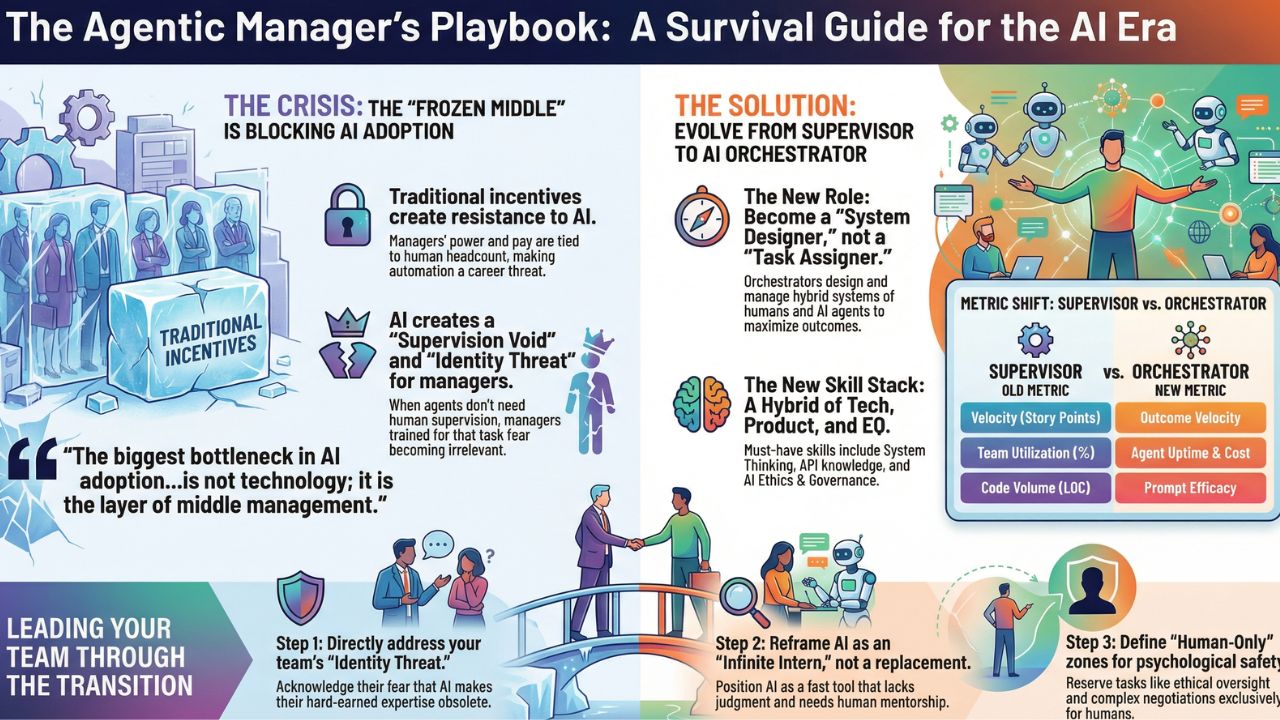
5. Frequently Asked Questions (FAQ)
A: An Agentic Manager is a leader who shifts focus from supervising human effort to orchestrating outcomes delivered by hybrid teams of humans and autonomous AI agents. They manage the system, not just the people.
A: AI will automate administrative supervision (status checks, ticket routing, basic scheduling), requiring managers to pivot toward system design, ethical oversight, and human-centric coaching (EQ).
A: It refers to the layer of middle management that blocks AI implementation—not out of malice, but because their current incentives (like headcount-based power) and KPIs conflict with automation goals.
A: No. Metrics like "lines of code" or "hours worked" are irrelevant when agents generate code. You must focus instead on "outcome velocity," "error rate reduction," and "cost per outcome".
A: AI will replace the administrative tasks of managers (status checks, ticket assignment), but will elevate the role to high-level system architecture and people development. The "Boss" disappears; the "Orchestrator" emerges.

6. Sources & Recommended Reading
- Forrester. (2025). Predictions 2026: AI Agents, Changing Business Models, And Workplace Culture.
- Kellton. (2025). Agentic AI trends 2026: Key innovations transforming business operations.
- TechInformed. (2025). Agentic AI predictions: Nine trends to look out for.
- CRN. (2025). The Invisible Middle: Are Midlevel Leaders Quietly Burning Out?
- Medium (Marton Schneider). (2025). How AI Agents Will Reshape Engineering Teams by 2030.
- Netguru. (2025). How to Measure Agent Success: KPIs, ROI, and Human-AI Interaction Metrics.
- Academy of Management. (2025). Human-like AI at Work Will Generate Three Threats.