The Best AI Coding Agents Your Juniors Actually Need
- AI is making your junior developers either dangerously fast or incredibly lazy; without strict guardrails, they risk generating unmaintainable code.
- The Best AI Coding Agents for Junior Developers focus on synchronous learning and problem decomposition rather than fully autonomous execution.
- Relying entirely on agentic AI for entry-level tasks threatens to erode the traditional talent pipeline, leading to a critical shortage of senior engineers in the future.
- Engineering leaders must implement "The Documentation Discipline," forcing juniors to write clear specifications before prompting their AI tools.
- Mentorship is no longer about teaching language syntax; it is about teaching junior engineers how to orchestrate, review, and govern AI outputs securely.
The Double-Edged Sword of AI Onboarding
The rapid integration of generative artificial intelligence into the software development lifecycle has created a massive paradigm shift. As engineering departments rush to embrace The Agentic Coding Shift, entry-level programmers are caught in the crossfire.
AI is fundamentally changing how we onboard new talent. If you are a technical leader searching for the Best AI Coding Agents for Junior Developers, you must tread carefully. Equipping a recent bootcamp graduate with an unrestricted, multi-agent AI framework is a recipe for architectural disaster.
These powerful tools can write thousands of lines of code in seconds, but they cannot inherently validate business logic. When juniors use AI indiscriminately, they fall into the trap of "vibe coding."
This occurs when developers accept AI-generated slop simply because it compiles, without truly understanding the underlying mechanics. To protect your enterprise codebase, you must strictly govern which tools your juniors use and how they interact with them.
The Junior Talent Pipeline Crisis
The Automation of Grunt Work
Historically, junior developers learned their craft by taking on the tedious grunt work that senior engineers avoided. They wrote boilerplate code, fixed minor UI bugs, and documented legacy systems.
Today, a single senior engineer equipped with an AI coding agent can automate these entry-level tasks entirely. This automation has caused the traditional hiring pipeline to wobble dangerously.
Some industry studies suggest that when companies fully adopt generative AI, junior developer employment can drop by nearly 10% within six quarters. If businesses use AI strictly to cut headcount, the industry faces a looming crisis.
The Threat of "Slow Decay"
Veterans in the tech industry refer to this phenomenon as the "slow decay". If organizations stop hiring and training junior developers today, they will inevitably face a massive leadership vacuum in five to ten years.
Today's juniors are tomorrow's system architects. Therefore, the solution is not to ban AI tools or stop hiring juniors. Instead, engineering leaders must redefine the junior developer role.
The modern junior must become an "AI-native" developer, capable of using AI as a force multiplier while simultaneously developing deep domain knowledge and problem-solving skills.
Benchmarking the Best AI Coding Agents for Junior Developers
To prevent your junior engineers from relying blindly on fully autonomous agents, you must restrict their toolset to applications that encourage learning. Here is a breakdown of the top tools to consider for your onboarding stack.
GitHub Copilot: The Essential Baseline
For a junior developer, synchronous autocomplete is often the safest starting point. Tools like GitHub Copilot provide real-time code completion as the developer types. This keeps the cognitive load squarely on the human engineer's shoulders, forcing them to drive the logic line by line.
Because Copilot requires the developer to actively initiate the code structure, it acts more like a pair-programming partner than a replacement. Before exploring advanced platforms, you must weigh the ROI of standard autocomplete tools.
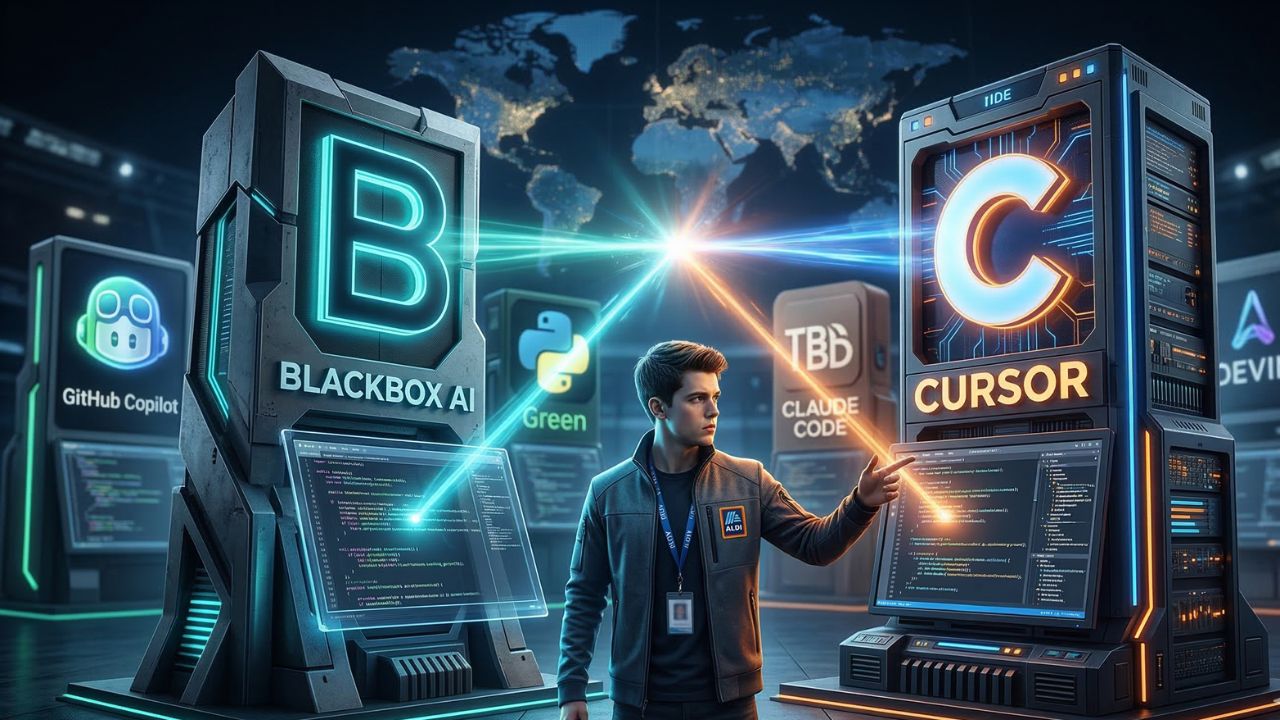
A careful review of the GitHub Copilot vs Blackbox AI debate will help you define your baseline.
Cursor: The Overeager Apprentice
Cursor is an AI-enhanced IDE that deeply integrates generative models directly into the editing environment. It goes beyond simple autocomplete by offering full-file refactoring and natural language codebase queries.
This is incredibly powerful for juniors trying to navigate a massive, undocumented enterprise repository. However, Cursor requires strict oversight. Many senior engineers compare using Cursor to managing a brilliant but overeager junior developer.
If your human juniors rely too heavily on it, they will merge unoptimized code. You must carefully benchmark these advanced IDEs, such as evaluating Blackbox AI vs Cursor, before granting junior access.
CLI Agents: For Advanced Onboarding Only
Command Line Interface (CLI) agents, such as Claude Code or Gemini CLI, represent the cutting edge of autonomous development. These tools operate within the project context, execute multi-step terminal tasks, run tests, and commit changes autonomously.
While CLI agents offer massive productivity boosts for senior engineers, they are generally unsafe for absolute beginners. Abstracting the terminal away from a junior developer prevents them from learning vital DevOps and system administration fundamentals.
Reserve CLI agents for mid-level engineers and above.
Establishing Guardrails for Vibe Coding
The Documentation Discipline
If you want your junior developers to succeed with AI, you must force them to act like Tech Leads. The biggest mistake juniors make is jumping straight into a chat interface with a vague prompt like "build a login page."
This inevitably results in chaotic, insecure code generation. Instead, enforce "The Documentation Discipline". Require your juniors to use consumer-grade AI models strictly for writing comprehensive project specifications and implementation plans first.
Once a senior engineer approves the written specification, only then can the junior prompt the coding agent to generate syntax.
The Chunking Strategy
AI models, much like junior developers themselves, excel when given focused, narrowly defined tasks. If a junior asks an AI to build an entire microservice at once, the AI will likely hallucinate or introduce circular logic errors.
Teach your juniors the "Chunking Strategy". They must break massive features down into three to five distinct, manageable phases.
By feeding the AI agent one highly constrained "chunk" at a time, the junior maintains tight control over the architectural direction and can easily review the resulting diffs.
Mandatory Explainability Rules
The ultimate guardrail against vibe coding is the explainability rule. Junior developers should be permitted to use AI to generate complex features, but they must be able to explain every single line of that code during a pull request review.
If a junior submits an AI-generated pull request but cannot explain the time complexity of the algorithm or the security implications of the database query, the PR must be rejected immediately.
This friction ensures that the AI acts as an educational tutor, rather than a crutch that bypasses the learning process completely.
Reframing Mentorship for AI-Native Teams
Shifting Focus Away from Syntax
The widespread adoption of AI coding agents means that memorizing language syntax is no longer a valuable skill. Therefore, senior engineers must completely overhaul how they mentor their junior counterparts.
Spending hours reviewing minor formatting errors is a waste of expensive engineering time. Mentorship must now focus heavily on problem decomposition, system architecture, and domain-specific business logic.
Seniors need to teach juniors how to evaluate different architectural patterns and how to spot the subtle logical errors that AI models frequently introduce into enterprise systems.
Teaching AI Prompting and Orchestration
Furthermore, prompting an AI agent is becoming a core engineering competency. Senior developers must actively coach juniors on how to construct highly detailed context prompts.
A junior must learn how to feed the AI existing repository patterns, strict stylistic guidelines, and known security constraints before asking it to write code.
By teaching juniors how to meticulously orchestrate multiple specialized agents, you elevate them from manual typists to entry-level system architects. This ensures that your organization continues to grow top-tier technical talent, even as the foundational mechanics of software development become entirely automated.
Conclusion
The software engineering industry cannot afford to abandon its entry-level talent, even as automation reaches unprecedented heights. Choosing the Best AI Coding Agents for Junior Developers is only the first step in a much larger organizational shift.
True success requires implementing rigid guardrails, enforcing documentation discipline, and fundamentally changing the nature of engineering mentorship.
By treating AI tools as educational partners rather than fully autonomous replacements, you can accelerate junior onboarding while protecting the stability of your enterprise codebase. Equip your juniors properly, demand code explainability, and secure the future of your engineering leadership pipeline.
Frequently Asked Questions (FAQ)
For beginners, synchronous autocomplete tools like GitHub Copilot are generally the best starting point. They provide helpful syntax suggestions while keeping the junior developer actively engaged in structuring the code. Advanced AI IDEs like Cursor can also be helpful if configured with strict oversight and code-review guardrails.
Yes, but with strict limitations. Juniors should use AI as an educational tool to learn idiomatic syntax and overcome roadblocks. However, they must be required to thoroughly review, understand, and explain every single line of AI-generated code before merging it into a production codebase.
AI agents dramatically accelerate onboarding by acting as a personalized, always-available tutor. They can explain complex legacy codebases, instantly summarize undocumented enterprise repositories, and help junior engineers understand internal naming conventions and stylistic guidelines without constantly interrupting senior staff.
They will hinder learning if used improperly. If juniors engage in "vibe coding"—blindly accepting AI outputs without understanding the logic—their problem-solving skills will atrophy. Enforcing mandatory code reviews and demanding that juniors write technical specifications first prevents this dangerous over-reliance.
Devin and other highly autonomous AI software engineers are generally too advanced for raw junior developers. These tools abstract away too much of the fundamental software development lifecycle, preventing beginners from learning vital debugging, deployment, and structural engineering principles necessary for long-term career growth.