The Agentic AI Framework Big Consulting Firm Hides
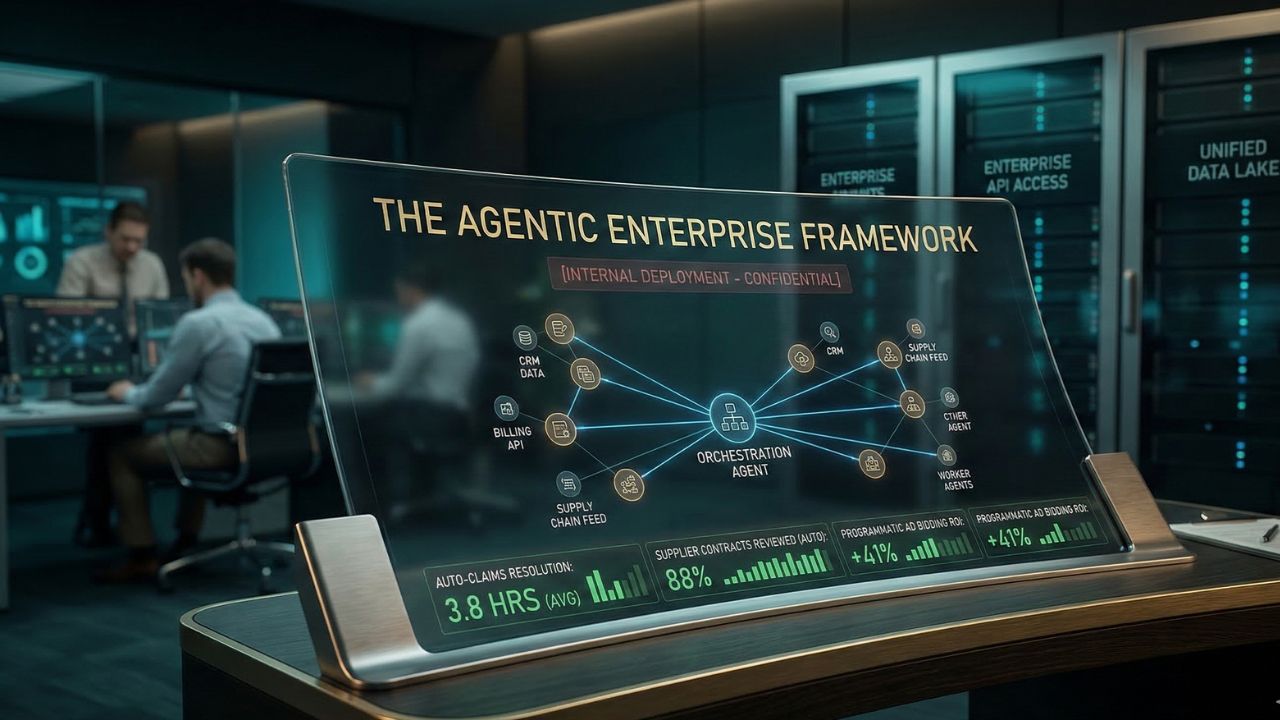
- Orchestration over Generation: True agentic systems do not just generate text; they plan, execute, and dynamically replan across multiple enterprise APIs.
- The Data Spine Mandate: Autonomous agents require a unified data spine to function; breaking down legacy data silos is a prerequisite for deployment.
- Dynamic Role Assignment: Multi-agent frameworks utilize specialized "worker" agents overseen by a "manager" agent, mirroring human corporate hierarchies for quality control.
- Proactive Disruption Solving: Unlike reactive scripts, agentic workflows proactively solve disruptions as they happen, shifting operations from defensive to offensive.
Ninety percent of enterprises are currently wasting millions on glorified chatbots disguised as autonomous agents. Executive boards are demanding immediate ROI from AI investments, yet IT leaders are struggling to integrate fragile generative models into mission-critical business processes.
Stop the cash bleed and read our definitive framework on actual agentic ai use cases workflows to build resilient, autonomous enterprise architectures.
Moving Beyond the Chatbot: The Reality of Agentic AI Use Cases
The transition from generative AI to agentic AI represents the most significant shift in enterprise technology since the advent of cloud computing. Traditional large language models (LLMs) are passive; they wait for a prompt, generate a response based on probabilistic token prediction, and stop.
They do not possess agency. Implementing autonomous systems without proper guardrails risks severe data leaks. Top-tier firms utilize autonomous architectures where models are equipped with tools, memory, and reasoning frameworks to execute multi-step workflows independently.
These agents manage processes across billing, technical support, and account management without manual human handoffs. This multi-agent coordination is critical when executing high-stakes playbooks, particularly regarding agentic ai in cybersecurity.
Relying on human analysts to triage 10,000 daily security alerts is a guaranteed path to a major breach. See how autonomous defense agents are instantly neutralizing zero-day threats.
Industry Warning: The Agentic Reality Check
Gartner predicts that over 40% of agentic AI projects will fail by 2027 because legacy systems cannot support modern AI execution demands. If your underlying data infrastructure relies on fragmented, on-premise silos, your multi-agent deployments will inevitably hallucinate.
Without a clean data environment, agents will fail to execute critical API calls, stalling entire operational pipelines.
The Information Gain: Why High-Profile AI Deployments Fail Fast
A common misconception among C-suite executives is that agentic AI is a plug-and-play solution that instantly replaces human workflows. The hidden truth big consulting firms rarely disclose upfront is that deploying agentic ai in finance creates hidden algorithmic bias risks.
Banks are deploying autonomous AI without updating their risk models, practically begging for regulatory fines. The failure point is rarely the AI model itself; it is the absence of a "data spine".
Autonomous agents operate at speeds that expose bad data hygiene instantly. Agentic fraud detection only works if the data feeding the models is highly reliable.
You must invest in pipelines that turn messy, incomplete transaction data into clean signals. This allows human reviewers to step in only for high-risk edge cases.
Furthermore, building human-in-the-loop (HITL) safeguards is not just about compliance; it is about system stability. A poorly configured agent might aggressively execute a task until it breaks a downstream system.
True autonomy requires programmatic boundaries—hardcoded limits on API spend, strict isolation environments, and read-only access phases during initial rollout.
High-Stakes Agentic AI Workflows Across the Enterprise
To understand the transformative power of this technology, we must examine specific, production-ready deployments across different operational domains.
1. Financial Services and Automated Compliance
In the financial sector, autonomous systems are moving beyond basic analytics. Upstart uses machine learning and agentic systems to evaluate loan applicants beyond traditional credit scores for fairer, faster approvals.
Wealthfront and Betterment leverage AI-powered robo-advisors to provide personalized investment advice and automated portfolio management 24/7. Agents are also revolutionizing back-office operations through automated claims processing.
Meanwhile, regulatory compliance monitoring agents continuously scan transactions for violations and map activity against global regulatory frameworks.
2. Supply Chain and Autonomous Sourcing
Global logistics is inherently unpredictable, making it prime territory for autonomous orchestration. Procurement teams manually reviewing 500-page supplier contracts are bleeding margin and missing geopolitical risks.
You must deploy agentic ai in procurement to establish an autonomous sourcing blueprint. Organizations are seeing massive returns here.
Walmart employs AI agents to forecast demand and dynamically adjust inventory levels across stores based on historical data, local weather, and community events.
3. IT Operations and Cyber Defense
The speed of modern cyberattacks has rendered manual threat hunting obsolete. CrowdStrike's cybersecurity platform utilizes agentic AI to autonomously analyze behavior, isolate compromised devices, and escalate incidents.
Agents manage AI-driven phishing mitigation by inspecting suspicious URLs, retroactively quarantining emails, and resetting compromised credentials in near real-time.
However, organizations must build robust, fail-safe permission systems to ensure rogue AI agents don't aggressively delete essential logs.
4. Marketing Orchestration and Customer Experience
Marketing departments are rapidly transitioning from static automation to dynamic orchestration. If your team is still manually adjusting ad bids, your competitors are stealing your market share.
Deploying agentic ai in marketing without strict guardrails guarantees brand safety disasters. Doctronic uses an autonomous agent to triage over 10 million inquiries via chat.
This leads to end-to-end issue resolution without human involvement, eliminating data silos so your AI can consolidate CRM systems.
5. Enterprise Physical Operations
Physical enterprise operations are also being overhauled. Enterprise COOs are realizing that static RPA bots break the second a process changes.
Scaling agentic ai in operations without unified data lakes leads to catastrophic process failures. Amazon deploys AI agents in fulfillment centers to manage inventory dynamically.
Transitioning to agentic operations requires retraining your teams to focus on designing for autonomy, shifting humans from executing tasks to orchestrating AI.
Emerging Horizons: Unthought-of Agentic AI Capabilities
To future-proof your organizational strategy, you must look beyond immediate operational efficiencies and prepare for the next wave of autonomous capabilities.
- Sovereign AI Ecosystems: Multi-agent systems that operate entirely within localized Small Language Models (SLMs) to ensure absolute national data sovereignty.
- Dynamic AI Agent Ecosystems: By 2028, networks of specialized agents will dynamically collaborate across multiple enterprise applications.
- Smart Grid Self-Balancing: Agentic systems embedded deep within infrastructure that forecast power consumption and reroute supply instantly to avoid blackouts.
- Autonomous ESG Enforcers: Agents that continuously scan global news to instantly flag and shift supply away from vendors exposed to ESG instability.
Implementing the Blueprint: Your Next Steps
Deploying enterprise agentic AI is an architectural challenge, not just a software purchase. Start by identifying a high-volume, low-risk workflow where data is already heavily structured.
Build your underlying data spine, establish strict programmatic guardrails, and implement a robust human-in-the-loop oversight protocol.
The organizations that successfully map their legacy workflows into autonomous, multi-agent pipelines today will outpace their competitors exponentially by the end of the decade.

Frequently Asked Questions (FAQ)
The most profitable use cases involve dynamic supply chain reallocation, automated financial compliance workflows, and autonomous cybersecurity threat mitigation. These applications drastically reduce operational overhead while preventing costly regulatory fines and critical data breaches.
Traditional generative AI is reactive and solely creates content based on a user's prompt. Agentic AI possesses autonomy; it can plan workflows, interact with external software via APIs, continuously monitor environments, and execute complex actions independently to achieve a defined goal.
Security risks include algorithmic bias, unauthorized execution of critical system commands, and data leaks if agents lack proper isolation environments. Rogue agents could aggressively delete essential forensic logs or inadvertently isolate business-critical networks without robust fail-safes.
Establish strict read-only phases during deployment and implement programmatic boundaries limiting API spend. Route high-risk edge cases to human reviewers and transition human roles from manual task execution to high-level orchestration, auditing, and continuous monitoring of AI actions.
ROI timelines vary but can be rapid for "no-regret" workflows like automated invoice reconciliation or support triage. Telecommunications firms have seen complex resolution times drop from days to hours instantly, yielding measurable operational savings within the first quarter.
Sources and References
- McKinsey QuantumBlack - Scaling Enterprise AI and Guardrails
- CrowdStrike - Autonomous Threat Hunting and Phishing Mitigation
- Upstart - Algorithmic Loan Evaluation Frameworks
- Waymo - Autonomous Sensor Data Interpretation in Physical Operations