Sovereign AI Hosting in India: Navigating the Mumbai vs. Hyderabad Cloud Divide
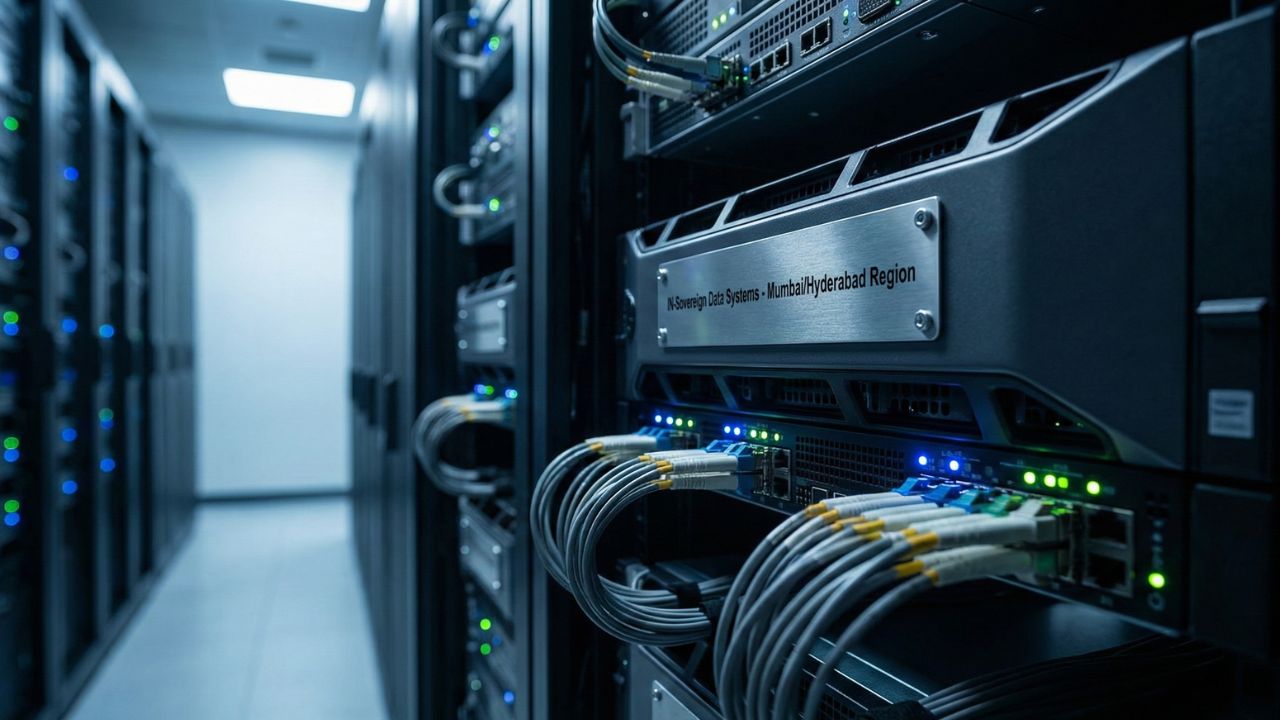
- The "Data Residency" Trap: Hosting AI models in foreign cloud regions is now a direct violation of India's Digital Personal Data Protection (DPDP) Act for sensitive data.
- Latency vs. Compliance: Mumbai offers low latency essential for trading bots, while Hyderabad provides robust compute scalability for training large models.
- The "Sovereign Cloud" Definition: It ensures that foreign governments cannot subpoena your data and that the management control plane remains entirely in India.
- Cost Implications: Local sovereign hosting commands a 15-20% infrastructure premium but efficiently avoids multi-crore regulatory fines.
- SLMs as a Strategy: Small Language Models (SLMs) hosted on local edge servers are frequently more compliant and cost-effective than global API endpoints.
In the rapidly evolving world of autonomous agents, the boundaries of physics and law collide directly at the server rack. When you deploy a swarm of intelligent agents to process Indian financial or personal data, the physical geographic location of those silicon chips absolutely determines your legal survival. This deep dive is a critical module of our extensive guide on the Agentic Governance & Liability Framework.
Understanding sovereign AI hosting compliance for Mumbai vs Hyderabad cloud regions is no longer a minor technical detail delegated to DevOps—it is a frontline boardroom governance issue. If your enterprise agents process the personal data of Indian citizens on a server located in Virginia or Frankfurt, you are likely already operating in non-compliance with the Digital Personal Data Protection (DPDP) Act.
1. The "Sovereign Cloud" Mandate for Indian Enterprises
The public cloud is incredibly convenient, but the sovereign cloud is demonstrably compliant. For Global Capability Centers (GCCs) and large Indian enterprises, it is no longer sufficient for the data to merely sit in India; the control plane (the infrastructure management layer) must also be firmly rooted in India.
The Mumbai Advantage (The Financial Fortress)
Target Use Case: High-Frequency Trading (HFT) autonomous agents, Real-Time Payment resolution bots, and latency-sensitive customer service swarms.
Why: Mumbai hosts the core landing stations for international subsea cables and is physically positioned closer to major financial stock exchanges like the BSE and NSE.
Compliance Angle: It is the ideal regional choice for "Critical Data Fiduciaries" who require absolute millisecond-level audit trails and guarantees that financial data never leaves Indian soil.
The Hyderabad Advantage (The Training Ground)
Target Use Case: Training Large Language Models (LLMs), executing heavy Retrieval-Augmented Generation (RAG) clusters, and deep-data analytics.
Why: Hyderabad offers vast, accessible land for hyperscale data centers coupled with lower industrial power costs. Furthermore, it provides superior disaster recovery stability due to being in a seismically safer zone compared to coastal Mumbai.
Compliance Angle: Perfectly suited for "Data Processors" requiring massive, highly compliant compute power for batch processing without incurring Mumbai's steep real estate and latency premium.
2. Navigating the DPDP Act & Combating "Agentic Drift"
The DPDP Act does not outright ban cross-border data flows, but it heavily regulates them via "whitelisted" destinations. However, for Significant Data Fiduciaries, the inherent risk of an autonomous system inadvertently sending restricted data to a "blacklisted" or non-compliant region is an existential threat.
Modern autonomous agents often dynamically select APIs based on latency or cost to complete their tasks. This creates a severe compliance risk known as "Agentic Drift." If your agent autonomously routes a sensitive query to a cheaper, US-based inference endpoint simply to save fractions of a cent, it has instantly committed a major compliance violation under Indian law.
The definitive technical fix is to strictly configure your Sovereign AI Framework and Algorithmic Transparency Dashboards to aggressively geo-fence your agents. Your infrastructure-as-code (IaC) must explicitly block any API call or data egress that resolves to an IP address outside of approved sovereign zones.
3. The Strategic Pivot: Small Language Models (SLMs) on the Edge
For organizations dealing with ultra-sensitive information, the ultimate sovereign hosting strategy is intentionally bypassing the public cloud entirely. For critical tasks—such as autonomously analyzing private medical records or proprietary legal contracts—deploying Small Language Models (SLMs) directly on-premise or on edge devices is rapidly becoming the enterprise gold standard.
Why SLMs Win on Compliance and Sovereignty:
- Zero Egress Architecture: Sensitive data definitively never leaves your Virtual Private Cloud (VPC) or local bare-metal servers.
- Absolute Auditability: You completely own the model weights. You are not blindly renting opaque intelligence from a black box server situated in San Francisco.
- Predictable Cost Control: Running a highly optimized 7B parameter model locally in a Hyderabad data center is significantly more cost-effective over time than unpredictable, token-based billing for global foundation models.
To successfully secure the intellectual property generated by these localized models, refer immediately to our Enterprise AI Agent Usage Policy Template to ensure your corporate ownership rights are fully and legally documented.
Frequently Asked Questions (FAQ)
What exactly is Sovereign AI hosting in India?
It refers to specialized cloud infrastructure where the data storage, active processing, and the administrative "control plane" reside entirely within Indian legal jurisdiction. This creates an impenetrable boundary protecting your data from foreign subpoenas and extra-territorial laws like the US CLOUD Act.
Why is the Mumbai cloud region more expensive for AI data residency?
Mumbai naturally commands a premium due to significantly higher commercial real estate and industrial power costs. Because of its extreme density and status as a primary financial hub, enterprises pay a premium for the ultra-low latency connectivity required for high-speed transactions.
How can I manage "Data Localization" technically for autonomous agent swarms?
You must architect utilizing "Region-Locked" Virtual Private Clouds (VPCs). Operationally configure your Kubernetes clusters to exclusively spin up active pods in designated zones like ap-south-1 (Mumbai) or ap-south-2 (Hyderabad) while explicitly blocking all unauthorized egress traffic to public internet gateways.
What is the core difference between Public Cloud and Sovereign Cloud?
While public clouds share massive resources globally across borders, a sovereign cloud guarantees cryptographically and legally that your data and underlying metadata stay strictly within a specific national border and are managed exclusively by local, cleared citizens.
How do we actively mitigate regulatory fines for AI data residency errors?
You must conduct a rigorous "Data Lineage Audit." You need to map exactly where your autonomous agent sends every single prompt. Ensure you have an ironclad "Data Processing Agreement" (DPA) with your vendor, or defensively switch entirely to locally hosted models (SLMs).
Conclusion: Architecting for Sovereignty
Your strategic choice of sovereign AI hosting compliance for Mumbai vs Hyderabad cloud regions directly dictates your enterprise risk profile. Mumbai offers unparalleled speed for real-time transactions, while Hyderabad offers the massive, cost-effective scale required for intelligence training. Both locations offer vital immunity from catastrophic regulatory non-compliance. You must architect your cloud hosting strategy not just for algorithmic performance, but for unassailable legal sovereignty.