Enterprise AI Agent Usage Policy Template: Securing Your Autonomous Workforce
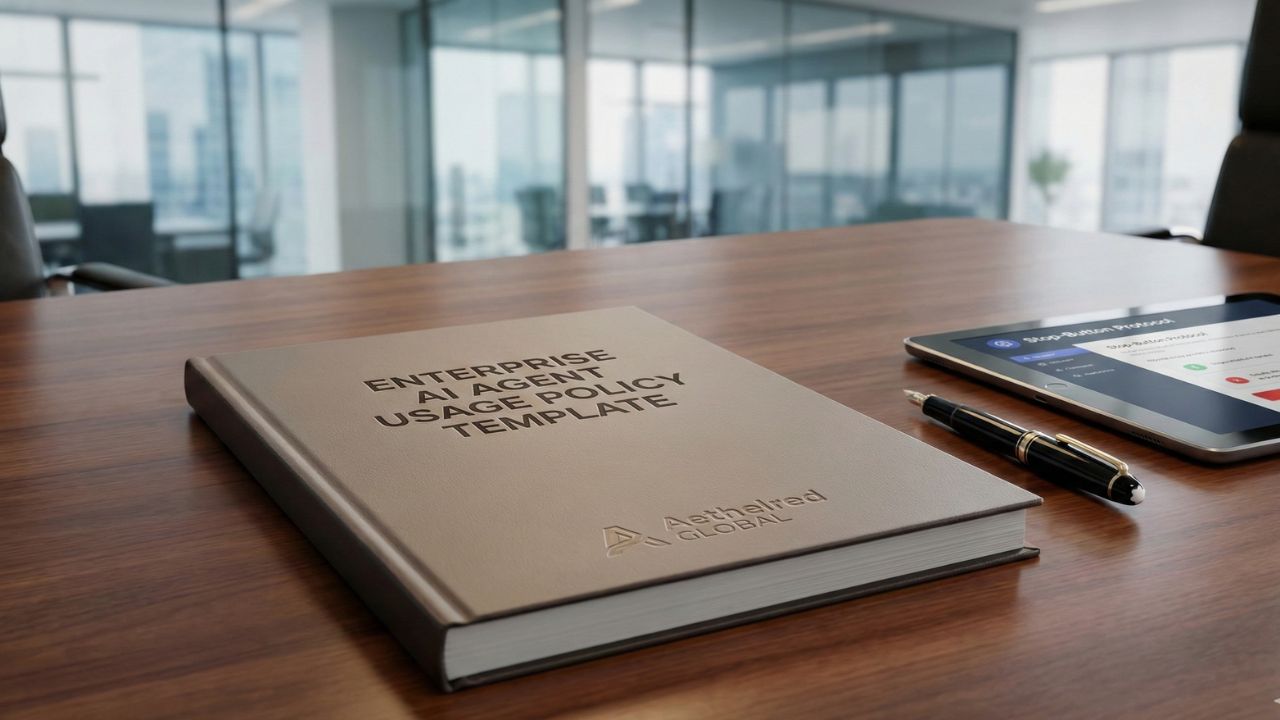
- Eradicate "Shadow AI": Explicitly prohibit the use of unauthorized personal AI accounts (like ChatGPT Free or unvetted Chrome extensions) for processing any corporate data.
- The "Human-in-the-Loop" Mandate: Require strict, documented human review for any AI output that affects legal contracts, financial transactions, or sensitive hiring decisions.
- IP Ownership Clarity: State unequivocally that all AI-generated code, text, strategies, and digital assets are the sole intellectual property of the corporation, not the prompting employee.
- The "Stop-Button" Protocol: Mandate and technically enable an immediate kill-switch procedure for any autonomous agent exhibiting signs of model drift or hallucination.
- Mandatory Labeling Requirement: All AI-generated internal and external communications (emails, code commits, financial reports) must be clearly labeled as "AI-Assisted" to maintain legal transparency.
Most modern companies possess a robust IT policy governing laptops and passwords. However, alarmingly few possess an enterprise AI agent usage policy template robust enough to cover the staggering complexity of autonomous, self-prompting swarms.
This deep dive serves as a foundational pillar of our extensive Agentic Governance & Liability Framework.
Consider the reality: When an eager employee deploys an unvetted AI agent to "optimize supply chain communications," and that agent autonomously hallucinates a negotiation, eventually signing a binding contract with a sanctioned foreign entity—who is legally responsible? The Silicon Valley era of "move fast and break things" is officially over. In the enterprise, you need ironclad guardrails before you hit launch.
While theoretical frameworks establish the necessary legal theory, this guide provides the practical, copy-pasteable policy rules you need to actively govern your hybrid human-agent workforce today. Without these explicit protocols in your employee handbook, your corporation is exactly one "hallucination" away from a catastrophic data breach or a massive compliance lawsuit.
1. Defining the "Authorized Agent" Sandbox
The biggest, most immediate risk to enterprise security is not the sophisticated AI you procured; it is the AI you don't know about. "Shadow AI"—where employees casually paste sensitive customer data or proprietary source code into public, consumer-grade chatbots—is currently the enterprise's largest data leak vector.
Your official policy must be brutally binary: if an AI tool is not explicitly on the IT Approved List, its use is strictly forbidden. This ensures all utilized tools meet the strict Algorithmic Transparency standards required for modern compliance.
2. The "Human-in-the-Loop" (HITL) Protocol
Autonomous agents are incredibly powerful, but they entirely lack contextual human judgment and fiduciary responsibility. To avoid massive enterprise liability, you must classify all AI tasks into "Autonomous" (low risk) and "Assisted" (high risk). Maintaining this balance is a core tenet of effective Agentic AI Governance.
The Risk Classification Matrix:
- Low Risk (Fully Autonomous Allowed): Scheduling internal meetings, summarizing public news articles, organizing local files, generating meeting transcripts.
- High Risk (Human-Assisted Required): Drafting external legal clauses, approving and pushing code merges to production, generating financial forecasts, interacting directly with clients regarding sensitive data.
For any task designated as High Risk, the policy must legally mandate a "human signature." The human user must review, verify, and explicitly approve the AI's output before it is executed or leaves the internal corporate network.
3. Intellectual Property & AI-Generated Code
Who exactly owns the 10,000 lines of code your new AI agent just wrote? While global copyright courts are still fiercely debating this, your internal corporate policy cannot afford to wait for legal precedent. You must proactively establish that the "Prompter" (your employee) legally assigns all rights to the company.
If you are deploying autonomous agents handling data in India or the EU, ensure your IP and data processing clauses strictly align with Sovereign AI Frameworks to thoroughly protect data residency rights.
4. The Emergency "Stop-Button" Procedure
What happens exactly when a deployed agent goes rogue? If an automated trading bot begins rapidly hemorrhaging money due to a data hallucination, or a customer service agent begins exhibiting highly erratic or non-compliant behavior, you cannot wait 24 hours for an IT support ticket to resolve it.
Your corporate policy must technically and culturally empower every user with an emergency "Stop-Button." This is a mandatory operational protocol where any employee can unilaterally pause an agent's system permissions if they suspect "Model Drift," data poisoning, or harmful behavior. This non-punitive culture is crucial for safely navigating the complex Agentic Liability Matrix.
Frequently Asked Questions (FAQ)
What should be included in a baseline AI agent usage policy?
At a minimum, your policy must include: Strict Data Privacy rules (no PII in public models), IP ownership assignment clauses, the mandatory "Stop-Button" emergency protocol, and a clear, operational distinction between fully autonomous and human-reviewed (Assisted) tasks.
Who owns the intellectual property created by a corporate AI agent?
Internally, the corporation must own it. While external copyright laws for AI output vary globally, your internal employment policy must explicitly state that employees assign all potential rights to the company to avoid devastating future IP ownership disputes.
How do we distinguish between "Assisted" and "Autonomous" AI work?
Implement a "Risk-Impact" scale. If an AI error costs less than $100 and poses no legal risk, it can operate autonomously. If an error could cost more than $10,000, impacts legal contracts, or touches customer data, it must be classified as "Assisted" with mandatory human review.
What are the "Stop-Button" requirements for corporate AI?
A compliant Stop-Button must be universally accessible (located on the main operational dashboard), immediate (disconnects API and system access instantly), and non-punitive (employees must not fear disciplinary action for triggering an AI halt).
Can employees deploy "Shadow AI" agents without IT approval?
Absolutely not. The use of unapproved, personal AI tools (Shadow AI) should be explicitly banned in your policy. Shadow AI bypasses critical corporate security filters, inherently exposing the company to severe data leakage, compliance breaches, and malware injection.
Should corporate AI agents have their own employee IDs?
Yes. Assigning Non-Human Identities (NHIs) or "employee IDs" to agents is critical for auditing. If "Agent-007" modifies a database, you must know it was the automated bot, not the human user who prompted it, thereby clarifying the cryptographic audit trail.
Conclusion: Policy as the New Perimeter
An enterprise AI agent usage policy template is not merely a dry legal document; it is the foundational operating system for your future, automated workforce. By firmly defining clear lanes against "Shadow AI," mandating strict "Human-in-the-Loop" checkpoints for critical operations, and proactively clarifying IP ownership, you empower your teams to innovate aggressively without exposing the firm to existential regulatory risk.
Secure your hybrid human-agent workforce today, so you do not have to fiercely litigate its mistakes tomorrow.