The 2026 MarTech Stack: CDPs, CRMs, and Agentic Orchestration
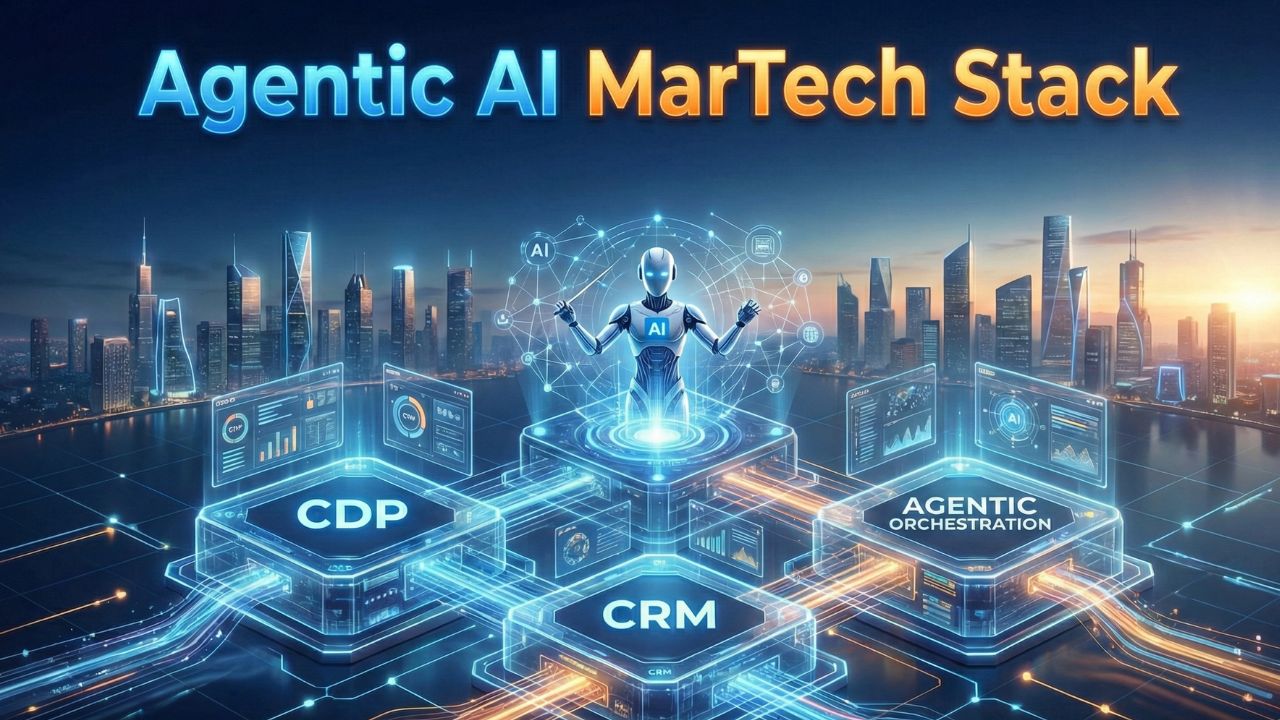
For CMOs & Marketing Ops Leaders: The traditional MarTech stack—a chaotic sprawl of disconnected tools—is incapable of supporting Algorithmic Growth. In 2026, the success of your Generative UI, AI Sales Workforce, and Agentic CX is entirely dependent on an AI-Native data architecture. This is your definitive Buyer's Guide to building the modern martech stack 2026.
We break down the critical role of the Customer Data Platform (CDP) and compare the readiness of major players like HubSpot and Salesforce for true multi-agent marketing orchestration.
The Three Pillars of the AI-Native MarTech Stack
The new architecture organizes tools into three interconnected, API-driven layers. This structure is essential for orchestrating multi-agent marketing, where AI agents need seamless, two-way data flow to act autonomously.
- 1. The Data Layer (The Brain): Centered on the Customer Data Platform (CDP) and the Data Warehouse. This layer unifies all customer identity, behavioral, and transactional data into a single source of truth for the agents.
- 2. The Intelligence Layer (The Strategist): Where AI agents live. This includes generative AI models, proprietary customer journey mapping algorithms, and predictive scoring tools. They consume data from the Data Layer and push instructions to the Execution Layer.
- 3. The Execution Layer (The Hands): Your traditional tools—CRM (HubSpot/Salesforce), Email Service Providers, Ad Platforms, and CMS (for Generative UI). This is where the agents’ instructions are carried out at scale.
CDP vs. Data Warehouse: Defining the Data Layer
The most common point of confusion for CMOs migrating to the modern martech stack 2026 is understanding the necessity of the CDP alongside an existing Data Warehouse (DW). The two are not substitutes; they are complementary, serving different purposes.
| Feature | Customer Data Platform (CDP) | Data Warehouse (DW) |
|---|---|---|
| Primary Goal | Operational Activation. Creating unified customer profiles for real-time action. | Analytical Querying. Historical reporting and business intelligence. |
| Data Identity | Connects, cleans, and merges fragmented identities (deterministic identity resolution). | Stores raw, structured, and unstructured data; identity must be managed externally. |
| Best Use Case | Feeding AI sales agents for b2b with real-time intent signals; powering Generative UI. | Financial reporting; complex trend analysis; training large foundational AI models. |
For the best martech tools for b2b to function with agentic autonomy, the CDP must be the central hub, providing the single, clean source of truth that agents rely on for decision-making.
Buyer's Guide: CRM and CDP Platform Comparison
Choosing the right CRM is crucial as it forms the backbone of the Execution Layer. Here is how the major enterprise platforms stack up regarding AI readiness and suitability for marketing ops automation.
1. HubSpot: The Integrated B2B Powerhouse
HubSpot's primary advantage is its unified data model, which makes integrating AI into HubSpot relatively straightforward. The platform is designed for mid-market to enterprise B2B and is rapidly adding generative features. Its native CDP capabilities are strong for the inbound model but may require augmentation for complex, multi-source outbound data waterfalls.
2. Salesforce: Enterprise Flexibility and Scale
Salesforce offers the highest degree of customization and ecosystem support, making it ideal for organizations with complex, decades-old sales and service processes. Its value for agentic marketing lies in its powerful Marketing Cloud and external CDP (Data Cloud). While highly flexible, orchestrating multi-agent marketing requires significant architectural investment to ensure seamless data flow across the vast number of clouds and integrations.
3. Adobe Experience Cloud: B2C & Creative Mastery
Adobe is the dominant choice for B2C and brands with a strong focus on creative content and personalization. The Adobe Experience Platform (AEP) functions as its core CDP, offering high performance for massive, real-time data streams. It is often the choice for companies prioritizing dynamic, Generative UI-driven customer experiences over traditional B2B sales cycles.
The Future of Marketing Ops Automation
AI agents are poised to revolutionize the Marketing Operations (MOPs) function. Historically, MOPs has been the bottleneck, focused on manual campaign setup, list scrubbing, and platform maintenance. The new MOPs leader focuses on governing and optimizing agents rather than executing tasks.
- Autonomous Campaign Deployment: Agents can deploy A/B/n tests across thousands of ad variations and landing pages without human intervention. (Related: Generative UI & 1:1 Marketing)
- Compliance Monitoring: AI monitors all outbound campaigns for GDPR, CCPA, and CAN-SPAM compliance, virtually eliminating human error in regulatory adherence.
- Real-time Budget Optimization: Financial agents dynamically shift budget allocations across channels based on real-time ROI signals, ensuring optimal spend efficiency.
Explore Other Pillars of Algorithmic Growth
Pillar Page: The Algorithmic Growth & Agentic CX Hub Return to the complete 2026 Revenue Playbook Next Step (Sales): The AI Sales Workforce: Automating SDRs & Outbound See how to feed your sales agents with hyper-clean, qualified data from your new CDP Prior Step (Customer Support): Agentic CX: From Chatbots to Autonomous Resolution Learn how a unified data layer enables autonomous resolution and proactive supportFrequently Asked Questions (FAQ)
A: A Data Warehouse (like Snowflake) is optimized for analytical querying by analysts. A Customer Data Platform (CDP) is optimized for operational activation—creating unified customer profiles and pushing segmented, real-time data directly to execution tools (CRMs, ad platforms) for orchestrating multi-agent marketing.
A: Integrating AI into HubSpot currently focuses on generative features for content creation (email, blog posts), predictive lead scoring, and basic conversational bots. The future involves agents using HubSpot data to autonomously manage campaigns and update CRM records (marketing ops automation).
A: The best B2B tools center on deep account-level intelligence and agentic workflow. Key tools include a robust CDP (e.g., Segment), a flexible CRM (HubSpot or Salesforce), an account-based marketing (ABM) agent layer (e.g., Clay), and comprehensive analytics.

Sources & References
- Gartner Magic Quadrant for Customer Engagement Center (Digital Customer Service & Support Context)
- Forrester Wave: B2B Marketing Automation Platforms (Current Category Reports)
- State of Marketing AI Report (Marketing AI Institute - Current Edition)
- Salesforce "State of Sales" Report Hub (Data on AI & Autonomous Agents in Sales)