Hyper-Personalization at Scale: Generative UI & 1:1 Marketing
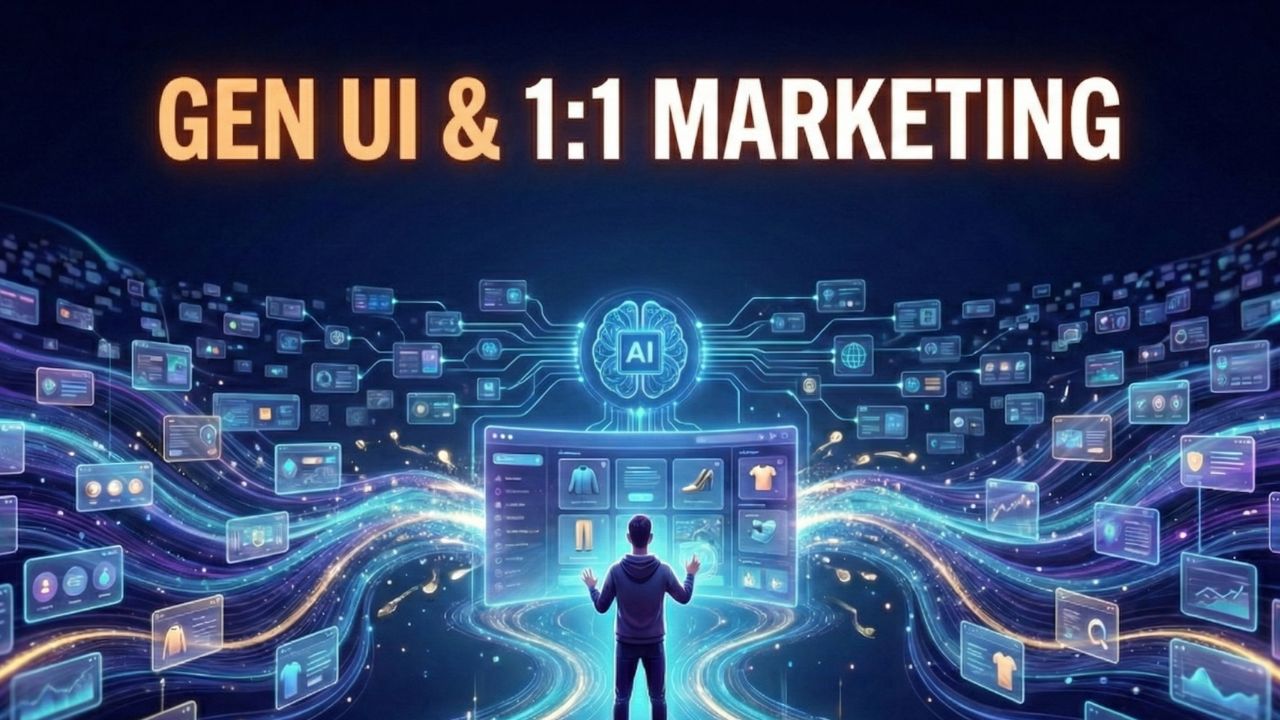
The "Death of the Open Web" is accelerating the need for true 1:1 marketing. As third-party cookies vanish and organic search yields fewer immediate conversions, the focus must shift to maximizing the value of every known visitor.
Hyper-personalization engines, powered by Generative UI, are the answer. This strategy moves beyond simply swapping out a headline (Level 1 personalization) to fundamentally restructuring the user interface and content on the fly to meet the visitor's predicted intent.
Defining Generative UI: The End of Static Design
Generative UI (GUI) refers to systems that dynamically assemble or reorganize interface elements in real-time, tailoring the layout, components, and content to each user's behavior or context. It’s an evolution from template-based website design to programmatic design.
A Generative UI engine performs three key actions in milliseconds:
- Intent Detection: Using behavioral data, referral source, and predictive analytics to determine the user’s immediate goal (e.g., “Price research” or “Ready to buy”).
- Component Selection: Based on intent, the AI selects the optimal sequence of components (e.g., a pricing table should be above the fold, a case study from the banking sector should be featured).
- Generative Design: The LLM creates the 1:1 copy and visual assets (images, charts) necessary to fill the selected components, ensuring a fully contextual experience.
From A/B Testing to Predictive Customer Journey Mapping
Traditional marketing optimization relies on A/B testing, which is slow and focuses on localized maxima. Generative UI enables true multivariate testing at scale, effectively becoming an A/B/C/D...Z test for every user.
Hyper-personalization engines like Adobe Target and Dynamic Yield leverage a Customer Data Platform (CDP) to ingest a unified view of the customer. They move beyond simple segmentation to predictive customer journey mapping, anticipating the next best step for the user before they even click.
For example, a visitor who arrives from a LinkedIn ad targeting "CTOs" receives a different layout focusing on "Scalability and Integration" compared to a visitor from a Google Search targeting "Low Cost CRM," who sees "Pricing and Support" featured prominently.
Scaling B2B: ABM Automation with AI
Account-Based Marketing (ABM) has always promised 1:1 experiences but was historically bottlenecked by manual content creation. Generative UI solves this challenge, enabling true ABM automation with AI.
For a target account, the Generative AI system:
- Identifies the visitor's IP address and cross-references it with the target account list.
- Pulls data on the account's recent pain points (e.g., "M&A activity" or "layoffs") from third-party intent providers.
- Dynamically generates a landing page hero section that references the company's name, features a headline related to their specific industry challenge, and automatically selects the most relevant case study.
- Adjusts the form fields and CTA to route the lead to the correct dedicated Account Executive (AE) instantaneously.
The Data Layer: A Prerequisite for Generative CX
None of this is possible without a robust, AI-native infrastructure. The power of a Generative UI engine is only as good as the data it consumes. This necessitates investing in platforms that can handle real-time ingestion and orchestration of vast, varied datasets.
Learn how to build the foundation for this level of personalization:
Read Next: The AI-Native Infrastructure & Data Strategy Preparing your data stack for Generative UI and autonomous agentsStrategic Interlinking: Explore the Algorithmic Growth Pillars
Hyper-personalization is the marketing half of the Autonomous Revenue Engine. It works in lockstep with the automated sales and customer support functions.
Pillar Hub: The Algorithmic Growth & Agentic CX Hub Return to the main strategy guide for CMOs and CROsSee how the hyper-personalized leads generated here are monetized by autonomous agents:
Related Topic: The Autonomous Sales Workforce How AI agents handle lead qualification and deal negotiationFrequently Asked Questions (FAQ)
A: No. Generative UI replaces repetitive, rule-based design work. Human designers transition to a "Generative Design System" role, where they build the component libraries, define ethical constraints, and set the high-level goals that the AI engine must follow. They become orchestrators, not pixel-pushers.
A: The shift is to First-Party Data. Generative UI must be grounded in consent-based Customer Data Platforms (CDPs) and utilize anonymous, real-time behavioral data (e.g., mouse movement, scroll depth) rather than relying on inferred third-party identity. Strong data governance is critical.
A: A diverse range of tools now democratize Generative UI. While enterprise platforms (like Adobe) offer high-end, custom solutions, new AI-native startups allow even mid-sized companies to deploy dynamic landing pages that adjust based on the visitor's referral source and behavior for a fraction of the cost.