Agentic CX: From Chatbots to Autonomous Resolution
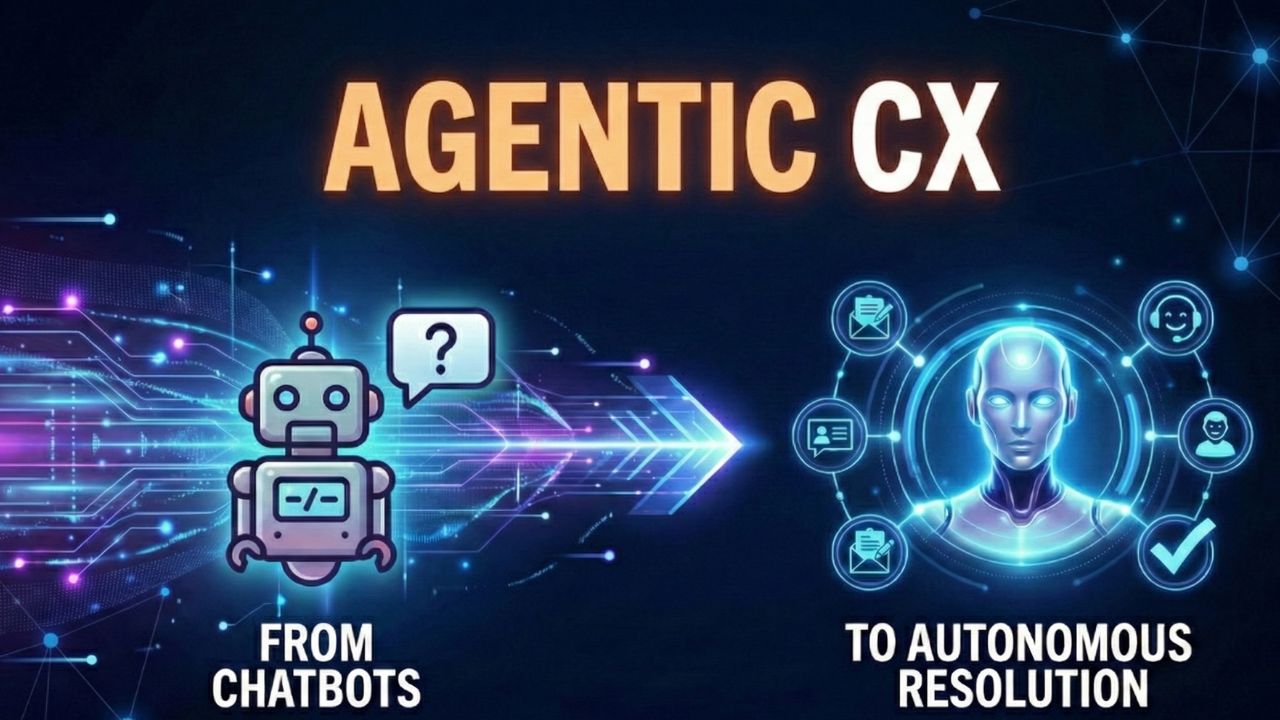
For the last decade, the promise of "AI Customer Support" has been largely disappointing. We built chatbots that were essentially glorified FAQ search bars. They were excellent at deflecting users but terrible at solving problems.
In 2026, the strategy shifts from Deflection to Autonomous Resolution.
Agentic Customer Experience (CX) relies on AI agents that are not just "trained" on your data but are "provisioned" with tools. They can access your ERP to check inventory, authenticate against your CRM to verify identity, and trigger API calls to process refunds—all without a human in the loop.
The Architecture of an Autonomous Agent
To understand why Agentic CX is different from the chatbots of 2023, we must look at the underlying architecture. A standard GenAI bot has a "Brain" (LLM) and "Memory" (RAG). An Agent adds two critical layers:
- Tool Use (Function Calling): The ability to translate natural language ("I want a refund") into executable code (e.g., `process_refund(user_id, order_id)`).
- Permissioning Layer: A security framework that determines who the agent is acting on behalf of, ensuring it doesn't hallucinate a policy override.
- State Management: Unlike stateless chat sessions, agents maintain a "Goal State" (e.g., "Issue Resolved") and will loop through attempts until that state is reached or a human escalation is required.
This architecture is what allows companies to move from "Human-Led, AI-Assisted" support to "AI-Led, Human-Governed" support.
The Platform Battle: Salesforce Agentforce vs. Zendesk AI
For Enterprise leaders, the choice of infrastructure often comes down to two giants. Here is the technical breakdown for 2026 decision-making:
Salesforce Agentforce
Best for: Enterprises deeply integrated into the Salesforce ecosystem (Sales Cloud, Service Cloud).
The Edge: Its integration with the Data Cloud means the agent has immediate, zero-latency access to the customer's entire history. It doesn't just know they have a ticket open; it knows their contract renewal date and their lead score.
The Downside: High implementation cost and complexity. It requires a mature data strategy.
Zendesk AI
Best for: Mid-Market to Enterprise companies prioritizing speed of deployment and ease of use.
The Edge: "Intelligent Triage" comes pre-trained on billions of CX interactions. It requires less custom engineering to get started. Their "Agent Copilot" features are often more intuitive for human agents working alongside the AI.
The Downside: Data isolation. If your billing data lives in Netsuite and your usage data in Snowflake, Zendesk may struggle to "see" the full picture without complex middleware.
The India Advantage: Voice AI & Hinglish
India is the global epicenter of customer support, and Agentic CX is transforming the BPO landscape. The critical breakthrough in 2026 is Voice AI Latency and Code-Switching.
Modern Voice Agents (using models like OpenAI's GPT-4o Realtime or specialized SLMs) can now handle:
- Sub-500ms Latency: Conversations feel natural, without the awkward "walkie-talkie" delay of old IVR systems.
- Hinglish Fluency: Agents can seamlessly switch between Hindi and English in the same sentence, a requirement for domestic Indian support.
- Noise Cancellation: AI filters can isolate user intent even in noisy background environments.
Strategic Interlinking: The Next Steps
Building an Agentic CX function is not an isolated task. It requires data from your marketing teams and feeds insights back to sales.
Back to the Hub: The 2026 Revenue Playbook Return to the main strategy guide for CMOs and CROsFurthermore, the data collected by your support agents is a goldmine for your sales team. Learn how to feed this data into your outbound strategy:
Read Next: The AI Sales Workforce How to turn support insights into automated sales opportunitiesFrequently Asked Questions (FAQ)
A: A chatbot uses NLP to answer questions based on a script or knowledge base (Information Retrieval). An Agentic CX system has "tools" (API connections) and "permissions" to perform actions like processing refunds, changing passwords, or upgrading subscriptions without human help.
A: It depends on your ecosystem. Agentforce is superior for organizations already deep in the Salesforce Data Cloud, as it natively grounds agents in CRM data. Zendesk AI is often faster to deploy and more cost-effective for mid-market companies focused purely on ticket deflection.
A: By moving from "Deflection" (telling the user to read an FAQ) to "Resolution" (fixing the problem), Agentic AI prevents the ticket from ever reaching a human agent. This can lower the average cost per ticket from $5-$12 (human) to under $0.50 (agent).