Cut Enterprise AI Token Costs by 300% Before Scaling
Key Takeaways
- The API Token Tax: Scaling conversational generative AI to millions of customers shifts IT expenses from predictable, fixed-cost server hosting to highly volatile, usage-based token consumption.
- Vendor Lock-in is Inevitable: Sovereign AI deployments, which are mandated by EU data residency laws, effectively force CTOs to surrender multi-cloud negotiating leverage and fully lock into a single hyperscaler ecosystem like Google Cloud.
- FinOps Kill-Switches are Mandatory: Deploying generative health companions at an enterprise scale without strict API rate-limiting, semantic caching, and budget-based kill-switches is tantamount to financial suicide.
The recent announcement of DocMorris migrating its entire infrastructure to Google Cloud to construct a Gemini-powered "digital health companion" is being lauded as a breakthrough in personalized medicine. But for Chief Technology Officers and Enterprise Architects observing from the sidelines, this move exposes a brutal, often unspoken reality of enterprise AI: sovereign AI necessitates total vendor lock-in, and rolling it out to the masses creates a devastating "token tax."
If you are a technology leader planning to scale conversational AI to a large user base—DocMorris boasts 11 million active customers—you are no longer just managing software. You are managing a highly volatile commodities market where the commodity is compute tokens. Without aggressive enterprise AI API cost management, the financial drain of autonomous models will quickly eclipse any operational savings.
The Devastating Reality of the API Token Tax
In the era of traditional Software as a Service (SaaS), cloud computing costs were relatively predictable. You spun up Kubernetes clusters, load-balanced your web traffic, and paid a relatively static monthly fee based on server utilization. A million users clicking through a standard HTML form had a negligible marginal cost.
Generative AI shatters this financial paradigm. When a patient interacts with a conversational AI agent, they are not just querying a database. Their prompt is tokenized. The system then likely runs a Retrieval-Augmented Generation (RAG) process, fetching thousands of words of dense medical history and pharmaceutical guidelines, appending them to the hidden system prompt. This massive context window is sent to the LLM (like Gemini Pro), which then generates a tokenized response.
Every single word sent, processed, and received incurs a micro-charge. This is the Token Tax. When you multiply a complex 4,000-token interaction by multiple conversational turns, and then multiply that by 11 million users experiencing ailments throughout the year, the resulting API bill can grow exponentially. Worse yet, if the system is multimodal—allowing users to upload high-resolution images of rashes or medical documents—the token consumption skyrockates. CTOs rolling out generative health companions without strict FinOps governance will bankrupt their IT budgets before they ever recognize a positive ROI.
Why Sovereign AI Demands Vendor Lock-in
DocMorris's strategic choice to migrate entirely to Google Cloud is not merely a preference for Google's developer tooling; it is a regulatory imperative. Healthcare data is bound by strict compliance frameworks like GDPR in Europe and HIPAA in the United States. You cannot send protected health information (PHI) bouncing across disparate, multi-cloud APIs located in different geographical jurisdictions.
To use powerful foundation models legally, enterprises are forced to adopt Sovereign AI infrastructure. This means the entire stack—from the patient database to the vector search engine to the LLM inference nodes—must reside within a ring-fenced, localized data center (e.g., Google Cloud EU).
The business consequence of this is total vendor lock-in. Previously, CTOs could play AWS, Azure, and Google Cloud against each other to secure heavy discounts on raw compute. In the AI-first era, once your proprietary data and custom RAG pipelines are deeply entangled with a hyperscaler's proprietary, sovereign-hosted LLM, extracting yourself becomes near impossible. You are entirely at the mercy of their API pricing models.
Deploying FinOps Kill-Switches for Generative AI
If enterprise AI API cost management is the disease, aggressive Cloud FinOps is the cure. Deploying conversational AI to millions of customers without a sovereign infrastructure strategy is financial suicide. You must treat AI API calls with the same scrutiny as corporate expense accounts.
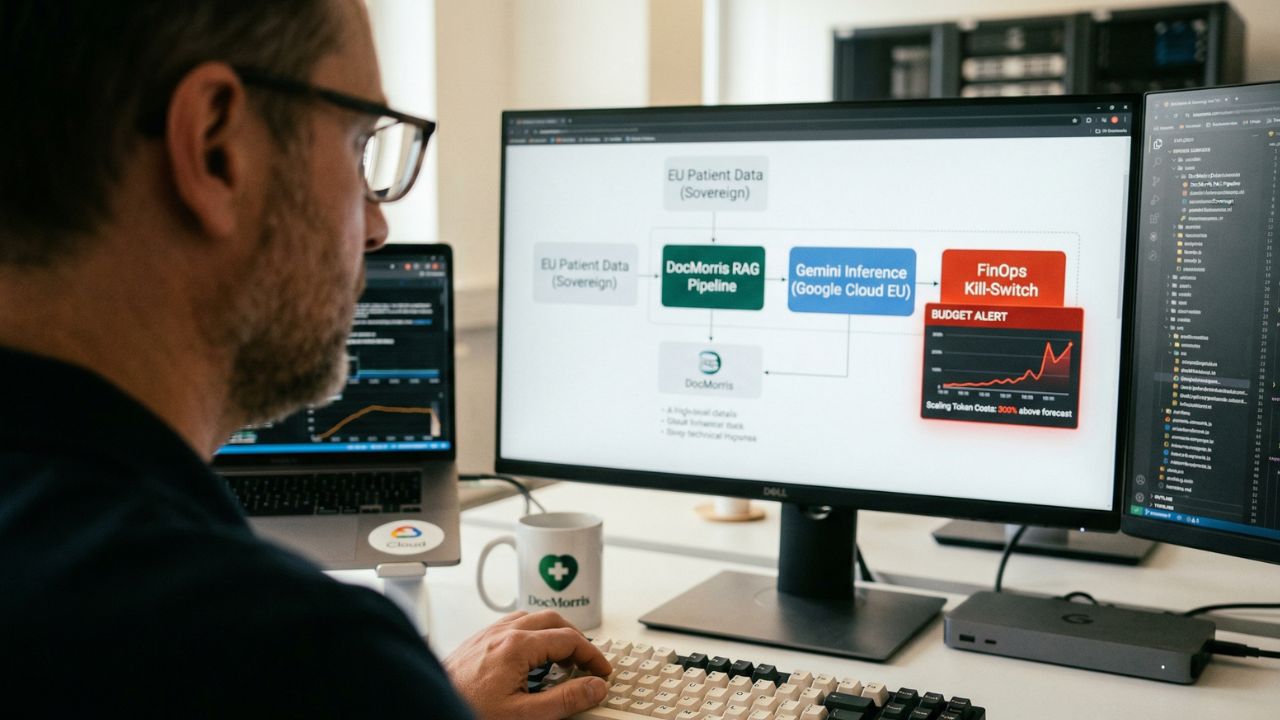
The most critical safeguard a CTO can deploy is the FinOps Kill-Switch. A kill-switch is an automated, logic-based gateway that sits between the user interface and the LLM API. It continuously monitors the real-time token spend associated with a specific user, session, or global application tier.
If an application starts experiencing a runaway loop, or if a user is aggressively pinging the multimodal model, the kill-switch activates. It severs the connection to the expensive foundation model and immediately downgrades the user experience to a cheaper, smaller model (like Gemini Flash), or routes them to a traditional, static rules-based chatbot or human operator. Never allow an open-ended API connection to face the public internet without a hard financial ceiling programmed into the architecture.
Mastering Semantic Caching and Multi-Model Routing
Beyond emergency kill-switches, sustainable AI deployment requires architectural efficiency. For an organization like DocMorris, thousands of users will likely ask the exact same questions daily: "Are there side effects to taking Amoxicillin with Ibuprofen?" or "How do I redeem my e-prescription?"
Sending these identical, repetitive queries to an expensive LLM to generate a fresh response every single time is an egregious waste of capital. Enterprises must implement Semantic Caching. When a query comes in, a fast, cheap embedding model checks a localized cache. If a similar question was answered recently with a high confidence score, the system returns the cached AI response, bypassing the primary LLM entirely and saving 100% of the inference cost.
Furthermore, CTOs must adopt Multi-Model Routing. Not every problem requires the reasoning power of Gemini Ultra. Simple symptom checks or password resets should be routed to tiny, highly efficient open-source models hosted locally, reserving the premium API calls strictly for high-value diagnostic reasoning or complex data synthesis.
The True ROI of Migrating to AI-First Architectures
Evaluating the ROI of an AI-first transformation requires a fundamental shift in metrics. It is not about user engagement; it is about cost per resolution. A thorough understanding of managing enterprise AI API costs and governance is essential here.
If a human call center agent costs $4.00 to resolve a pharmacy ticket, and the new Gemini-powered digital companion costs $0.40 in compute tokens to resolve the same ticket autonomously, the ROI is massive. However, if poorly optimized prompts, excessive RAG context windows, and hallucination-induced API loops drive the token cost to $5.00 per interaction, the AI has become a financial liability.
The Google and DocMorris partnership is a masterclass in the potential of digital health. But beneath the polished conversational interfaces lies a rigorous, unforgiving economic engine. Before you sign a hyperscaler deal to bring generative AI to your users, ensure your FinOps architecture is as intelligent as the models you are deploying.
Explore the Complete DocMorris AI Disruption Series
Frequently Asked Questions
To calculate the token tax, multiply the average tokens per interaction (both input prompt context and generated output) by the cost per 1,000 tokens of your chosen LLM (e.g., Gemini Pro). Then, multiply this figure by the expected daily interactions across the 11 million users. Do not forget to add the compute costs of your RAG vector database queries.
Beyond raw API token prices, hidden costs include data egress fees across cloud regions, the expense of maintaining highly available vector databases for semantic search, and the compute overhead of real-time PII (Personally Identifiable Information) scrubbing middleware required for healthcare compliance.
Implementing AI FinOps requires setting up granular tagging for all AI requests to trace costs back to specific users or departments, deploying semantic caching to serve repeat queries without hitting the LLM, and establishing hard budget alerts that throttle API usage before cost overruns occur.
Data sovereignty laws like GDPR mandate that sensitive health data remain within specific geographic boundaries (like the EU). To ensure this, companies must often migrate their entire stack into a single hyperscaler's localized data center to avoid accidental cross-border data transfer during AI inference.
The ROI hinges on whether the massive reduction in human call center and triage labor outweighs the new, variable cost of cloud compute and API tokens. Positive ROI is only achieved if the AI safely and autonomously resolves a high percentage of Tier 1 and Tier 2 tickets without human intervention.
Deploy multi-model routing. Route simple, generic queries to cheaper, faster models (like Gemini Flash) and reserve heavy, expensive models (like Gemini Pro or Ultra) exclusively for complex diagnostic or medical history reasoning.
By migrating its infrastructure entirely to Google Cloud, DocMorris ensures that all patient data, RAG vector embeddings, and LLM inferences occur strictly within Google's heavily audited, EU-based physical data centers, maintaining compliance with European privacy standards.
The best strategies include semantic caching, strict input prompt optimization (removing unnecessary context words), dynamic multi-model routing, and establishing organizational quotas with hard kill-switches.
CTOs can configure API gateways to monitor real-time token spend. If a specific application or user exceeds an allocated budget threshold within a given timeframe, the gateway automatically severs the LLM connection and falls back to a standard, static UI or traditional rule-based chatbot.
Multimodal AI (processing images, audio, and video alongside text) consumes tokens at a vastly accelerated rate compared to text-only interactions. Unrestricted user uploads of high-resolution medical imagery can cause exponential spikes in API billing, bankrupting IT budgets if left unmonitored.
Sources and References

About the Author: Sanjay Saini
Sanjay Saini is an Enterprise AI Strategy Director specializing in digital transformation and AI ROI models. He covers high-stakes news at the intersection of leadership and sovereign AI infrastructure.
Connect on LinkedIn