Cricket Australia Deploys GPT-5: The Real-Time AI Architecture Disrupting Live Sports
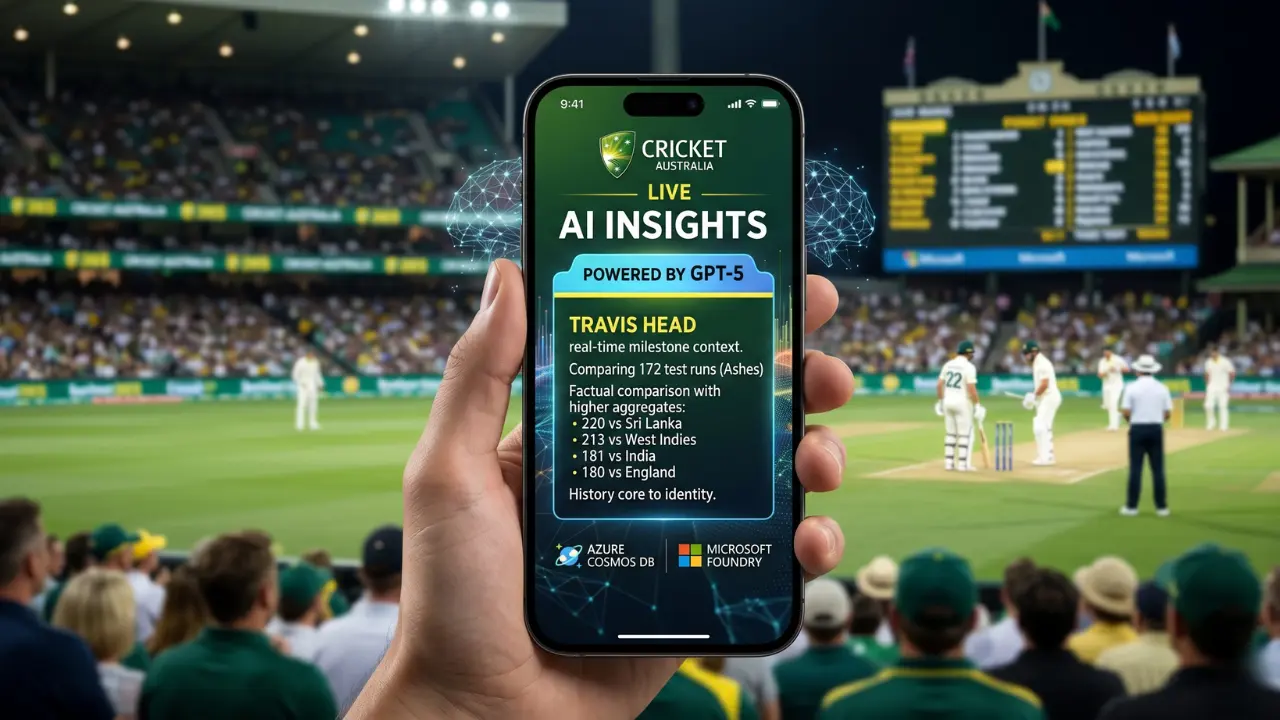
Cricket Australia has fundamentally re-engineered digital fan engagement by integrating OpenAI’s GPT-5, hosted within Microsoft Foundry, into the Cricket Australia Live app. Debuting with high-stakes fixtures like the January Ashes series, the new "AI Insights" feature abandons the traditional static scoreboard. Instead, it delivers live, match-aware context regarding player milestones, historical records, and key match dynamics directly to users' screens.
To power this capability, the governing body ingested an exhaustive archive of official scorecards dating back to 1886. According to Balamurugan P M, Cricket Australia’s Chief Technology and Digital Officer, aligning this massive historical dataset took three months of rigorous validation. The goal was to shift the digital experience from merely reporting scores to interactive storytelling, allowing fans to ask follow-up questions about the live action and historical context.
The stakes for this deployment were massive, requiring a fast-tracked launch ahead of critical T20 and Ashes tournaments. Cricket Australia relied heavily on Microsoft Azure’s cloud infrastructure and partnered with Insight Enterprises, HCL Tech, and Skewer to accelerate the build. As Cricket Australia CEO Todd Greenberg noted, the immediate analytics proved that delivering AI-generated insights in the right format and timeframe profoundly spikes user engagement.
The Zero-Latency Data Pipeline: Architecting GPT-5 for Live Broadcasts
Integrating a sprawling, 140-year-old dataset into a live generative environment is a monumental engineering challenge. In the unpredictable realm of live sports, developers must master the real-time RAG workflow needed to build generative UIs at scale to prevent hallucinations that would instantly alienate hardcore, statistics-obsessed fans. Because trust is "non-negotiable," the engineering team implemented intense data alignment protocols to ensure GPT-5's outputs remain strictly factual.
The backbone of this real-time architecture is Azure Cosmos DB, which serves as the hyper-scalable data layer. Supporting an ecosystem that includes the PlayCricket app—which hosts scores for up to 7,000 community matches a weekend—Cosmos DB ensures instantaneous updates during live play. As Greenberg pointed out, live sports have no pauses, meaning the underlying database must ingest, process, and serve generative insights reliably under the crushing peak demand of millions of concurrent users.
From a product engineering standpoint, the roadmap is shifting toward hyper-personalization. Future iterations of the app will allow users to self-select personas—such as "newcomer," "history buff," or "stats guru"—to tailor the AI’s output. For software architects, this means building dynamic prompt-routing layers that adjust the LLM’s context window and stylistic constraints on the fly, transforming a single API endpoint into a multi-tiered narrative engine.
The Executive Playbook: Monetizing Engagement and Navigating Hyperscaler Costs
For the C-Suite, Cricket Australia's deployment represents a masterclass in driving digital monetization through deep engagement. By giving fans the tools to set up their own narratives, executives are extending session lengths and building lifelong brand partnerships that span from 8 to 80-year-old demographics. This level of stickiness is exactly what digital officers across all global sports franchises are currently scrambling to replicate.
The strategic involvement of HCL Tech highlights the indispensable role of the Indian IT and GCC ecosystem in executing high-stakes, time-sensitive AI deployments. Global enterprises are increasingly relying on offshore talent to bridge the gap between hyperscaler infrastructure (like Microsoft Azure) and operational readiness. Indian tech partners are no longer just maintaining legacy systems; they are actively architecting the consumer-facing AI applications that define global brands.
However, CTOs observing this rollout must carefully calculate the FinOps reality of such an architecture. When millions of fans simultaneously query GPT-5 during a tense Ashes test match, the resulting API token consumption and cloud compute costs can easily spiral out of control. Scaling this level of generative AI requires stringent infrastructure cost management, robust caching mechanisms for common queries, and rigorous load testing to ensure hyperscaler bills do not eclipse the revenue gained from increased app engagement.
Frequently Asked Questions
Cricket Australia utilizes OpenAI's GPT-5 via Microsoft Foundry to power its "AI Insights" feature on the Cricket Australia Live app. This tool provides real-time, match-aware context, historical records, and interactive storytelling based on official scorecards dating back to 1886.
To handle the massive, concurrent demand of live sports without lag, the architecture relies on Azure Cosmos DB. This provides a highly scalable and fast data layer capable of processing live match data and feeding it into the generative AI models instantaneously.
Major technology partners and system integrators, including HCL Tech and Insight Enterprises, are crucial for accelerating the build and integration of complex AI platforms. They provide the operational readiness and engineering scale required to launch enterprise-grade AI applications ahead of strict tournament deadlines.