SAFe AI Practitioner Path: 5 Steps, Zero Waste
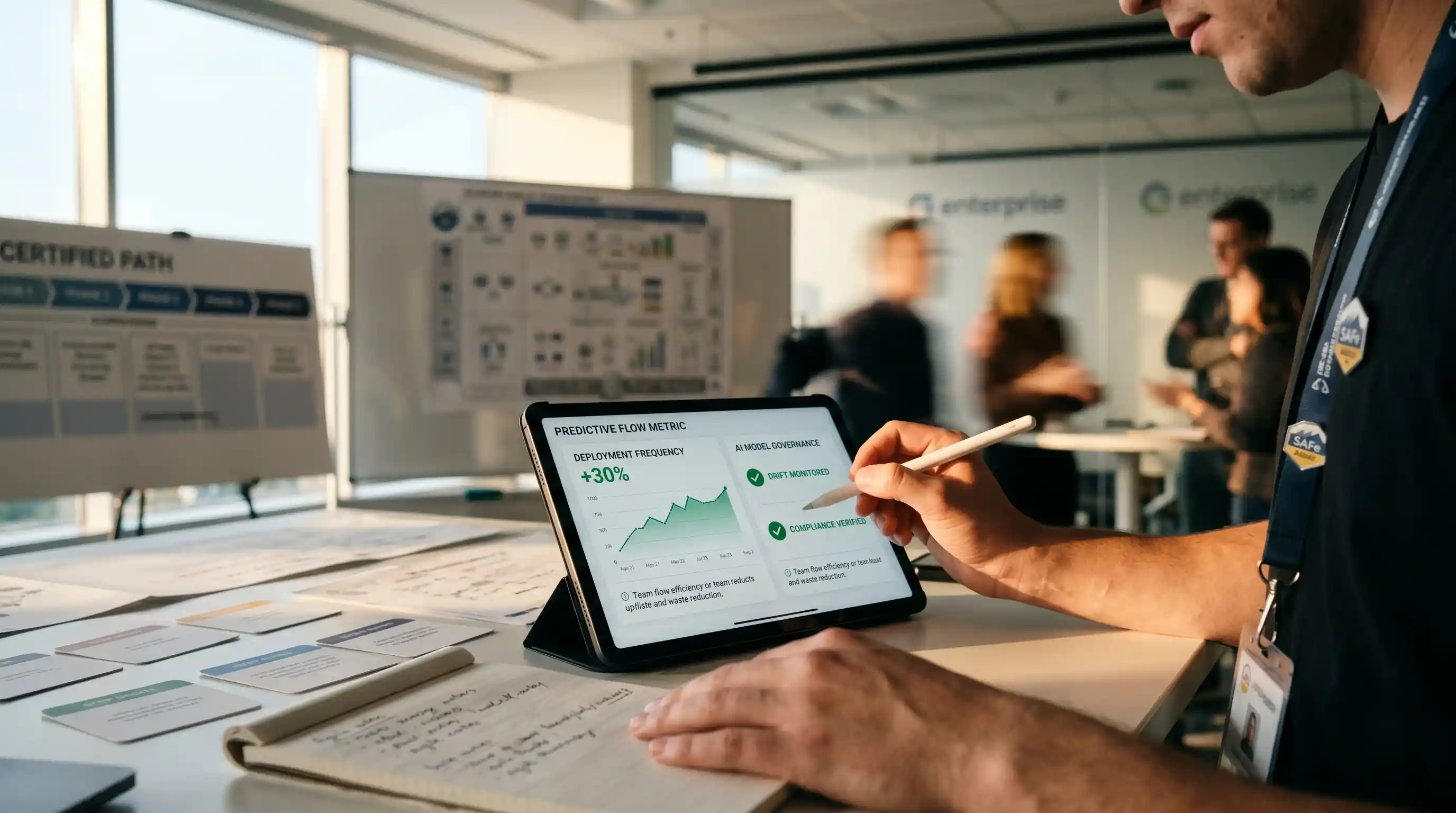
- Sequence Matters: Taking advanced AI governance courses before mastering the 2026 SAFe baseline wastes time and money.
- Role-Specific Focus: A generic agile AI upskilling path fails; you must branch into specialized roles like the AI Product Owner or AI Model Steward.
- The Missing Link: The AI-empowered leading SAFe course bridges the gap between basic framework theory and real-world AI tooling.
- Economic ROI: The final step focuses entirely on portfolio economics, proving to executives that your AI integrations actually reduce cost-of-delay.
Most practitioners pick the wrong certification first, burning their enterprise training budget on disconnected AI theory. When 54% of Agile practitioners cite "integration uncertainty" as their single biggest barrier, a generic AI course will not save your value stream.
You do not need to learn how to build neural networks; you need to learn how to govern them within an Agile Release Train. Before designing your personal curriculum, you must understand the broader enterprise operating model outlined in our master hub, SAFe 6.0 + AI Integration: The Practitioner's Survival Guide.
This certified SAFe AI practitioner learning path sequences five exact steps so each credential pays off. Stop collecting random badges and start building a roadmap that directly impacts flow predictability.
Step 1: Secure the Baseline with SAFe Certification 2026
You cannot automate a broken framework. The absolute prerequisite for this learning path is a rock-solid understanding of cadence, synchronization, and Lean-Agile principles. If you are new to the framework, start with the standard Leading SAFe certification.
The SAFe certification 2026 curriculum places a much heavier emphasis on flow metrics and value stream mapping than previous iterations.
Goal: Understand the PI Planning heartbeat and Agile Release Train dynamics.
Outcome: You learn the rules before you learn how AI bends them.
Step 2: The AI-Empowered Leading SAFe Bridge
Once you have the baseline, you must take the bridging course. The AI-Empowered Leading SAFe module is designed specifically to translate generic generative AI capabilities into SAFe-specific workflows.
This step teaches you how to use AI to draft candidate PI objectives, calculate historical capacity, and identify cross-team dependencies before they hit the program board.
Goal: Learn to apply LLMs to administrative SAFe toil without breaking human alignment.
Outcome: You transition from a manual framework executor to an AI-assisted facilitator.
Step 3: Role-Specific AI Application
A single, monolithic certified SAFe AI practitioner learning path does not exist because every role uses AI differently. Step 3 requires you to specialize.
If you are a Product Owner, you must learn how to audit AI-generated backlog items and track data provenance. If you are a Scrum Master, your focus shifts to automating flow metric aggregation and resolving bottlenecks.
To deepen this specific track, review the essential AI certification for Scrum Masters.
Goal: Master the localized AI workflows unique to your daily Agile role.
Outcome: Drastic reductions in your personal administrative overhead.
Step 4: Mastering Governance and the Model Steward Mandate
As you advance, the challenge shifts from productivity to safety. At scale, an ungoverned AI output propagates errors across synchronized teams and dependency maps.
Step 4 focuses on SAFe agilist AI training geared toward technical governance. You must learn how to establish model guardrails, monitor for algorithmic drift, and ensure compliance.
Goal: Prevent unsupervised models from shipping unverified code or logic.
Outcome: You acquire the skills necessary for the emerging AI Model Steward role.
Step 5: Executive Scaling and Portfolio Economics
The final step is for Release Train Engineers, System Architects, and Portfolio Managers. "AI made us faster" is not a business case that secures funding. You must learn how to tie flow improvements directly to value stream economics.
This means calculating the exact SAFe course cost against the reduction in cost-of-delay achieved through AI integration.
For leaders looking for intensive executive training outside the SAFe ecosystem, balancing this step with a university-backed program is highly effective. You can evaluate this option in our LSE AI leadership accelerator review.
Goal: Build a mathematically sound AI business case for the Lean Portfolio Management team.
Outcome: You become the authority who secures enterprise budget for scaled AI rollouts.
Conclusion: Start Your Path Today
Randomly testing AI tools will not make you a recognized expert in your enterprise. Following a disciplined certified SAFe AI practitioner learning path ensures that every hour and dollar spent on training directly translates to measurable flow predictability.
Start with the baseline, bridge the AI gap, and position yourself as the leader who finally solves integration uncertainty for your Agile Release Train.

Frequently Asked Questions (FAQ)
You become a certified practitioner by sequencing foundational SAFe training, completing the AI-Empowered Leading SAFe bridge course, and then specializing in role-specific AI applications like prompt governance and flow metric automation. There is no single monolithic badge, but rather a structured pathway of credentials.
While Scaled Agile integrates AI practices into existing certifications and offers specific micro-credentials and AI-empowered variants, a standalone "SAFe AI" mega-certification is less common than role-based updates. Practitioners prove expertise by combining their core SAFe credentials with targeted AI execution workshops and verified flow improvements.
It is a targeted curriculum designed to bridge standard Lean-Agile theory with practical generative AI applications. It teaches practitioners how to safely use LLMs to pre-compute historical capacity, draft candidate PI objectives, and identify dependency strings without replacing the necessary human negotiation during PI Planning.
Always secure the baseline first. Take the foundational Leading SAFe or SAFe Agilist certification, followed by the AI-Empowered bridging courses. Only after mastering the framework and basic AI assistance should you pursue advanced, role-specific technical governance or portfolio economics certifications.
The total cost varies based on your starting point. Foundational courses generally range from $800 to $1,200. Adding AI-specific micro-credentials, executive bridge courses, and specialized tooling workshops can bring the total enterprise investment to between $2,500 and $4,500 per practitioner over a 12-month period.
Start with advanced prompt engineering tailored to Agile artifacts. Learn how to prompt an LLM to split user stories, draft acceptance criteria, and summarize daily syncs. Once mastered, immediately move to data provenance tracking and understanding model hallucinations to ensure you can audit AI outputs safely.
Yes. SAFe certifications require annual renewal. As the framework evolves to embed more AI practices, maintaining your active membership and completing the continuous learning modules ensures your credentials reflect the most current 2026 AI integration standards and updated governance models.
This learning path directly qualifies you for emerging, high-demand positions such as the AI Product Owner, who curates model-generated backlogs, and the AI Model Steward, who monitors algorithmic drift across the Agile Release Train. It also heavily elevates the market value of traditional RTEs.
For an active Agile practitioner, completing the foundational baseline, the AI bridge courses, and the role-specific technical modules typically takes 3 to 6 months of combined coursework and practical application. Mastery requires applying these concepts across at least one full Program Increment.
Absolutely. With over 54% of practitioners paralyzed by integration uncertainty, professionals who can explicitly map AI tools to enterprise value streams are commanding significant salary premiums. It transitions your resume from a standard framework administrator to a specialized enterprise AI strategist.