AI Value Stream Mapping: Find 40% Hidden Waste
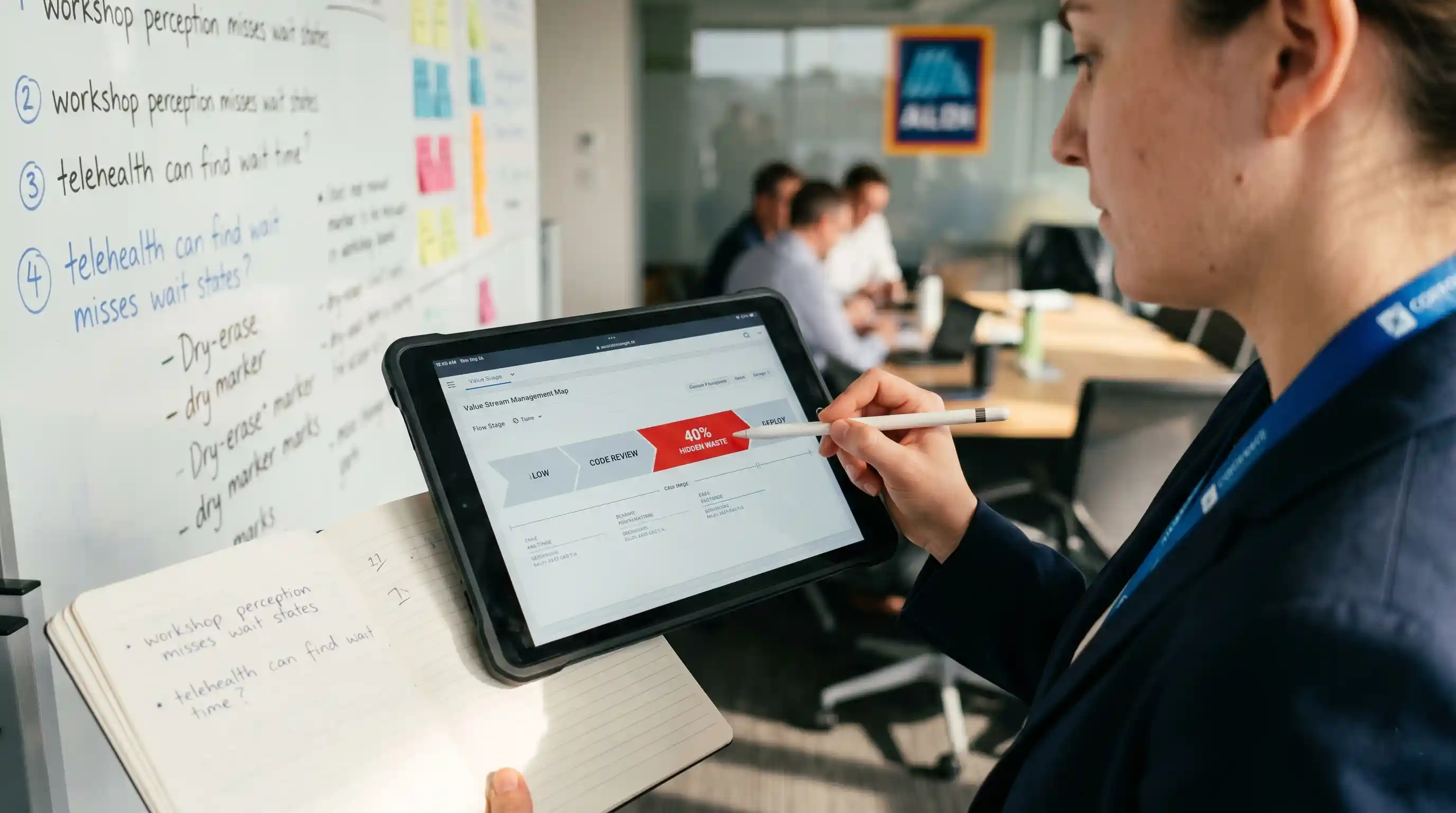
- Move Beyond Whiteboards: Manual mapping relies on human memory; AI mapping relies on telemetry, capturing hidden systemic delays.
- Find the 40% Waste: Machine learning models surface invisible wait states and bottlenecks costing your enterprise valuable releases.
- Predictive, Not Reactive: AI doesn't just show where you failed last PI; it predicts where the value stream will break next.
- Tool Agnostic Integration: Successful mapping requires stitching together data across ALM, CI/CD, and ITSM platforms.
Manual value stream maps miss the bottlenecks costing you releases. Whiteboard sessions capture the ideal state, but they fail to capture the invisible wait states, blocked dependencies, and silent handoff delays that drain your capacity.
In fact, AI value stream mapping for enterprise architectures frequently surfaces up to 40% hidden wait states that manual maps overlook.
To scale these insights across your portfolio, you must first anchor your approach in a governed framework. We strongly recommend reading the core operating model in SAFe 6.0 + AI Integration: The Practitioner's Survival Guide.
By transitioning to AI-driven mapping, you move from a static quarterly exercise to continuous, real-time flow predictability. Here is how to build the integration.
How is AI Value Stream Mapping Different from Manual VSM?
Manual Value Stream Mapping (VSM) is an exercise in human perception. A group of architects and Release Train Engineers gather in a room to map how value flows from concept to cash.
The problem is cognitive bias. Humans map the process as it should work, or as it works on a good day. They miss the micro-delays: the code sitting in a pull-request queue for 18 hours, or the ticket bouncing between three teams due to unclear acceptance criteria.
AI value stream mapping enterprise tools ingest actual execution data. They don't ask how the work flows; they observe the telemetry.
This creates a dynamic, living map that updates with every code commit and Jira status change. It transforms VSM from a retrospective workshop into an active early-warning system.
Surfacing Hidden Bottlenecks at Enterprise Scale
Can AI identify bottlenecks in a SAFe value stream automatically? Yes, and it does so with terrifying accuracy.
In a traditional Scaled Agile Framework, flow is often interrupted by unmapped cross-team dependencies. An AI layer monitors the historical cycle times of these handoffs.
If a specific API integration typically takes four days but is currently on day seven, the AI flags the bottleneck before the dependent Agile Release Train misses its milestone.
To ensure you are measuring the right systemic outputs when surfacing these bottlenecks, integrate these insights with your Agile team AI productivity KPIs.
Connecting Value Stream Data Across Tools
The biggest hurdle to enterprise AI mapping is fragmented data. Your value stream does not live in one tool.
Requirements live in Jira Align, code lives in GitHub, deployments run through Jenkins, and incidents land in ServiceNow. To map the value stream, the AI needs a unified data lake.
It must connect the Git commit ID back to the original SAFe Epic. Leading AI mapping tools specialize in this exact integration.
They stitch together the timestamps across your entire DevOps toolchain, creating a unified timeline of how long value actually takes to reach the customer.
Measuring ROI and Flow Efficiency with AI
"Flow efficiency" is the ratio of active work time to total lead time. In most enterprises, this number is shockingly low—often under 15%.
AI measures flow efficiency by calculating the exact minutes a work item spends in a "waiting" state versus an "active" state.
The ROI of this visibility is massive. By identifying and eliminating just a fraction of these hidden wait states, organizations can increase their deployment frequency without adding a single headcount.
Start small. Do not try to map the entire portfolio on day one. Pick a single, high-friction value stream, plug in your ALM and CI/CD data, and let the AI find your first bottleneck.
Conclusion: Stop Guessing, Start Measuring
If you are still mapping your value streams on a whiteboard, you are managing your enterprise based on an illusion.
AI value stream mapping for enterprise architectures replaces guesswork with undeniable telemetry.
Find the 40% hidden waste, connect your toolchain, and finally build a predictable flow of value.

Frequently Asked Questions (FAQ)
AI replaces static, workshop-based mapping with real-time telemetry. It ingests data across the DevOps toolchain to create a living map that surfaces hidden wait states, silent handoff delays, and cross-team bottlenecks that human perception consistently misses.
Yes. By analyzing historical cycle times and current work-in-progress (WIP) limits, AI algorithms automatically detect when a specific feature or dependency is aging past its statistical norm, alerting the Release Train Engineer before the bottleneck impacts the iteration.
AI needs timestamp data across your entire delivery pipeline. This includes status changes in your ALM (like Jira or Rally), commit and merge times in your source control, build durations in CI/CD, and incident resolution times from your service management tools.
Manual VSM relies on human memory and captures the idealized process. AI value stream mapping relies on hard system data to capture the actual, messy reality of how work flows, automatically updating as conditions change rather than waiting for the next quarterly workshop.
Enterprise solutions typically involve dedicated Value Stream Management (VSM) platforms like Tasktop (Planview), Plutora, or Digital.ai, which leverage machine learning layers over unified data lakes to connect fragmented ALM, Git, and CI/CD ecosystems.
AI calculates flow efficiency by dividing the exact time an item is actively being worked on by the total lead time (concept to cash). It automatically categorizes states like "in review" or "blocked" as wait times, providing a highly accurate, unmanipulated percentage.
Yes. By utilizing predictive analytics, AI assesses current load, historical team capacity, and incoming dependency complexity. It can forecast which teams or architectural nodes are most likely to become bottlenecks in the upcoming Program Increment.
You use integration hubs or unified VSM platforms that pull APIs from disparate tools (Jira, GitHub, Jenkins). These platforms use common identifiers, like an Epic ID or ticket number, to stitch the fragmented timestamps into a single, continuous value stream timeline.
The ROI is driven by recovering lost capacity. By surfacing and eliminating the 40% hidden wait states in a value stream, enterprises drastically increase feature throughput and reduce time-to-market without needing to hire additional engineering headcount.
Select a single, well-defined Agile Release Train. Connect just two primary tools first—usually your ALM (e.g., Jira) and your source code repository. Establish a baseline flow efficiency, use the AI to identify the largest wait state, and adapt your process before scaling.