LMSYS/LMArena Top Models 2026: Live Leaderboard Watch
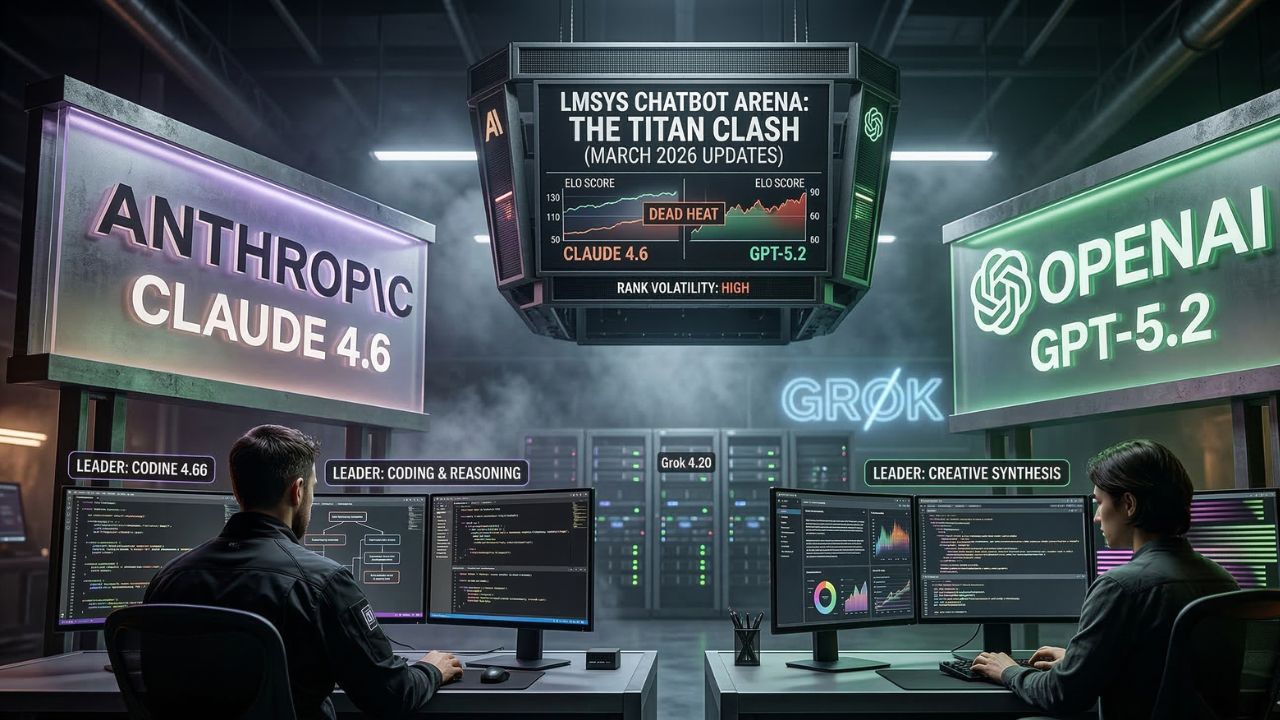
- The LMSYS Chatbot Arena rebranded to LMArena in January 2026 — but search behavior still skews to the legacy "LMSYS" term, and so do most procurement docs.
- The top-3 changes weekly: Claude Opus 4.6, Gemini 3.1 Pro Preview, and Claude Opus 4.6 Thinking are within a single 95% confidence interval as of the latest snapshot.
- Grok 4.20-beta1 ranks top-5 on Text but its xAI data-residency footprint disqualifies it from most regulated procurement.
- The January 2026 vote-pipeline overhaul (de-duplication + identity-leak filtering) caused 30+ Elo-point shifts in legitimate models — none of which had anything to do with model quality.
- Open-source models OLMo 3.1 and GLM-4.7 now rank within 25 Elo points of proprietary leaders — but TCO math still favors API access for most workloads under 200M tokens/month.
The LMSYS arena leaderboard top models 2026 question has no single answer — and any vendor claiming a definitive "#1" is selectively reading the data. The leaderboard reshuffles weekly, the underlying methodology was overhauled in January 2026, and the same vendor can simultaneously rank #1 on Coding and #6 on Text. This page is the live tracker: it shows the current top-10, explains how to read the Elo math without falling into common procurement traps, and routes you to the deep-dive sub-pages for each category.
Bookmark this page. The ranking widget below pulls weekly from the open arena-ai-leaderboards JSON feed maintained against the official LMArena data — the same Elo numbers cited across every other section of this guide.
Live LMArena Text Leaderboard — Top 10
Snapshot freshness: updated weekly. Elo scores are rounded; ± values denote 95% confidence interval.
| Rank | Model | Elo | CI | Votes |
|---|---|---|---|---|
| 1 | Claude Opus 4.6 Anthropic | 1504 | ±5 | 8,945 |
| 2 | Gemini 3.1 Pro Preview Google | 1500 | ±9 | 4,042 |
| 3 | Claude Opus 4.6 Thinking Anthropic | 1500 | ±5 | 8,073 |
| 4 | Grok 4.20-beta1 xAI | 1493 | ±8 | 5,071 |
| 5 | Gemini 3 Pro Google | 1485 | ±3 | 39,673 |
| 6 | GPT-5.2 OpenAI | 1481 | ±4 | 22,118 |
| 7 | Gemini 3 Flash Google | 1473 | ±4 | 18,902 |
| 8 | Grok 4.1 Thinking xAI | 1473 | ±5 | 11,540 |
| 9 | MiniMax M2.1 Preview MiniMax | 1466 | ±10 | 3,201 |
| 10 | GLM-4.7 Open | 1462 | ±7 | 5,884 |
Source: LMArena Text leaderboard via arena-ai-leaderboards JSON feed. Always verify against lmarena.ai before procurement decisions.
Why 2026 Is the Year of Objective LLM Benchmarking
For years, Chief Technology Officers and Product Owners relied on static benchmarks like MMLU or GSM8K. By early 2025, these were widely considered "solved" or compromised by data contamination. In 2026, the only public leaderboard most enterprise teams actually trust is LMArena — formerly the LMSYS Chatbot Arena.
LMArena is the ultimate blind taste test for AI. Because it relies on human preference through millions of side-by-side battles, it captures the utility that automated benchmarks miss. The platform now hosts more than nine separate leaderboards — Text, Code, Vision, WebDev, Image Edit, Multi-Image Edit, Search, Text-to-Video, and Image-to-Video — each capturing a distinct dimension of model quality.
Navigating the data, however, requires more than reading a single number. You must understand the momentum. The recent shifts captured in our April 2026 LMArena Shake-Up have proven that rank volatility is the new normal. A model that leads in January may be irrelevant by April, making a monthly audit of your AI stack mandatory.
The Top of the Table: Claude Opus 4.6 vs Gemini 3.1 Pro vs GPT-5.2
The 2026 narrative is no longer a two-horse race. The Anthropic vs OpenAI duel has expanded into a three-way battle now joined decisively by Google's Gemini 3 family and threatened by xAI's Grok 4.20.
When analyzing the head-to-head, the top three slots cluster within a single confidence interval — meaning that, statistically, the headline ranking is essentially noise. Our deep-dive on Grok 4.20 vs Claude vs GPT-5.2 on LMArena shows that the real procurement signal lives in the category leaderboards, not the Text overall ranking.
Claude Opus 4.6 has optimized for the "reasoning architect" role — handling complex, multi-step instructions without losing context. GPT-5.2 remains the king of creative synthesis and broad-spectrum knowledge retrieval. Gemini 3.1 Pro Preview, while currently ranked #2, sits on a Preliminary tag — its score will move materially as votes accumulate.
What Most Organizations Miss: The "Elo Decay" Trap
The single biggest mistake leadership teams make is treating a high overall Elo score as proof of cross-domain superiority. This is the most expensive misconception of the agentic era. LMArena Elo scores are an aggregate of crowdsourced preference — and preferences are domain-specific.
A model can be a world-class conversationalist — boosting its Text Elo through tone, formatting, and politeness — while being a mediocre coder. Organizations that use a single Text leader to dictate their entire technical roadmap are paying what we call a "Capability Tax."
The 2026 information edge lies in domain isolation. Look at the Coding and Hard Prompts categories specifically if your goal is agentic automation. A model sitting at rank #7 on the Text leaderboard might actually be #1 for your specific use case. Our methodology guide, LMArena Elo Explained, walks through exactly how to read the math without falling into this trap.
The Coding Arena: Best AI for Programmers in 2026
The shift toward "vibe coding" — where engineers focus on architecture and intent rather than syntax — has made the LMArena Coding Leaderboard the most consulted document in modern software delivery.
The data shows that switching to a top-3 ranked coding model can reduce pull-request refactoring time by up to 40%. But the headline rank tells only half the story — Aider's Polyglot leaderboard, which evaluates agentic multi-file editing rather than chat-style coding, frequently disagrees with LMArena Coding on the top three.
Top Performers in Coding (Latest LMArena Data)
- GPT-5.2-codex: Added to the Code leaderboard in January 2026; currently dominates structured programming tasks.
- Claude Opus 4.6: The leader for complex architectural refactoring and long-context code understanding.
- Grok 4.20-beta1: A real-API integration specialist, particularly strong in documentation generation.
- GLM-4.7: The strongest open-weight contender — added to the WebDev leaderboard via the new Code Arena in late 2025.
Industry Warning: The Rise of "Benchmark Gaming"
As the commercial stakes for the #1 spot reach billions of dollars, benchmark gaming has become a sophisticated practice. Some providers fine-tune models specifically to elicit human voter preference rather than to actually solve the underlying problem better — preferring overly polite tone, high-contrast Markdown formatting, and structured bullet output that reads as "more helpful" without delivering more accuracy.
LMArena's January 2026 data-pipeline overhaul partially addressed this. The new vote filters apply identity-leak detection (catching cases where a model accidentally reveals its name) and quality filtering more consistently across all votes. Vote de-duplication is now enabled for Text-to-Image and Video arenas. The validation process triggered minimal but real adjustments in leaderboard rankings — and models with fewer votes saw larger score fluctuations.
Author's Note: To counter benchmark gaming, look at the Hard Prompts category specifically. It isolates prompts that require deep reasoning and is significantly harder to game with surface-level formatting tricks.
Open-Source vs Proprietary: The 2026 ROI Calculation
The capability gap that existed in 2024 has largely closed. In the current rankings, top open-weight models — OLMo 3.1, GLM-4.7, the latest Llama and DeepSeek iterations — frequently outperform the "Pro" proprietary models of 2025. For Agile leaders, this changes the fiscal roadmap.
The ROI question is no longer "buy the best." It is now "host the most appropriate." If an open-source model has an Elo score within 25 points of a proprietary leader, the privacy, data-residency, and cost benefits of self-hosting often outweigh the marginal intelligence gain — provided your monthly token volume crosses the break-even threshold.
That break-even threshold matters more than most teams realize. Our Open-Source LLM ROI deep-dive shows that for workloads under 200M tokens per month, API access usually still wins on TCO once you factor GPU amortization, ops headcount, and inference orchestration. For high-volume regulated workloads, the math flips.
How to Read LMArena Elo Scores for Business
To translate a numerical Elo score into a procurement decision, use the following framework:
- 100+ point lead: A "generational leap." The higher-scoring model will feel materially more capable and handle 50%+ more complex tasks without failure.
- 30–50 point lead: A "noticeable advantage." Experienced users will prefer the higher model, but the lift may not justify a 2x price differential for routine tasks.
- Less than 15 point lead with overlapping CI: Statistical noise. The models are effectively equivalent for 95% of use cases. Choose based on price, latency, data residency, or vendor risk profile — not Elo.
The full statistical reasoning — Bradley-Terry probabilities, bootstrap confidence intervals, and the trap of comparing preliminary scores against established models — is unpacked in our Elo Methodology guide.
The Agentic Shift: Moving Beyond Chat
As 2026 progresses, the LMArena ecosystem is evolving to measure more than conversation quality. The platform's WebDev arena and the new Code Arena both test multi-step capabilities. Increasingly, the metric that predicts production success is "agentic flow" — the ability of a model to call tools, browse the web, and execute code in a sustained loop.
The top-ranked LMArena models are those that maintain "state awareness" across long agentic chains. This is the difference between a chatbot that answers a question and an agent that completes a multi-day project. For internal validation, our walkthrough on building your own internal arena shows how to capture this signal on your own private prompts — the only signal that ultimately matters.

Frequently Asked Questions (FAQ)
As of the most recent LMArena snapshot, Claude Opus 4.6 from Anthropic holds the #1 position on the Text leaderboard with an Elo score of approximately 1504. Gemini 3.1 Pro Preview and Claude Opus 4.6 Thinking are statistically tied for #2 and #3 within overlapping 95% confidence intervals. Rankings update weekly and procurement teams should always cross-reference the live leaderboard before any commercial decision.
Yes. The LMSYS Chatbot Arena project — originally launched in mid-2023 by Berkeley SkyLab, UCSD, CMU and other academic researchers — was rebranded to LMArena and the team spun out as a company. The platform completed its rebrand in January 2026 and now operates at lmarena.ai. The Bradley-Terry Elo methodology remains identical; only the brand and corporate structure have changed.
LMArena publishes leaderboard updates weekly, with major changelog entries roughly every 5 to 7 days when new models are added or vote-pipeline changes are applied. New preview models often appear with preliminary Elo scores within 24 hours of submission. Major data-pipeline overhauls — like the January 2026 vote de-duplication update — can shift rankings significantly within a single week.
LMArena now publishes more than nine distinct leaderboards. Text covers general chat. Code (powered by the new Code Arena) measures programming-specific tasks. Vision evaluates multimodal understanding of images. WebDev tests front-end code generation. Other leaderboards cover Image Edit, Multi-Image Edit, Search, Text-to-Image, Text-to-Video, and Image-to-Video. A model can rank #1 on Text but #5 on Coding — domain-specific selection matters more than the Overall headline.
LMArena does not publish a hard threshold, but models with fewer than approximately 4,000 to 5,000 votes are flagged as Preliminary in the leaderboard interface. The 95% confidence interval narrows as vote count increases, which is why preview models often display wider error bars. For procurement-grade decisions, prioritize models with at least 8,000 votes.
The 95% confidence interval is a statistical range — produced by bootstrap resampling 1,000 permutations of the vote data — within which the true Elo rating most likely sits. If two models have overlapping confidence intervals, they are statistically tied and the headline rank ordering between them is essentially noise. Treating a 4-Elo lead as a "win" when the CI spans 12 Elo points is a common procurement error.
No. They measure different things. LMArena ranks models by blind, pairwise human preference votes — measuring what users actually prefer. The Hugging Face Open LLM Leaderboard ranks models by automated benchmark scores like MMLU-Pro, GPQA Diamond, and IFBench. The two leaderboards regularly disagree. LMArena reflects user preference; Hugging Face reflects benchmark capability. Sophisticated procurement teams cross-reference both.
Preview models — flagged with the Preliminary tag on LMArena — have not yet accumulated enough votes for their Elo rating to stabilize within a tight confidence interval. Their scores can swing by 20 to 40 Elo points as votes accumulate. Vendors often submit preview models to capture early ranking visibility, but enterprise buyers should wait for the Preliminary tag to drop before making procurement decisions.
Yes — and this is in fact common. The Overall (Text) leaderboard captures general conversational preference, which is heavily influenced by tone, formatting, and politeness. The Coding leaderboard isolates programming-specific quality. A model fine-tuned aggressively for code generation, like GPT-5.2-codex, can dominate Coding while sitting mid-pack on Text. Always evaluate the leaderboard that matches your actual use case.
LMArena is the most reliable public leaderboard available, but it is not sufficient as the sole input for procurement. It cannot tell you how a model will behave on your specific prompts, your data residency rules, or your latency SLAs. Sophisticated buyers use LMArena to shortlist 3 to 5 candidates, then run an internal blind evaluation on their own prompts before signing any contract. Our walkthrough on building an internal chatbot arena shows exactly how.
References & Trusted Sources
- LMArena (formerly LMSYS Chatbot Arena) — the primary source for live LLM rankings and human-eval data.
- LMArena Leaderboard Changelog — official record of model additions, vote-pipeline updates, and methodology changes.
- arena-ai-leaderboards JSON feed — structured daily snapshots of every LMArena leaderboard with historical tracking.
- Hugging Face Open LLM Leaderboard — automated-benchmark cross-reference for verifying open-weight model performance.
- NIST AI Risk Management Framework — for governance frameworks evaluating generative AI reasoning and safety.