AI Quality Assurance and Model Evaluation: The CQO Guide to Preventing the $100M Hallucination
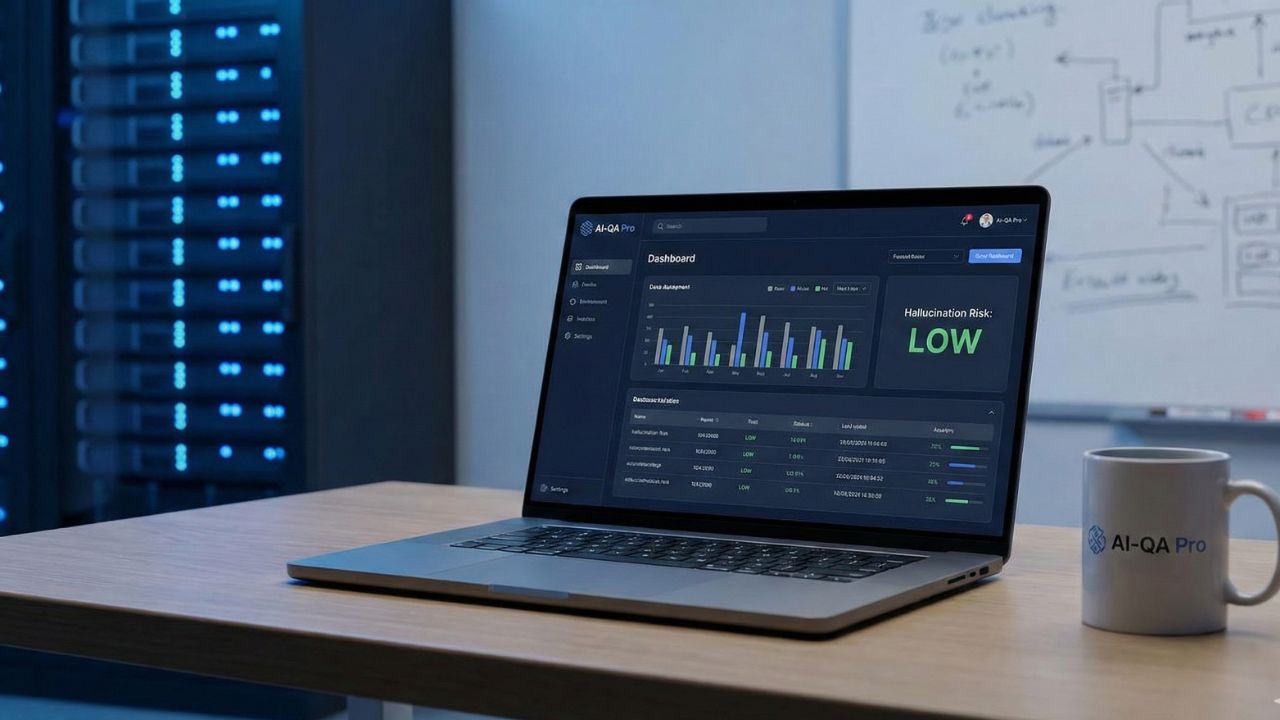
- Probabilistic vs. Deterministic: Traditional software testing fails for AI because agentic outputs are probabilistic, meaning the same input can yield different—yet valid—results.
- The Golden Dataset: Success depends on building a "Golden Dataset" that acts as the ground truth for measuring accuracy.
- Eval-Driven Development (EDD): Shift your engineering culture from simple "vibe checks" to rigorous automated evaluation frameworks.
- The New Toolkit: Modern leaders are ditching legacy tools for specialized frameworks like RAGAS and DeepEval to monitor cost and latency.
The rapid deployment of autonomous systems has left many leaders vulnerable to a new breed of technical debt that standard testing cannot catch.
If your organization is relying on old-school scripts to validate generative outputs, you are essentially flying a high-stakes mission without a radar.
Why Every Leader Needs an AI Quality Assurance and Model Evaluation Strategy
In 2026, ai quality assurance and model evaluation has transitioned from a niche technical task to a boardroom imperative.
The risk of a single high-profile hallucination can result in millions in lost revenue, regulatory fines, and irreparable brand damage.
Legacy automation tools were built for predictable code, but AI agents "think" through reasoning paths that evolve.
To understand why your current team might be struggling, you must accept that why selenium is dead for ai testing—it simply cannot handle the semantic nuances of generative UI and nondeterministic logic.
To navigate this shift, organizations are adopting an enterprise ai testing strategy that treats prompts and agentic behaviors with the same rigor as production code.
Orchestrating the Generative AI QA Framework
Building a generative ai qa framework requires moving beyond simple pass/fail metrics.
You need to measure "Faithfulness," "Relevance," and "Context Precision" in real-time.
A critical first step is establishing your benchmarks. Most high-performing teams find that the most effective path is to follow a guide on how to build golden dataset for agent testing to ensure every model update is measured against a verified truth.
The Shift to Algorithmic Judges
Manual review is no longer scalable when your agents handle thousands of queries per hour.
Many leaders are now turning to automated grading systems. By following a technical llm-as-a-judge automation guide, you can deploy "grader models" that evaluate your production agents 24/7.
Measuring ROI and Performance in 2026
Your ai model performance metrics must account for more than just accuracy; they must monitor the "Cloud Bill."
High-latency evaluations can kill the user experience and inflate API costs.
When selecting your infrastructure, conducting a ragas vs deepeval vs trulens comparison is essential.
These tools offer different advantages:
- RAGAS is the gold standard for component-wise RAG evaluation.
- DeepEval offers a developer-friendly, CI/CD-integrated experience.
- TruLens provides deep observability for production-level monitoring.
Protecting the Perimeter: Post-Launch Governance
Testing autonomous agents does not end at deployment. In fact, the most dangerous phase of the AI lifecycle begins after your agent hits the real world.
"Model drift" can occur as data environments change, leading to a steady decline in output quality.
Every CISO should have a localized ai drift detection and monitoring playbook to prevent their "bots from going rogue" and to maintain strict compliance with global AI regulations.
Stop wasting time building slides manually. Create stunning Agile presentations and documents in seconds with AI using Blackbox AI.

Frequently Asked Questions (FAQ)
AI Quality Assurance is the systematic process of evaluating AI models to ensure they meet specific accuracy, safety, and performance standards. Unlike traditional QA, it focuses on probabilistic outcomes and semantic relevance rather than fixed code responses.
Evaluation involves testing the model against a "Golden Dataset" of ground-truth examples. Metrics such as faithfulness (is the answer based on the facts provided?) and relevance (did it answer the user's intent?) are measured using automated judges or specialized frameworks.
Key metrics include Context Precision (retrieving the right info), Faithfulness (avoiding hallucinations), Answer Relevance, Latency (speed), and Token Cost (efficiency). These provide a holistic view of the agent's business value.
Traditional testing relies on deterministic assertions where "Input A" must always equal "Output B." AI is probabilistic; the "correct" answer can be phrased in a thousand ways, making rigid scripts like Selenium brittle and ineffective.
Building a modern team requires a blend of data scientists, prompt engineers, and traditional QA specialists. The focus shifts from writing test scripts to designing "Evals," managing "Golden Datasets," and orchestrating automated judge-based pipelines.
LLM testing evaluates the base model's reasoning and language capabilities. RAG evaluation specifically measures the "Retrieval" component—how well the model finds and uses external data to ground its answers.
Human-in-the-loop (HITL) is typically used to verify "Golden Datasets" or to perform spot-checks on the "AI Judges." Humans act as the final arbiter of truth, ensuring the automated grading system itself hasn't drifted.
Poor evaluation can lead to "algorithmic bias," data privacy breaches, or the dissemination of false medical/legal advice. These can trigger massive fines under frameworks like the EU AI Act or the Indian DPDP Act.
Automation is achieved by integrating frameworks like DeepEval into CI/CD pipelines. Every code change triggers an automated evaluation against a benchmark dataset, ensuring that accuracy never drops below a predefined threshold before deployment.
A Golden Dataset is a manually verified collection of input queries and their ideal "ground truth" answers. It serves as the master benchmark for measuring how close an AI agent's actual response is to perfection.
Sources & References
External Authoritative Sources
- NIST AI 600-1: Generative AI Risk Management Framework
- ISO/IEC 42001: Information Technology — Artificial Intelligence — Management System
- OWASP Top 10 for LLMs: Large Language Model Security Project
Internal Resources
- RAGAS vs DeepEval vs TruLens Comparison: Cost and Latency Benchmarks
- LLM-as-a-Judge Automation Guide: Implementing Grader Models
- How to Build Golden Dataset for Agent Testing: Step-by-Step
- Why Selenium is Dead for AI Testing: The Shift to Probabilistic QA
- AI Drift Detection and Monitoring Playbook for Production Agents
As leaders navigate the complexities of 2026, ai quality assurance and model evaluation will remain the primary differentiator between organizations that scale AI successfully and those that fall victim to the "hallucination trap."
Build your frameworks today to ensure your AI agents remain safe, reliable, and profitable.