What is Platform Engineering? (Beyond the "Spotify Model")
Why copying Squads and Tribes failed, and how the Internal Developer Platform (IDP) is the missing link for Indian GCCs.
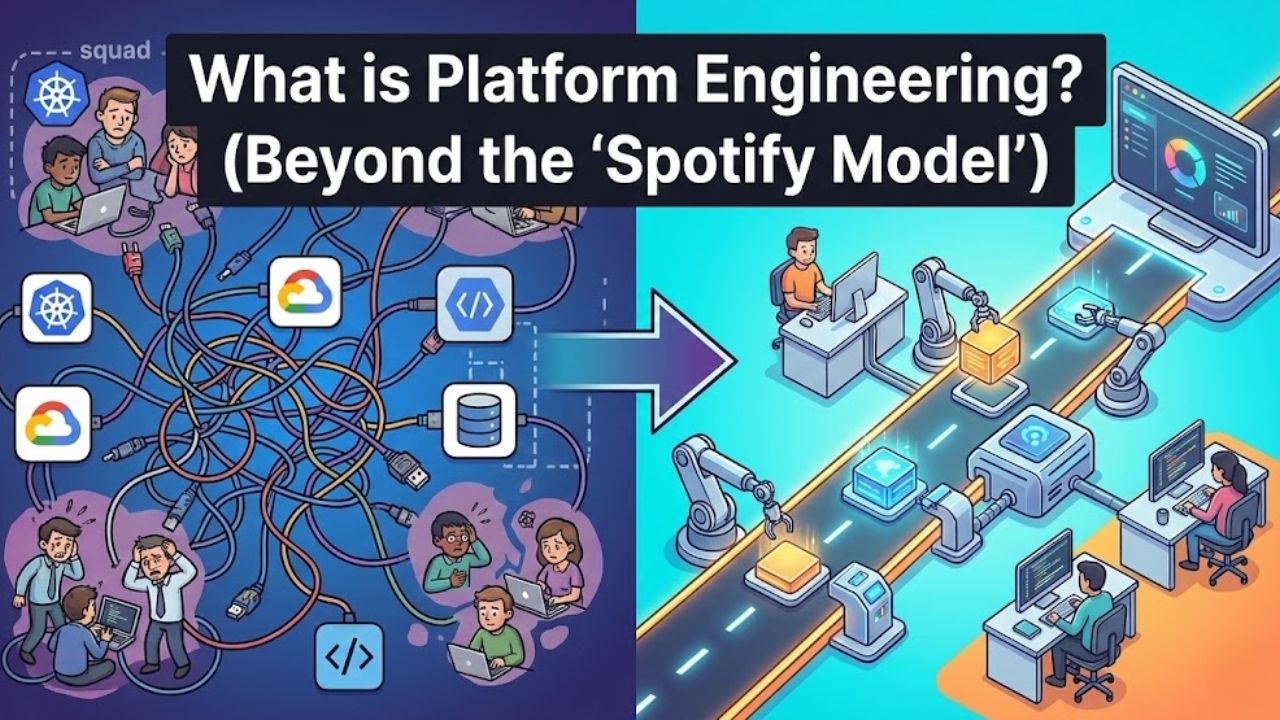
For the last decade, organizations rushed to adopt the Spotify Model. We renamed our teams to "Squads," our departments to "Tribes," and we told our developers: "You build it, you run it."
But in 2025, this has backfired. By forcing application developers to also manage Kubernetes clusters, Terraform scripts, and AWS security groups, we created a massive cognitive load. This is the DevOps Tax.
Platform Engineering is the evolution that fixes this. It acknowledges that not every developer wants to be an Ops expert. Instead of forcing everyone to do everything, we build an Internal Developer Platform (IDP), a product that provides "Golden Paths" for developers to self-serve infrastructure safely and quickly.
1. The "Spotify Model" vs. Platform Engineering
The biggest misconception in Agile transformation is that the Spotify Model was just about culture. The reality is that Spotify’s autonomy was powered by a robust technical platform (which eventually became Backstage).
- The Spotify Model (Misunderstood): Focuses on autonomy. Teams are free to choose their own tools. Result: Tool fragmentation and "Shadow IT."
- Platform Engineering: Focuses on standardized autonomy. Teams are free to move fast because the platform handles the boring, repetitive infrastructure work.
In the Spotify model vs platform engineering debate, the winner is clear: Culture cannot survive without a technical platform to support it.
2. What is an Internal Developer Platform (IDP)?
An IDP is the sum of all the tech and tools a platform engineering team binds together to pave golden paths for developers. It is not just a Wiki or a Jira board; it is a Self-Service Product.
Core Capabilities of an IDP:
- Self-Service Provisioning: A developer clicks "Create New Service," and the IDP automatically provisions the repo, CI/CD pipeline, and cloud resources.
- Service Catalog: A centralized directory of all microservices, APIs, and ownership details.
- Golden Paths: Pre-approved templates (e.g., "Spring Boot on AWS" or "React on Azure") that come with security baked in.
- Observability Dashboard: A single pane of glass to view build status, logs, and cloud costs.
3. The Tool Stack: Backstage vs. Port vs. Humanitec
This is the most critical decision for a Platform Product Manager. Do you build your own portal or buy a SaaS solution? Here is the definitive internal developer platform tools comparison for 2026.
Option A: Backstage (The Open Source Standard)
- What it is: Created by Spotify, this is a "Do It Yourself" (DIY) developer portal framework.
- Best For: Large Enterprises with engineering resources to customize the code.
- Pros: Free (Open Source), massive plugin ecosystem.
- Cons: High maintenance. Implementing Backstage for enterprise requires a dedicated team of React developers to maintain the instance.
Option B: Port (The No-Code SaaS)
- What it is: A commercial developer self-service portal that focuses on user experience and ease of setup.
- Best For: Mid-to-Large orgs that want an IDP now without hiring engineers to build it.
- Pros: Fast setup (days, not months), excellent UI, strong governance features.
- Cons: Paid licensing costs.
Option C: Humanitec (The Backend Orchestrator)
- What it is: Unlike Backstage (which is a frontend portal), Humanitec is a Platform Orchestrator. It handles the complex logic of generating configuration files.
- Best For: Solving the "config drift" problem in Kubernetes.
- Verdict: You often use Humanitec with Backstage or Port.
4. How to Build an IDP: A Step-by-Step Guide
Don't boil the ocean. Follow this IDP implementation guide to start small.
- Step 1: Identify the Thinnest Viable Platform (TVP). Don't try to automate everything. Find the one task developers hate the most (usually spinning up a new dev environment).
- Step 2: Define your Golden Path. Create one standardized template (e.g., "Java Microservice on Kubernetes").
- Step 3: Automate the Backend. Use DevOps platform automation tools like Terraform or Crossplane to script the infrastructure creation.
- Step 4: Build the Interface. Connect your automation to a portal (Backstage or Port) so developers can trigger it with a click.
- Step 5: Market it. Treat your platform like a product. If you build it, they won't necessarily come. You must sell the value to your dev teams.
5. The ROI: Why Executives Should Care
When pitching this to the C-Suite, do not talk about "Kubernetes" or "YAML." Talk about Internal Developer Platform ROI.
- Reducing Developer Onboarding Time: Without an IDP, a new joiner in a complex enterprise takes 3-4 weeks to push their first code. With an IDP, this drops to Day 1.
- Eliminating "Ticket Ops": Platform engineering removes the "please create a database for me" tickets that slow down Ops teams.
- Governance & Security: By forcing usage of "Golden Paths," you ensure every piece of software is compliant by default, reducing audit risks.
Frequently Asked Questions (FAQ)
A: No. DevOps is a philosophy ("You build it, you run it"). Platform Engineering is the enabler of that philosophy. It provides the tools so that "running it" doesn't burn out the developer.
A: Yes, but building an IDP with Kubernetes is the most common use case because Kubernetes is complex and needs abstraction. However, you can build an IDP for serverless, mainframes, or legacy VMs.
A: The Platform is the backend machinery (scripts, clusters, cloud). The Portal (like Backstage) is the frontend interface developers interact with. You need both.
A: Companies like Netflix, Uber, and Starbucks have documented their journey. In India, major unicorns like Flipkart and Swiggy utilize extensive IDP strategies to manage scale.
Sources & References [cite: 72, 73, 74, 75, 76]
- Gartner: Top Strategic Technology Trends for 2025: Platform Engineering.
- Humanitec: The State of Platform Engineering Report.
- Spotify Engineering Blog: How We Use Backstage to Manage Complexity.
- Puppet: State of DevOps Report 2024.
- Team Topologies: Organizing Business and Technology Teams for Fast Flow.