Agile vs. Platform Engineering: The Evolution of Leadership
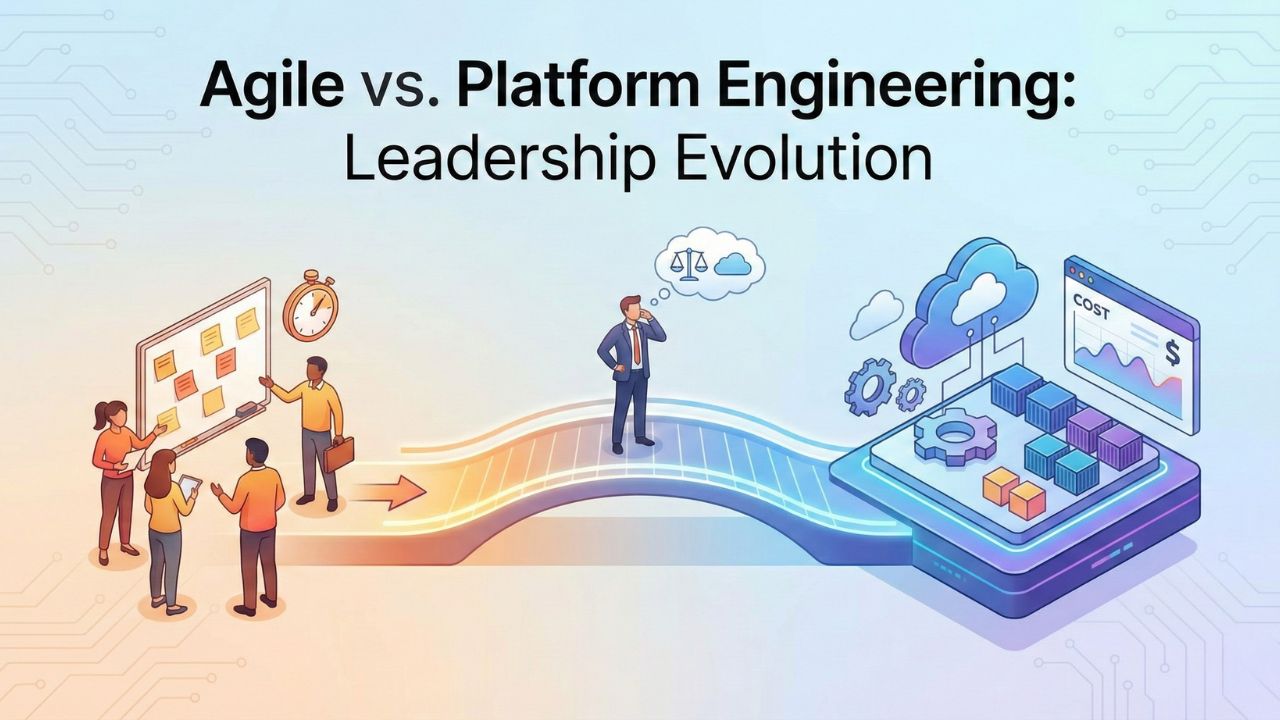
The software development landscape is witnessing a seismic shift. For over a decade, Agile leadership focused on team autonomy, rapid iteration, and breaking down silos. Today, however, as complexity grows, the focus is evolving toward Platform Engineering—a discipline that prioritizes efficiency, standardization, and reducing cognitive load through internal developer platforms (IDPs).
This transition requires a new breed of leadership. Modern engineering leaders must not only master delivery flows but also become stewards of financial and operational efficiency. Here is how leadership is evolving in the era of Agile vs. Platform Engineering, and why mastering the economics of the cloud is now a core competency.
From Velocity to Value Stream Mastery
Agile leadership was primarily concerned with velocity. Platform Engineering leadership, however, is obsessed with flow and removing friction. Leaders are now tasked with looking at the entire lifecycle of software delivery to identify bottlenecks.
To do this effectively, forward-thinking leaders are utilizing value stream mapping for software development to visualize the flow of work from idea to production. By conducting a value stream management tools comparison, organizations can select platforms that provide end-to-end visibility, allowing them to optimize processes rather than just individual tasks. This holistic view is essential for measuring DevOps ROI, proving that investments in platform teams actually translate to faster time-to-market and higher quality code.
The Financial Imperative: FinOps as a Leadership Skill
Perhaps the biggest shift for engineering leaders is the responsibility for cloud costs. In the pure Agile days, "move fast" often meant "spend fast." In the Platform Engineering era, efficiency is paramount. Leaders are increasingly pursuing FinOps certification for leaders to understand the mechanisms of cloud finance.
A primary responsibility is establishing enterprise cloud budget management frameworks that empower teams without stifling innovation. This involves defining clear FinOps KPIs and metrics—such as unit cost per transaction or resource utilization rates—to track efficiency alongside performance.
Strategies for Cost Optimization
Platform Engineering teams are uniquely positioned to implement cloud cost optimization strategies centrally, benefiting every product team that uses the platform. Leaders must champion the adoption of cloud bill analysis tools to gain granular visibility into spending patterns.
Key areas of focus include:
- Compute Efficiency: Leaders must drive initiatives for optimizing cloud compute costs. This often involves automated rightsizing and using AI for cloud cost management to predict resource needs and scale infrastructure dynamically, ensuring you only pay for what you use.
- Kubernetes Management: With containers becoming the standard, reducing Kubernetes costs has become a critical sub-discipline. Platform teams can enforce resource quotas and auto-scaling policies to prevent cluster sprawl.
- Commitment Management: Understanding financial instruments is crucial. Leaders must navigate the nuances of AWS Savings Plans vs. Reserved Instances, deciding which model offers the best long-term savings for their specific usage patterns.
Tooling and Best Practices across Clouds
A robust platform strategy is often multi-cloud or hybrid, requiring diverse expertise. Leaders need to be familiar with specific AWS cost reduction tools (like AWS Cost Explorer or Trusted Advisor) and implement Azure FinOps best practices (such as leveraging Azure Hybrid Benefit or Advisor recommendations) depending on their stack.
Furthermore, the "sprawl" isn't limited to infrastructure. The explosion of SaaS tools requires rigorous oversight. Implementing SaaS spend management software ensures that the organization isn't bleeding money on unused licenses or redundant developer tools. This is a key part of reducing cloud waste—eliminating zombie resources and unallocated storage that silently inflate the monthly bill.
The evolution from Agile to Platform Engineering does not mean abandoning Agile principles; it means scaling them through better infrastructure and tighter governance. The successful leader of tomorrow is one who can balance developer experience with fiscal responsibility. By mastering value streams and rigorously applying FinOps principles, leaders can build platforms that are not only technically sound but economically sustainable.
FAQ: Leadership in the Platform Era
A: Agile leadership primarily focuses on team autonomy, velocity, and iterative delivery of features. Platform Engineering leadership shifts the focus toward efficiency, standardization, and "flow." It treats the internal development platform as a product, aiming to reduce the cognitive load on developers so they can focus on coding rather than infrastructure management.
A: The first step is visibility. Before you can optimize, you must understand where the money is going. Leaders should implement cloud bill analysis tools and establish a tagging strategy to allocate costs to specific teams or products. Following this, pursuing a FinOps certification for leaders (such as through the FinOps Foundation) provides the necessary framework to drive cultural change.
A: Measuring ROI requires looking beyond simple uptime. Use value stream management tools to track metrics like "time to first commit," "deployment frequency," and "change failure rate." Additionally, track financial metrics like unit cost per transaction or cloud cost per customer. A successful platform should show a trend of decreasing unit costs even as total usage grows.
A: Absolutely. They are complementary. Agile principles guide how teams work (iteratively, with feedback), while Platform Engineering provides the foundation that enables them to work that way at scale without being bogged down by operational complexity.
A:
1. Eliminate Waste: Identify and terminate zombie assets (unattached storage volumes, idle load balancers).
2. Rightsizing: Use AI for cloud cost management to match instance types to actual workload performance.
3. Commitment Strategies: Analyze your consistent usage to purchase AWS Savings Plans or Azure Reservations, which can offer significant discounts over on-demand pricing.
Sources and References
To deepen your understanding of these shifts, we recommend the following resources which informed the strategies in this document:
1. FinOps and Cloud Financial Management
- The FinOps Foundation: The definitive source for FinOps best practices, framework definitions, and FinOps certification for leaders.
- Key Resource: "State of FinOps Report" (Annual publication).
- Cloud Provider Documentation:
- AWS: "Overview of AWS cost reduction tools and Savings Plans."
2. Platform Engineering and DevOps
- Team Topologies by Matthew Skelton and Manuel Pais: Essential reading for understanding how to organize teams for fast flow and the role of a "Platform Team."
- State of DevOps Reports (DORA): Provides data-driven insights into measuring DevOps ROI and the capabilities that drive high performance.
- Project to Product by Dr. Mik Kersten: A foundational text on moving from project-based management to value stream management and measuring business value.
3. Tools and Technologies
- Gartner Market Guide: For comparisons of SaaS spend management software and cloud bill analysis tools.
- CNCF (Cloud Native Computing Foundation): Resources on reducing Kubernetes costs and open-source tools for cloud-native cost visibility (e.g., OpenCost).
- Forrester Wave: "Value Stream Management Solutions" for a comprehensive value stream management tools comparison.
4. Methodologies
- Value Stream Mapping: Techniques for visualizing end-to-end flow.
- The Agile Manifesto: The historical context for the evolution into modern engineering practices.