The Agentic Economy: Preparing for Bot-to-Bot Commerce
Back to AI-Native Infrastructure Strategy Hub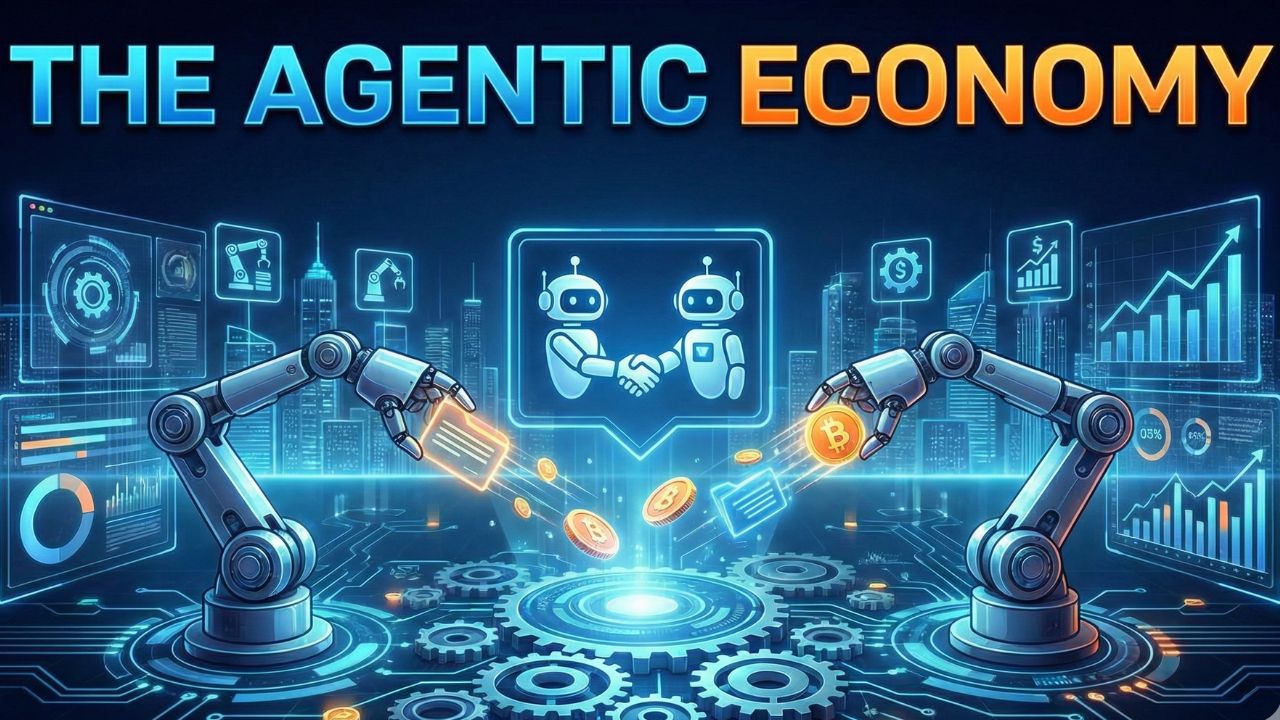
The next great frontier of digital commerce won't be B2C or B2B—it will be A2A (Agent-to-Agent). As AI agents move from information assistants to autonomous actors, they will soon become your customers, your vendors, and your supply chain negotiators.
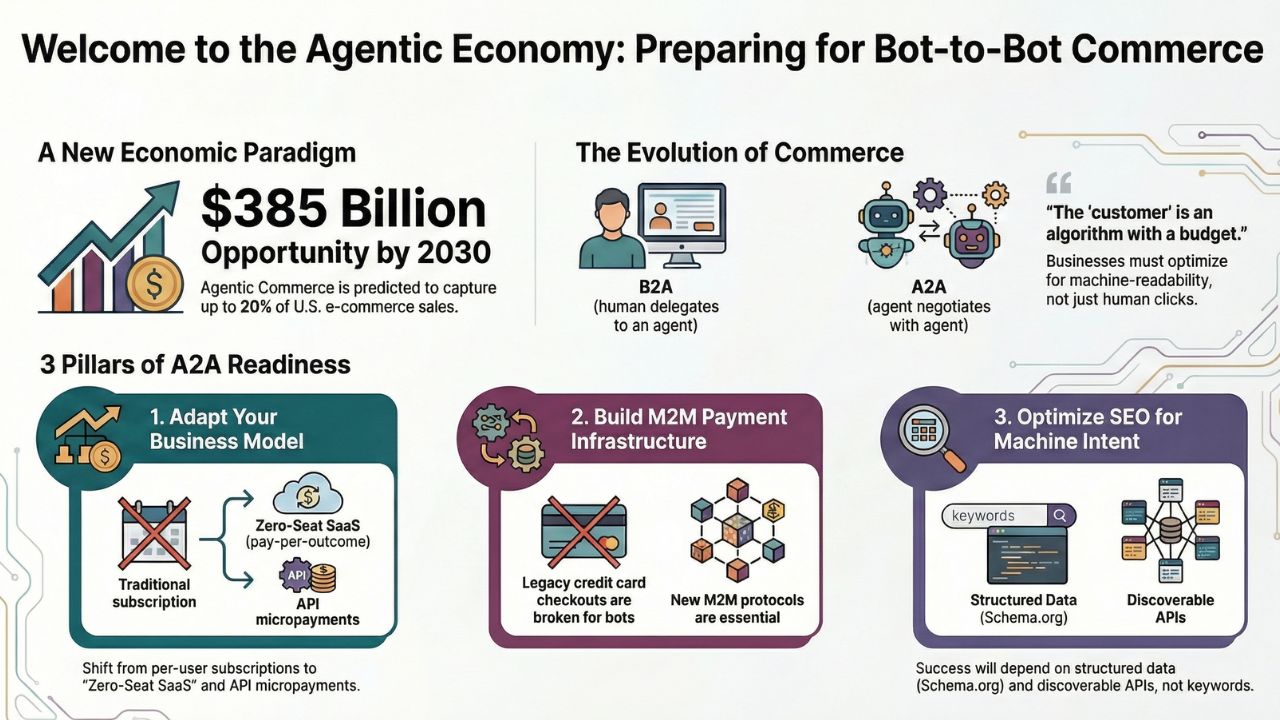
Morgan Stanley Research predicts that Agentic Commerce could capture **10% to 20% of U.S. e-commerce sales, totaling up to $385 billion by 2030.** This is not just a technology trend; it is a fundamental shift in how value is exchanged.
For visionary leaders, the question is no longer how to sell to humans, but how to enable your services and infrastructure to be discoverable, negotiated, and paid for by autonomous agents. This guide details the shift from human-centric business models to the **Agentic Economy**.
The New Commerce Architecture: B2A and A2A
The rise of agents creates two new commerce models:
B2A (Business-to-Agent)
This is the transitional phase. A human delegates a task to a personal AI shopping agent (e.g., "Buy me the most eco-friendly coffee maker under ₹5,000"). Your business sells to the human, but the interaction funnel is managed by the agent.
- Focus: Product optimization (pricing, availability) for agent consumption.
- Example: An airline exposes a flight booking API that a user's travel agent (bot) can query directly.
A2A (Agent-to-Agent) Commerce
The ultimate state of the Agentic Economy. An enterprise AI Procurement Agent communicates autonomously with a Vendor AI Sales Agent to negotiate an SLA, set a price, and execute the M2M payment, all within predefined parameters set by human executives.
- Focus: Automated procurement negotiation, real-time contract execution, and algorithmic commerce.
- Example: A car manufacturer's Inventory Agent sells surplus components to another company's Production Agent at a dynamically negotiated spot price.
Monetizing the Machine: Algorithmic Business Models
The shift to agents necessitates new revenue models:
1. Zero-Seat SaaS
Traditional SaaS bills per human user. In the Agentic Economy, businesses pay for **outcomes or workflows**, regardless of how many agents execute them. You pay per successful customer resolution, per data synthesis task, or per API call, not per employee license.
2. Pay-Per-Action APIs (Micropayments)
Agents will require small, specific services (e.g., retrieving a single data point, running a single complex calculation). Low-friction, machine-to-machine micropayments become essential for monetizing these granular services in real-time. This eliminates the need for monthly subscriptions for sporadic AI usage.
3. Agent Trust & Brokerage
The most valuable services will be **Agent Orchestrators**—the systems that manage and vouch for the reliability, security, and compliance of other agents. Businesses will pay brokerage fees to central agent marketplaces or trust providers to ensure their transactions are executed by verified, high-performance bots.
The Infrastructure: New M2M Payment Protocols
Credit cards and manual checkouts are fundamentally broken for bot commerce. Three emerging protocols are competing to become the standard for Machine-to-Machine (M2M) payments:
Agent Payments Protocol (AP2) - (Google, Mastercard, PayPal)
Focuses on **authorization and traceability**. AP2 uses cryptographically signed **Mandates**—digital contracts that verify a human user gave an agent the authority to spend money. This ensures accountability and auditability for agent-initiated transactions across different platforms.
Agentic Commerce Protocol (ACP) - (Stripe, OpenAI)
Focuses on **making existing checkouts agent-ready**. ACP provides a secure way for agents to interact with a merchant's e-commerce and payment infrastructure, facilitating purchases without exposing sensitive credentials. It supports physical goods and subscriptions.
x402 Protocol - (Coinbase, Cloudflare)
A decentralized protocol that leverages the long-reserved **HTTP 402 “Payment Required”** status code. It enables instantaneous, low-cost micropayments (often via stablecoins) directly over the HTTP layer, perfect for pay-per-use APIs and content access.
SEO for Agents: Optimizing for Machine Intent
Your future digital marketing team must shift focus from human click-through-rate (CTR) to **Agent Query Response (AQR)**.
The 3 Pillars of Agentic SEO
- Machine-Readable Data: Stop relying on unstructured HTML. Implement robust, nested Schema.org markup for every product, service, and policy. Agents can read Schema instantly, unlike scraping HTML.
- API Discoverability (Model Context Protocol - MCP): Expose your business logic (inventory, pricing, returns policy) not just as documentation, but as a structured, discoverable API payload that can be ingested directly by LLMs.
- Agentic Trust Signals: Agents prioritize reliability, security, and cost-efficiency. Publish transparent data on your uptime, compliance (like DPDP), carbon footprint, and real-time pricing to win the algorithmic negotiation.
Conclusion: SEO is becoming less about keywords and more about the structured quality of your underlying data and API layer.
Frequently Asked Questions (FAQ)
A: A2A or Agent-to-Agent Commerce is an emerging business model where one autonomous AI agent transacts, negotiates, and coordinates services directly with another autonomous AI agent without human intervention. This is the foundation of the Agentic Economy.
A: Traditional SEO targets human clicks. SEO for AI Agents requires optimizing your website and APIs for machine-readability. This means providing structured data (Schema.org), exposing data via the Model Context Protocol (MCP), and ensuring your APIs are easily discoverable and queryable by LLMs.
A: Three emerging protocols are: ACP (Agentic Commerce Protocol from Stripe/OpenAI) for agent-ready checkouts; AP2 (Agent Payments Protocol from Google) for authorization using cryptographically signed Mandates; and x402, a standard using the HTTP 402 code for real-time, low-friction micropayments.
