The Claude Code vs Cursor vs Codex Matrix Vendors Hide
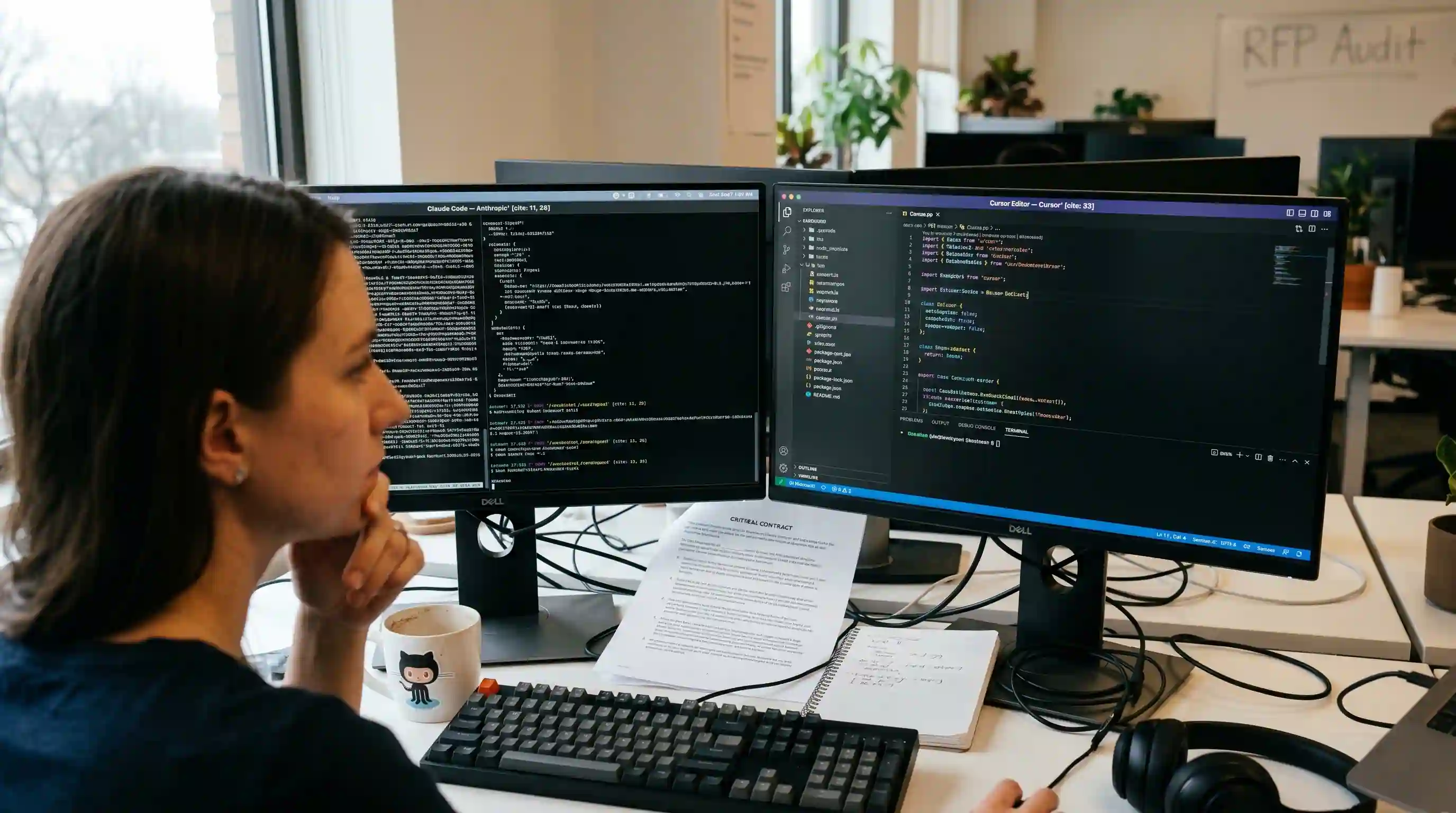
- The Cherry-Picking Problem: Anthropic, OpenAI, and Cursor strategically highlight different benchmarks, making direct comparisons impossible without a unified matrix.
- Diff-Edit Leadership: Claude (via Opus) continues to dominate pure syntax editing and issue resolution on Aider Polyglot and SWE-Bench Pro.
- Terminal Dominance: GPT-5 Codex holds a distinct leadership position on Terminal-Bench 2.0 for multi-tool shell execution.
- The Scaffolding Illusion: Cursor's perceived superiority often stems from its highly optimized IDE workflow scaffolding rather than underlying base-model dominance.
- The Tiebreaker: Factoring in the cost-per-correct-edit ($/Aider) completely re-ranks this matrix for enterprise-scale workloads.
Vendors are showing you partial scorecards. Our verified 2026 matrix strips away the cherry-picking to reveal the definitive head-to-head performance of Claude Code, Cursor, and Codex across all six major benchmarks.
By selectively citing only the tests their specific agent scaffolding was optimized for, AI vendors are creating a massive procurement blind spot. To make an enterprise-grade decision, software leaders must look beyond the marketed capabilities and consult the complete AI coding benchmarks decoded hub.
We have decoded the exact performance matrix your sales rep is desperately trying to hide, overlaying raw model fidelity against agentic execution and actual token cost.
Vendor Benchmark Cherry-Picking Exposed
When evaluating a coding agent head-to-head benchmark, the first rule of procurement is understanding what metric is being omitted.
Anthropic naturally leans heavily on SWE-Bench Pro and Aider Polyglot. OpenAI's Codex documentation will frequently push multi-tool benchmarks where their native execution environment shines.
Meanwhile, Cursor points to user-acceptance testing and holistic workflow speeds. This deliberate fragmentation creates an environment where every vendor can claim to be the undisputed market leader.
Without an ide coding agent score matrix, engineering directors end up paying premium enterprise license fees for capabilities that do not map to their specific internal toolchains.
The Agent Scaffolding Comparison
You are rarely buying a raw base model; you are buying the agent scaffolding wrapped around it. This scaffolding includes planning loops, automated file-system navigation, and self-critique mechanisms.
A sophisticated wrapper can artificially inflate a base model's score by up to 22 points on evaluations like SWE-Bench. When comparing these three giants, Cursor’s massive advantage lies almost entirely in its bespoke IDE scaffolding.
If you strip that away and test the raw API endpoints, the playing field levels dramatically, shifting the advantage back to Claude and Codex depending on the task type.
The IDE Coding Agent Score Matrix
To build a defensible enterprise coding agent rfp, you must measure these three tools against the exact same yardstick. We break down the frontier models across three distinct capability silos.
Claude Code: The Diff-Edit Specialist
When tested in a closed-book environment without heavy operational scaffolding, Claude Opus is the undisputed leader in edit-format fidelity.
On the Aider Polyglot benchmark, which tests raw syntax modification across six enterprise languages, Claude consistently preserves intent and passes the test suite.
For backend teams patching complex legacy systems where syntactic precision is critical, Claude holds the highest weight in our capability matrix.
Cursor: The Workflow Orchestrator
Cursor is not a standalone base model; it is an orchestrator that leverages models like Claude 3.5 Sonnet or GPT-4o. Its high perceived performance comes from its deep integration into the developer workflow.
While it may not uniquely lead a raw base-model benchmark, its agentic loops provide an exceptional user experience in the IDE. However, to understand the commercial implications of this orchestration layer, you must review the underlying token expenditure before authorizing a site-wide deployment.
Codex: The Terminal-Bench 2.0 Leader
Code generation is only half the battle. A true autonomous agent must be able to navigate a shell environment. This is where GPT-5 Codex separates itself.
It currently leads the Terminal-Bench 2.0 leaderboard, proving its superiority in multi-tool sequences. If your platform engineering team requires an agent to install dependencies, debug build failures natively, and orchestrate CI/CD pipelines, Codex provides the most robust shell-execution baseline.
Enterprise Coding Agent RFP: The $/Aider Tiebreaker
Capability metrics are meaningless without an operational financial overlay. The ultimate tiebreaker in this head-to-head matrix is the $/Aider metric.
A highly capable model that burns millions of tokens stuck in an infinite retry loop is financially unviable for enterprise-scale workloads. By demanding cost-per-edit reporting alongside your baseline accuracy metrics, you protect your FinOps budget.
Ensure your procurement team mandates these exact matrix disclosures using the standard procurement framework before a single contract is signed.

Frequently Asked Questions (FAQ)
There is no universal winner. Claude Code excels at complex diff-editing and issue resolution. Codex dominates terminal execution and multi-tool shell tasks. Cursor provides superior developer experience via IDE scaffolding. The "best" choice depends entirely on your team's specific workflow requirements.
A procurement-defensible matrix must include a weighted portfolio: Aider Polyglot for raw edit fidelity, SWE-Bench Pro for agentic issue resolution, Terminal-Bench 2.0 for shell execution, and LiveCodeBench to control for training data contamination.
As of May 2026, the underlying Claude Opus model leads the Aider Polyglot diff-edit split, demonstrating superior capabilities in producing syntactically valid, intent-preserving code edits across multiple enterprise programming languages.
Claude Opus currently holds the leadership position on the rigorously audited SWE-Bench Pro split. Because SWE-Bench evaluates agentic systems rather than pure models, Cursor can also post highly competitive scores when wrapping frontier models in its bespoke scaffolding.
Cost efficiency fluctuates based on API pricing and token optimization. However, models optimized to resolve issues on the first attempt without falling into expensive, multi-step retry loops consistently achieve the lowest $/Aider, heavily penalizing inefficient agent scaffolding.
No. Claude Code relies on Anthropic's proprietary models (like Opus or Sonnet). Codex utilizes OpenAI's proprietary architecture. Cursor, however, is an IDE orchestrator that allows users to toggle between different underlying foundational models, including those from Anthropic and OpenAI.
As of May 2026, GPT-5 Codex leads the Terminal-Bench 2.0 leaderboard. It outperforms its competitors in natively executing multi-step shell tasks, configuring environments, and debugging build failures without relying on a graphical IDE interface.
Agent scaffolding—adding planning, self-critique, and file-system access—can artificially inflate a base model's score by 8 to 22 points. This means a tool like Cursor might outscore a raw API endpoint, even if the underlying base model is less capable.
The cheapest agent is determined by the multi-benchmark frontier rank normalized by cost per correct edit. A highly accurate model with a slightly higher token cost is often cheaper at scale because it avoids the massive token burn associated with continuous scaffolding retry loops.
Anthropic typically highlights SWE-Bench Pro and Aider Polyglot to showcase reasoning and edit fidelity. OpenAI frequently emphasizes terminal and multi-tool evaluations where Codex excels. Cursor relies on holistic developer productivity surveys and customized internal workflow evaluations to highlight its IDE superiority.