The AI Coding Benchmarks 2026 Vendors Won't Show You
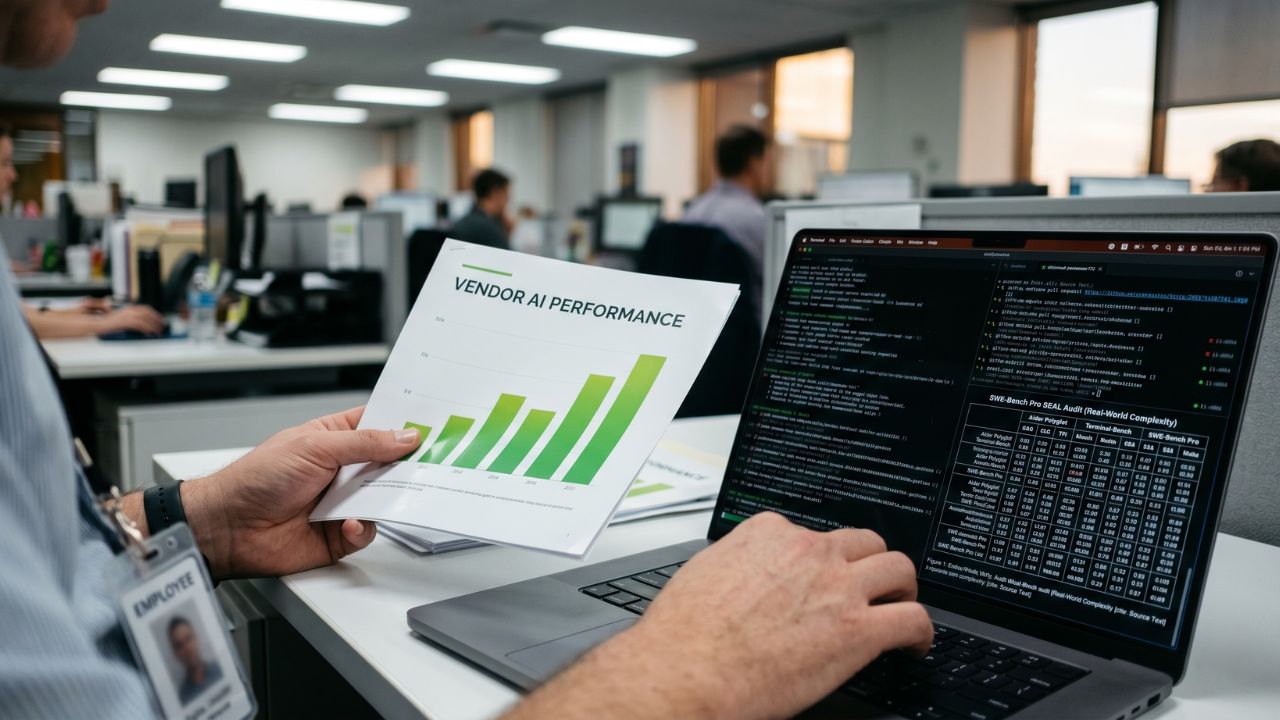
- The Core Issue: Vendor benchmarks lie.
- The Risk: Relying on them creates a 30-point procurement gap.
- The Pillars of Truth: The real 2026 leaderboard depends on Aider, SWE-Bench, and Terminal-Bench.
- The Strategy: Shift focus from base-model marketing to verified, agentic performance to secure your ROI.
Enterprise procurement teams are pouring millions into AI coding agents based on vendor-supplied metrics that completely misrepresent production capabilities. This reliance on curated marketing data creates a massive, hidden 30-point procurement gap that sabotages engineering ROI before deployment even begins.
This guide cuts through the noise to reveal the real AI coding benchmarks leaderboard 2026—exposing the unvarnished truth across Aider, SWE-Bench, and Terminal-Bench.
The Information Gain: Why Standard Benchmarks Fail the Enterprise
For years, Agile Leaders and PMO Directors have been handed neat, optimistic charts by AI sales teams. The reality is far more complex.
Standard benchmarks often measure base-model capability in sterile, isolated environments. However, real-world software engineering requires autonomous, agentic reasoning. When an AI model interacts with a massive, undocumented enterprise codebase, its standard benchmark score becomes irrelevant.
The true test is how the model performs within a sophisticated scaffold, executing multi-step operations and navigating dependency hell.
The Big Three: 2026's Procurement-Grade Leaderboards
To make informed, high-stakes decisions, enterprise teams must rely on the benchmarks that vendors actively try to avoid.
Aider Polyglot Deep-Dive
The Aider Polyglot test is the multilingual reality check that engineering directors need. It strips away the biases of single-language evaluations and forces models to prove their worth across diverse ecosystems. If your stack isn't just standard Python, this is the benchmark that dictates your true cost-per-edit efficiency.
SWE-Bench Verified vs SWE-Bench Pro
There is a profound difference between the standard Verified metrics and the rigorous SWE-Bench Pro. SWE-Bench Pro is the gold standard for agentic capability, testing how well a model can autonomously resolve real GitHub issues. This is where the illusion of baseline intelligence shatters, revealing which systems can actually navigate complex pull requests.
Terminal-Bench 2.0
The terminal is the heart of DevOps, and Terminal-Bench 2.0 measures exactly how well an AI can control it. Code generation is only half the battle; if your AI cannot accurately execute shell commands and handle environment configurations, your automation pipeline will stall. Terminal-Bench separates the coding assistants from true, autonomous DevOps agents.
The Contamination Crisis: Guarding Your Architecture
Perhaps the biggest secret in the 2026 AI landscape is training data leakage. Many impressive benchmark scores are the result of models accidentally (or intentionally) memorizing the test answers during their training phase.
Procurement teams must demand contamination-resistant scores. Evaluating an AI on memorized GitHub repositories is like giving a developer an open-book test for a closed-system problem; the results will inherently misrepresent their problem-solving agility.

Frequently Asked Questions (FAQ)
The most reliable benchmarks in 2026 move beyond simple code completion. The real AI coding benchmarks leaderboard 2026 relies on rigorous, agentic evaluations like Aider, SWE-Bench, and Terminal-Bench.
Leadership depends heavily on the specific test, which is why vendor benchmarks lie. No single model universally dominates; rather, different systems excel in specialized areas like Aider Polyglot, SWE-Bench Pro, or Terminal-Bench 2.0.
Benchmarks disagree because they measure fundamentally different capabilities. Some evaluate isolated base-model logic, while others, like SWE-Bench, measure complex agent-system execution and real-world issue resolution across entirely different scaffolding environments.
Aider Polyglot focuses on multilingual code editing and generation across diverse languages. In contrast, SWE-Bench Verified focuses on resolving complex, real-world GitHub issues, requiring deep codebase navigation and autonomous problem-solving capabilities.
Base-model scores reflect the raw intelligence of the LLM in isolation. Agent-system scores evaluate how that model performs when embedded in a specialized framework (scaffold) designed to execute multi-step tools, shell commands, and continuous reasoning.
Yes, training data leakage is a massive issue. Many models have inadvertently ingested the very GitHub repositories used for testing, artificially inflating their scores. Procurement teams must rely on contamination-resistant evaluations.
Procurement teams should trust a composite view of agentic benchmarks. Relying solely on Aider, SWE-Bench, and Terminal-Bench exposes a 30-point procurement gap, giving a much more accurate forecast of enterprise ROI.
Leaderboards are highly volatile and change frequently as new models and specialized agent scaffolds are released. Continuous auditing is required, as a model that dominates in Q1 may fall behind by Q3 due to new evaluation methodologies.
Terminal-Bench 2.0 evaluates an AI's ability to accurately execute shell commands and navigate the terminal. It matters for enterprises because it measures the true DevOps automation capability required for autonomous infrastructure management.
Yes, robust open-source models are increasingly competitive, especially when paired with powerful agentic scaffolds. Their viability heavily depends on the specific benchmark and the exact enterprise use case being evaluated.