Outcome-Based Agile Economics: Why Your CFO Still Hates Your Velocity (And How Outcome Based Pricing for Agile Services Fixes It)
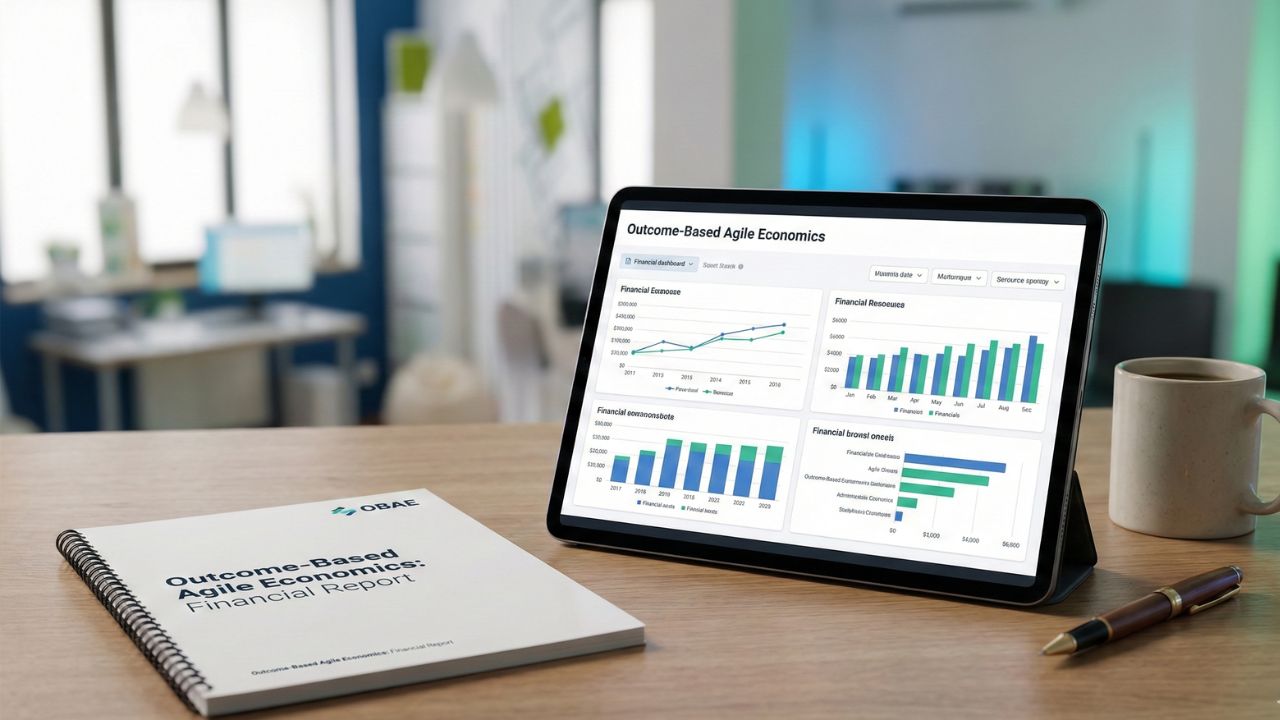
- Organizations must kill the FTE model.
- Leaders need to learn the 2026 framework for outcome-based agile economics to align your transformation with the CFO’s high-stakes KPIs.
- It is crucial to shift focus toward measuring agile business value realization rather than story point output.
- The death of the FTE billing model forces a shift toward prioritizing features based on the cost of delay vs agile ROI 2026.
- Enterprise agility now demands the implementation of value stream based funding models.
If your engineering teams are celebrating record-high velocity while your finance department questions the ROI, you have a severe economic disconnect. To bridge the gap between engineering output and financial impact, modern leaders must embrace outcome based pricing for agile services. This deep dive is part of our extensive guide on agile transformation.
Kill the FTE model. Learn the 2026 framework for outcome-based agile economics to align your transformation with the CFO’s high-stakes KPIs. Transitioning to these models is no longer optional for enterprises looking to scale effectively in an AI-accelerated market.
The Death of the FTE Billing Model
The traditional approach of billing by hours or headcount is rapidly becoming obsolete. The death of the FTE billing model is inevitable as AI dramatically alters developer productivity. When you are managing hybrid human-AI agile teams, traditional velocity metrics completely break down because AI accelerates code output exponentially.
You can no longer equate "time spent" with "value delivered." Instead, contracts and internal budgets must pivot. They must reflect the tangible business impact generated by the release, regardless of how many hours a human or AI agent took to build it.
Aligning Agile with the Financial Core
Financial alignment is essential for true business agility beyond software engineering. When embarking on an agile transformation for non-tech teams, such as Finance and Legal, bridging the language gap is critical.
Finance cares about capitalized vs expensed Agile, ROI, and EBITDA—not burn-down charts. To secure long-term buy-in, Agile practitioners must translate their progress into terms that resonate with the boardroom.
Measuring Agile Business Value Realization
Stop reporting team velocity to the C-suite. Instead, focus strictly on measuring agile business value realization. Velocity is a capacity metric for the team, not a financial metric for the business. True value realization happens when working software measurably increases revenue, reduces costs, or mitigates risk.
Understanding Cost of Delay vs Agile ROI 2026
Prioritization must shift from "what is easy to build" to what costs the most if left unbuilt. Mastering this trade-off is the hallmark of modern product management:
- Cost of Delay: This metric calculates the financial impact of postponing a feature release.
- Agile ROI: Weighing the cost of delay vs agile ROI 2026 ensures teams tackle high-value, high-risk items first.
- Financial Flow: This creates a direct line of sight between sprint planning and the company's bottom line.
Implementing Value Stream Based Funding Models
To fully escape the project-funding trap, organizations must adopt value stream based funding models. Instead of funding isolated projects with fixed scopes, finance provides a stable budget to a persistent value stream.
The Agile team then has the autonomy to pivot and allocate that budget toward the highest-value features. This eliminates the massive overhead of annual project budget approvals and allows the organization to pivot financially as fast as it pivots technically.

Frequently Asked Questions (FAQ)
How is outcome-based pricing different from T&M in Agile?
Time and Materials (T&M) bills for the hours worked, regardless of product success. Outcome-based pricing ties compensation or funding directly to achieving specific business goals, shifting the focus to value creation.
Why is the FTE billing model failing for AI-enabled GCCs?
Because AI automates routine coding, the time required to complete tasks drops drastically. Billing by the Full-Time Equivalent (FTE) penalizes AI-enabled Global Capability Centers (GCCs) for their increased efficiency.
How do you calculate the "Cost of Delay" for a feature?
Calculate the estimated weekly revenue, cost savings, or risk mitigation the feature will generate. The sum of this lost potential value over the delay period is your Cost of Delay.
What is value stream–based funding and how does it work?
It is a model where budgets are allocated to long-lived product lines (value streams) rather than temporary projects. This allows Agile teams to continuously prioritize work without requesting new project budgets.
How to report business value realization instead of team velocity?
Replace story point burn-downs in executive reports with metrics like customer acquisition cost reduction, feature adoption rates, and direct revenue generated by the latest sprint release.
What are the best KPIs for measuring Agile ROI in 2026?
Top KPIs include Value Realization Rate, Time-to-Market, Cost of Delay, and Customer Net Promoter Score (NPS), moving away from internal output metrics.
Conclusion
The evolution of delivery frameworks demands an evolution in financial modeling. Transitioning to outcome based pricing for agile services is no longer optional for enterprises looking to scale effectively. By killing the FTE model, understanding the cost of delay, and adopting value stream funding, you can finally speak a language your CFO respects. Stop selling hours, and start engineering business outcomes.
Sources & References
- Internal Pillar: Agile Transformation Guide
- Internal Link: The Cognitive Squad: Managing Hybrid Human-AI Teams
- Internal Link: Agile for Non-Tech: Scaling Agility to Finance, HR & Legal
- External Reference: Harvard Business Review - "The Shift to Outcome-Based Contracting in Tech" (2025)
- External Reference: McKinsey & Company - "Value Stream Funding: The Key to Enterprise Agility" (2024)