Beyond the Buzzwords: Choosing the Right Agile Transformation Model
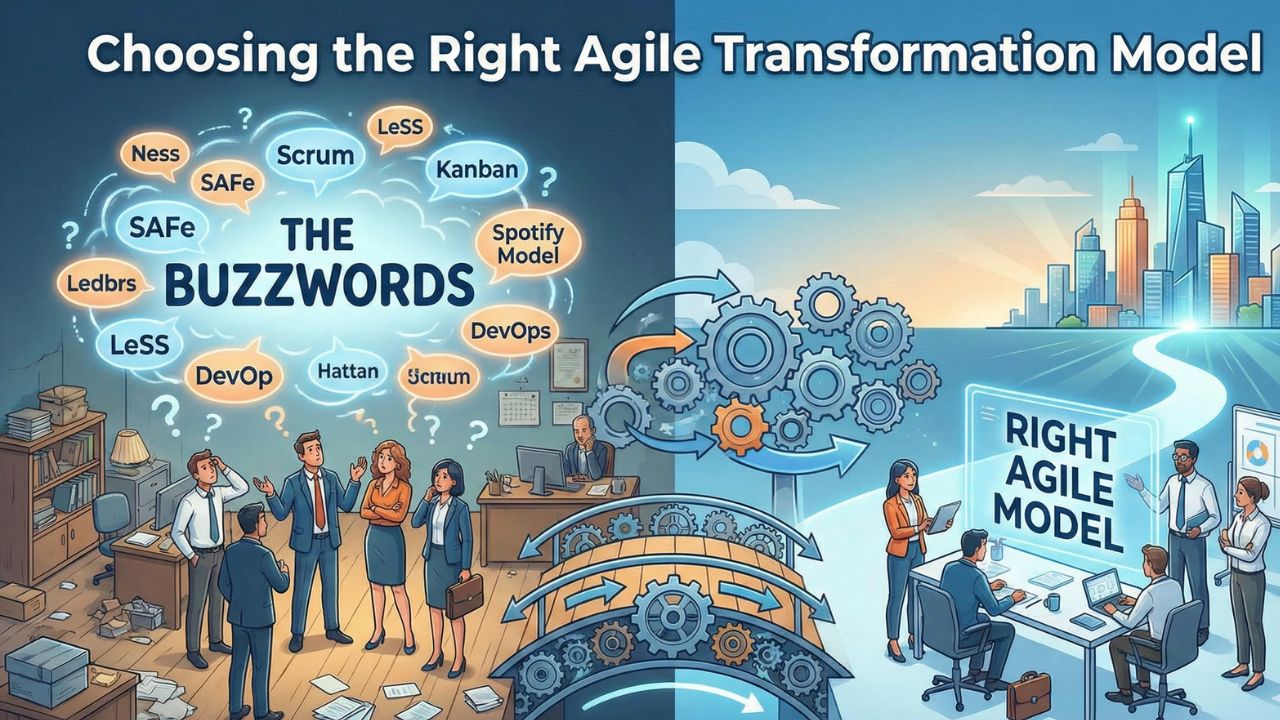
In the boardrooms of IT service companies, "Agile Transformation" often becomes a game of buzzword bingo. Leaders toss around terms like "SAFe," "Scrum," "Kanban," and "Spotify Model" without addressing the underlying engine of change.
The truth is, selecting a methodology (like Scrum) is easy. Selecting a Change Framework to get people to actually use Scrum is hard. One size does not fit all. A strategy that works for a startup will crush a legacy consulting firm.
Based on our experience transforming large enterprises, we break down the three most effective models for different stages of your journey: Kotter for urgency, Knoster for troubleshooting, and Rogers' Curve for timing.
1. Kotter's 8 Steps: The "Rocket Fuel" for Launch
Best For: Creating urgency and breaking inertia at the very beginning (Day 0-90).
John Kotter’s model is not about "Agile"; it is about "Movement." Most organizations are frozen in their old ways. Kotter’s first step, Create a Sense of Urgency, is critical.
If your teams are comfortable with Waterfall and see no reason to change, you need Kotter. It forces leadership to articulate a "Big Opportunity" (or a big threat) that makes the status quo dangerous. Without this spark, no amount of Jira training will save you.
2. The Knoster Model: The "Diagnostic Tool" for Chaos
Best For: Troubleshooting mid-transformation when things go wrong.
Six months in, your transformation might feel "weird." People are arguing, deadlines are slipping, or morale is low. The Knoster Model helps you diagnose the root cause by looking at the symptoms.
It breaks change down into five variables: Vision, Skills, Incentives, Resources, and Action Plan. If one is missing, you get a specific negative outcome:
- Confusion? You are missing Vision.
- Anxiety? You are missing Skills.
- Resistance? You are missing Incentives.
- Frustration? You are missing Resources.
- False Starts? You are missing an Action Plan.
This grid is your debugging tool. If your developers are anxious, stop pushing them to "work harder" and start training them (Skills). If they are resisting, check their bonus structure (Incentives).
3. Rogers' Curve: The "Timing Belt" for Rollout
Best For: Deciding who goes next during scaling.
A fatal mistake is forcing Agile on everyone at once (the "Big Bang" approach). Rogers' Diffusion of Innovations Curve teaches us that populations accept change at different rates.
Start with the Innovators and Early Adopters (the first ~16%). These are your pilot teams. They forgive mistakes and provide feedback. Do NOT try to convert the Laggards in Phase 1. They will sabotage the pilot. Wait until you have social proof from the Early Adopters before engaging the majority.
The Cheat Sheet: Which Model Should You Use?
Use this decision table to guide your strategy meetings.
| Scenario | Recommended Model | Why? |
|---|---|---|
| "Nobody thinks we need to change." | Kotter's 8 Steps | Focuses entirely on building Urgency and a Guiding Coalition. |
| "People are scared/angry/confused." | Knoster Model | Diagnoses the missing element (Skills, Incentives, Vision) causing the emotion. |
| "We have 50 teams. Who goes first?" | Rogers' Curve | Helps identify Early Adopters for pilots vs. Laggards to avoid. |
| "We need to change behavior/habits." | ADKAR | Focuses on the individual's journey (Awareness -> Ability). |
Connecting the Dots
Once you have selected your strategy, you need to address the human psychology behind it. Understand why individuals resist even the best strategies in our deep dive on ADKAR.
Read Next: The Psychology of Change (ADKAR) Learn how to manage the "People Side" of your transformation.FAQ: Choosing Your Framework
A: Kotter is best used at the very beginning of a transformation (Day 0) to create a "Sense of Urgency" and break through organizational inertia.
A: The Knoster Model is a troubleshooting tool. It helps leaders diagnose why a transformation is stalling by correlating symptoms (like Anxiety or Resistance) with missing elements (like Skills or Incentives).
A: No. According to Rogers' Curve, you should target the "Innovators" and "Early Adopters" first (about 16% of the org) to build momentum before engaging the "Late Majority".
A: Absolutely. Successful Strategy Leads often use Kotter for the launch, Rogers for the rollout plan, and Knoster for daily troubleshooting.
