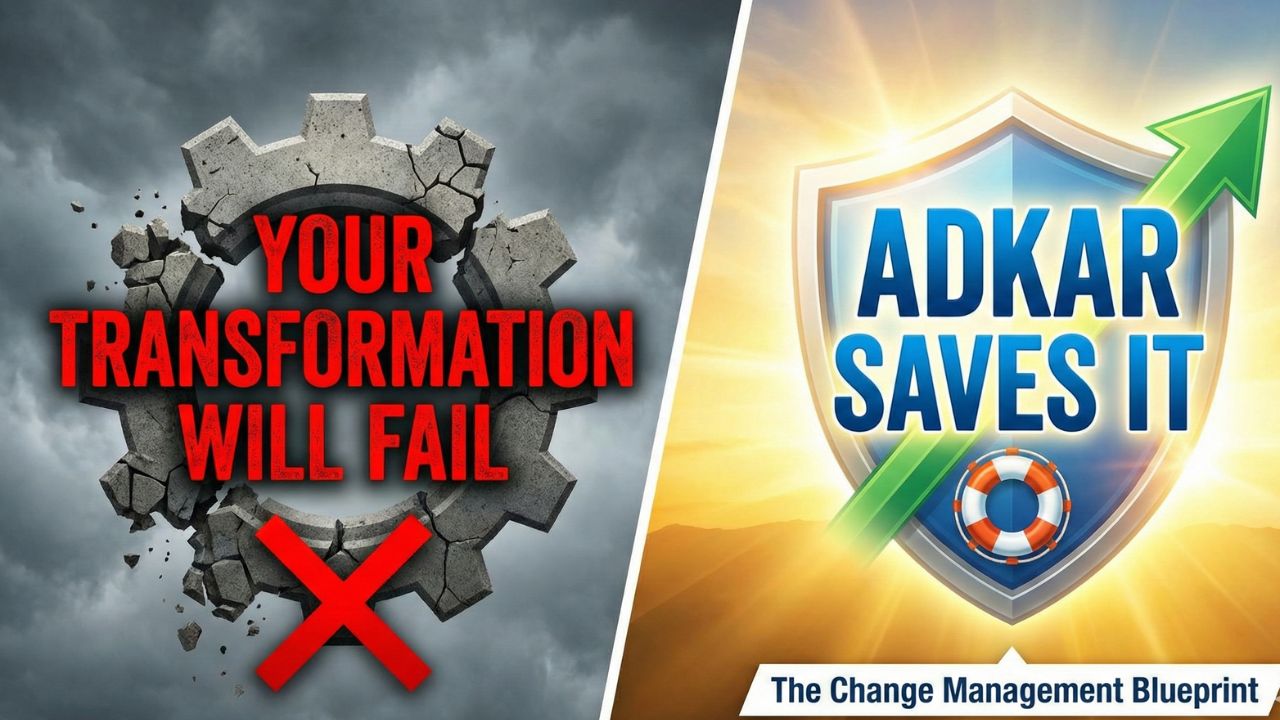
Why Your Agile Transformation Will Fail (And How ADKAR Saves It)
We have all seen the movie before. It starts with a flashy "Agile Kickoff." There is cake.
There are inspirational posters about "Synergy" and "Velocity." A high-priced consultant runs a two-day Scrum Master certification workshop. Everyone passes the quiz. Then, Monday morning arrives.
The team goes back to their desks. The "Daily Stand-up" turns into a 45-minute status report. The "Retrospective" becomes a blame game. And the Product Owner, under pressure from a client, demands a fixed scope by a fixed date.
Within three months, people say, "We tried Agile, but it doesn't work for our industry."
This isn't an Agile failure. It’s a people failure. Specifically, it is a failure to manage the psychology of change.
At most organizations, we focus 90% of our budget on Knowledge (training), while completely ignoring the other four elements required for human change. Enter the ADKAR Model. If you are about to start this journey, this is your roadmap to avoiding the "certification trap."
What is ADKAR? (The Agile Lens)
Developed by Jeff Hiatt (Prosci), ADKAR is a goal-oriented change management model. It stands for Awareness, Desire, Knowledge, Ability, and Reinforcement.
Here is how it plays out in the real world of an Agile transformation.
1. Awareness: "Why are we doing this?"
The Trap: Management sends an email saying, "We are moving to Scrum effective June 1st."
The Reality: Employees think, "Great, another flavor of the month. If I keep my head down, this too shall pass."
The Fix: You must articulate the business risk of not changing.
Heads-up: Expect skepticism. Your first job isn't to teach Scrum; it's to sell the problem.
2. Desire: "What's in it for me? (WIIFM)"
The Trap: Assuming everyone wants to change.
The Reality:
- Developers fear endless meetings.
- Middle Managers fear losing control (and their jobs).
- Testers fear being squeezed at the end of the sprint.
The Fix: Address the personal wins.
To Devs: "Agile protects you from the CEO tapping you on the shoulder to interrupt your code. The Sprint is your protected zone."
To Managers: "You stop being a babysitter chasing status updates and become a strategic leader removing roadblocks."
3. Knowledge: "How do we do it?"
The Trap: The "Sheep-Dip" Approach (dunking everyone in the same 2-day training).
The Reality: A Junior Developer needs different skills (TDD, Pair Programming) than a Sales VP (Agile Contracts, Fixed-Cost/Variable-Scope).
The Fix: Targeted, role-based learning. Don't teach the mechanics of a User Story to someone who just needs to read a Burndown Chart.
4. Ability: "Can I actually do this on Tuesday?"
The Trap: Confusing Knowledge with Ability.
Knowledge: I know the theory of riding a bicycle.
Ability: I can ride a bicycle in traffic without crashing.
The Reality: This is where the "Valley of Despair" happens. When you first start Agile, productivity will drop. The team is "wobbling."
The Fix: This is the most dangerous phase. Leadership must provide Shadow Coaches—someone to run alongside the bike. And critically, leadership must give permission to fail. If you punish the dip, teams will revert to Waterfall immediately.
5. Reinforcement: "Will it stick?"
The Trap: The consultants leave, and "muscle memory" takes over.
The Reality: If HR still promotes people for being "Individual Heroes," nobody will collaborate. If the Annual Bonus is based on individual code output, Pair Programming will die.
The Fix: You must rewire the organization's DNA. Update career ladders. Change the bonus structure to reward Team Velocity over Individual Utilization. Celebrate the wins publicly.
Heads-Up: The Emotional Rollercoaster
If you are reading this and preparing to launch a transformation, here is what you need to know:
- It will feel messy. The first 3 Sprints will feel chaotic. You are breaking old habits. That is uncomfortable.
- You will lose people. Some "rockstar" developers who refuse to collaborate may leave. This is painful, but often necessary for culture growth.
- It takes time. You cannot "install" Agile in Q1. You can plant the seeds, but the harvest takes seasons.
FAQ: Common Questions from the Trenches
A: No. If people don't know why they are changing, they will treat training as a vacation from work. Awareness is the anchor.
A: Speak their language: Money and Risk. Don't talk about "Story Points." Talk about "Faster Time to Revenue" and "Early Risk Reduction."
A: Check your Reinforcement. Are you still demanding Gantt charts and fixed-date commitments? If the system punishes Agile behavior, the behavior will stop.
A: No. Every single person goes through their own ADKAR journey at their own speed. Your Lead Architect might be stuck at Desire while your Juniors are already at Ability.

Sources & References
- Prosci ADKAR® Model: Hiatt, J. (2006). ADKAR: A Model for Change in Business, Government and our Community.
- Learning Center Publications.
- The Satir Change Model: Virginia Satir et al. (Used to explain the J-Curve of productivity).
- State of Agile Report: Digital.ai (Annual statistics on why transformations fail—often citing "Culture" as the #1 blocker).