The Leadership Guide to Agile: Risk, ROI, and Speed
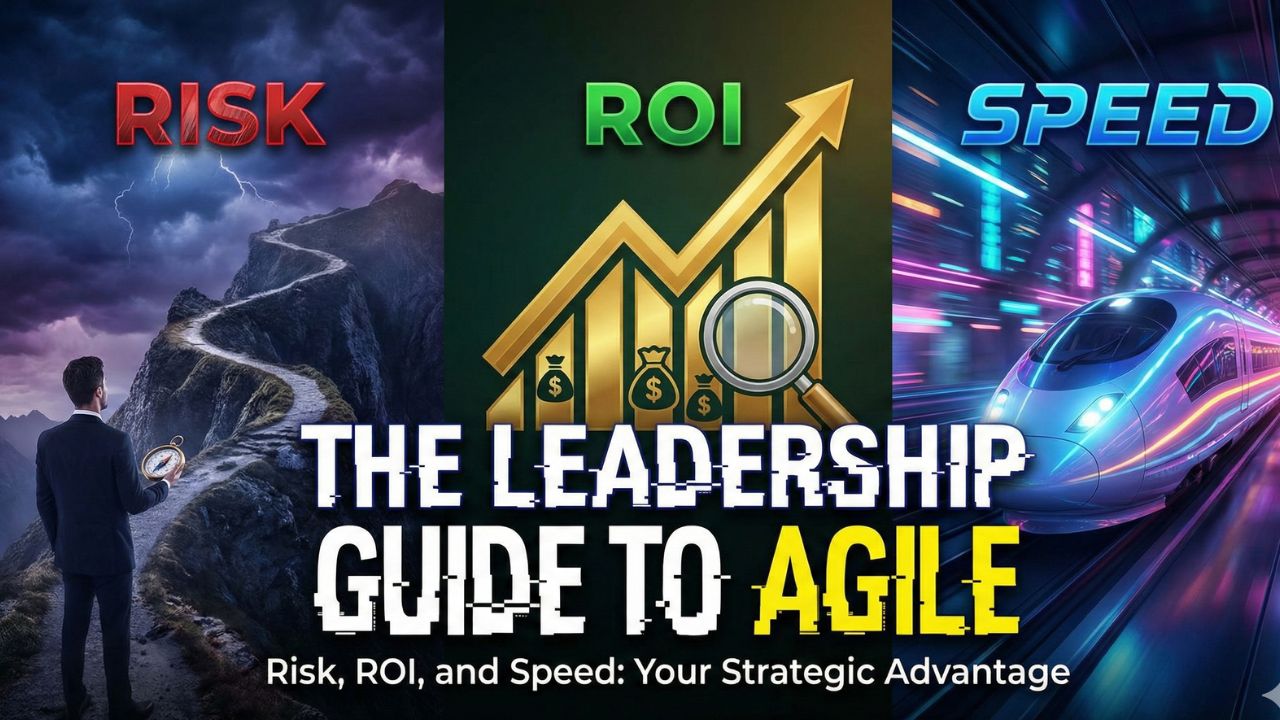
Agile is often sold to executives as a way to "code faster." This is a mistake. Agile is not a developer productivity hack; it is a corporate risk management strategy.
For the C-Suite, the conversation shouldn't be about "Daily Stand-ups" or "Jira tickets." It should be about Market Response Time. In a world where competitors deploy updates weekly, a 9-month Waterfall cycle is not just slow—it is an existential liability. This guide translates Agile into the language of the boardroom: Money, Risk, and ROI.
1. The Business Case: Why Change Now?
The "Cost of Delay" is the invisible killer of IT service companies. Every week a finished feature sits in a QA queue or waits for approval is a week it is not generating revenue.
The Agile Value Proposition:
- Early Revenue Realization: Instead of waiting 12 months for a "Big Bang" release, you release a Minimum Viable Product (MVP) in month 3. You start earning 9 months earlier.
- Killing Bad Ideas Cheaply: In Waterfall, you spend $2M to find out customers don't want the product. In Agile, you spend $200k to find that out. You just saved $1.8M.
- Quality as a Feature: By testing continuously (CI/CD), you reduce the "Technical Debt" that eventually grinds innovation to a halt.
2. The Risk Profile: Waterfall vs. Agile
Many leaders fear that Agile means "loss of control" because there is no fixed Gantt chart. In reality, Waterfall provides the illusion of control.
| Risk Factor | Waterfall Approach | Agile Approach |
|---|---|---|
| Scope Risk | High. You define everything upfront when you know the least about the problem. | Low. You adjust scope every 2 weeks based on reality. |
| Delivery Risk | "Big Bang" at the end. If it breaks, everything breaks. | Incremental. If it breaks, only the last 2 weeks of work are at risk. |
| Market Risk | You build what the market wanted 12 months ago. | You build what the market wants today. |
3. The Dashboard: Metrics That Actually Matter
Stop asking your teams for "Velocity." Velocity is a capacity planning tool, not a performance metric. If you incentivize velocity, teams will just inflate their estimates.
The Executive Dashboard should track:
- Lead Time: How long does it take from "Customer Request" to "Live in Production"? (Target: Days, not Months)
- Cycle Time: How long does work sit in the "In Progress" column? (Indicates process efficiency)
- Change Failure Rate: What percentage of releases cause an outage? (Indicates stability)
- Employee Net Promoter Score (eNPS): Are your best engineers burning out?
4. The Asset: Agile Maturity Assessment
Where does your organization stand? Use this quick checklist to grade your maturity.
Level 2 (Process Agile): We deploy monthly, but business stakeholders are not involved until the end.
Level 3 (Business Agility): Business strategy changes based on feedback from the last Sprint. Funding is dynamic, not annual fixed-budget.
The Strategic Pivot
Moving from Level 1 to Level 3 requires more than training; it requires a roadmap. Review the implementation steps to see how to guide your teams through this evolution.
Review the Roadmap: From Chaos to Clarity See the 4-phase execution plan for your teams.FAQ: The C-Suite Questions
The primary ROI of Agile is "Cost of Delay" reduction. By delivering value in 2-week sprints rather than 9-month cycles, organizations can monetize features earlier and kill bad ideas before they consume the entire budget.
Velocity is a planning tool for teams, not a productivity metric for leaders. Comparing velocity across teams leads to "Story Point Inflation." Leaders should track Lead Time and Cycle Time instead.
No, it reduces it. In Waterfall, risk is realized at the end of the project (the Big Bang release). In Agile, risk is distributed in small increments. If a sprint fails, you lose 2 weeks of work, not 2 years.
The cost includes training, coaching, and a temporary productivity dip (the J-Curve). However, the cost of NOT transforming is often higher due to lost market share and slow adaptation to competitor moves.
