From Chaos to Clarity: A 4-Phase Agile Implementation Roadmap
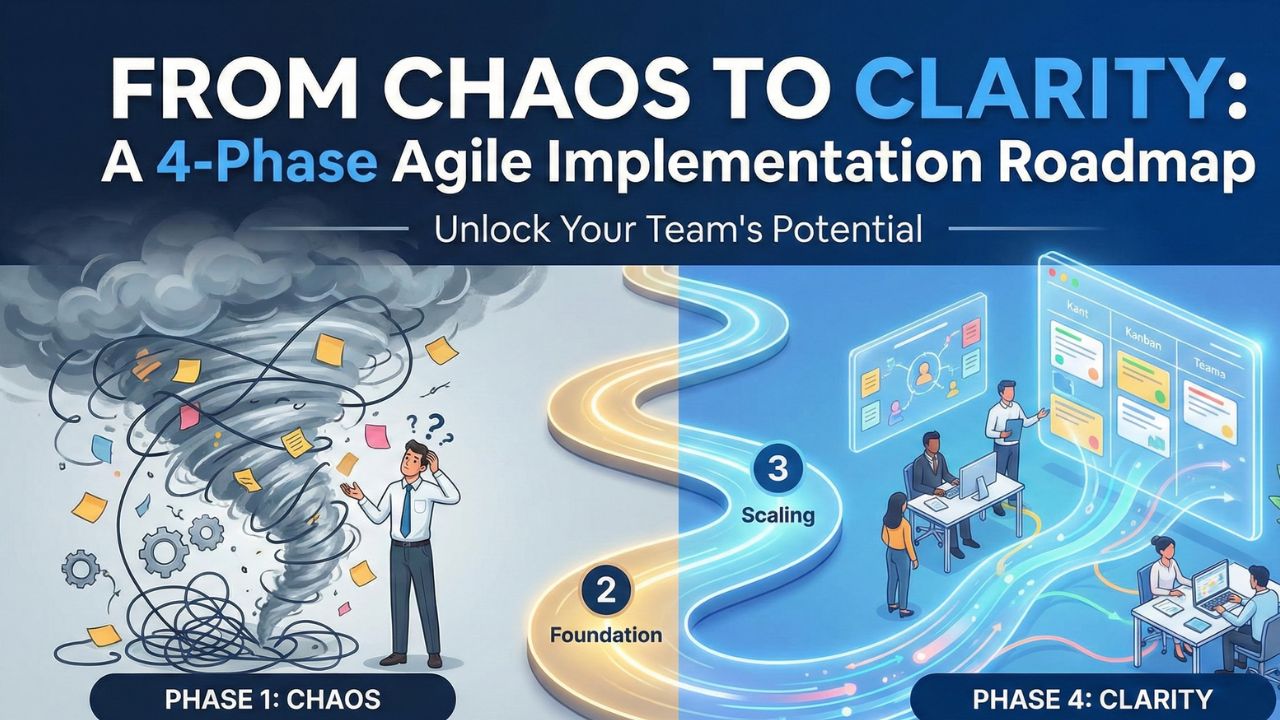
Most Agile transformations don't fail because the philosophy is wrong. They fail because the execution is chaotic. Leaders often mistake "Agile" for "random acts of speed," leading to a fragmented environment where developers are sprinting but going nowhere.
To move from chaos to clarity, you need a structured roadmap. This is not about rigid planning (which would be anti-Agile), but about disciplined phases of evolution. We break this journey down into four distinct phases: Diagnosis, Learning, Pilot, and Scaling.
Phase 1: Diagnosis (The Mirror)
Before you implement a solution, you must understand the problem. The goal of this phase is not to judge the teams, but to visualize the current flow of work.
Tactical Action: Value Stream Mapping
Instead of just asking "are we doing Scrum?", ask "how does value flow?". Map the journey of a feature from the moment a client requests it to the moment it is live in production.
- Identify Bottlenecks: Do requirements sit in a "To-Do" pile for 3 weeks? Does QA take 4 days?
- Cultural Audit: Use surveys to assess psychological safety. If teams are afraid to fail, Agile will not work.
Outcome: A clear "Current State" map and a "North Star" goal for the transformation.
Phase 2: Learning (The Foundation)
Training is where most organizations waste money. They put everyone through a generic 2-day workshop ("Sheep Dip" training) and expect results. Effective learning must be role-specific.
The "Learning Sprint" Concept
Before demanding delivery, declare a "Learning Sprint". In this sprint, the primary deliverable is competence, not code.
- Product Owners: Train on backlog prioritization and stakeholder negotiation.
- Developers: Train on TDD (Test Driven Development) and CI/CD pipelines.
- Managers: Train on "Servant Leadership"—moving from task assignment to roadblock removal.
Phase 3: The Pilot (The Sandbox)
Do not roll out Agile to the entire organization at once. You need a "Sandbox"—a controlled environment to prove the model works.
The Pilot Selection Checklist
Choosing the wrong project is the #1 killer of pilots. Use this checklist to select your team:
- Duration: 3-4 months (enough time to fail and recover).
- Size: 1-2 Teams (Small enough to manage, large enough to matter).
- Importance: "Goldilocks" level—important enough to get attention, but not so critical that a delay will bankrupt the company.
- Independence: Minimal dependencies on non-Agile teams.
The "Don't Panic" Moment: The J-Curve
Here is the hard truth: When you start Phase 3, productivity will drop. This is known as the J-Curve Effect.
Why? Because of the "Manual Override Tax". Your team is switching from "automatic" habits to "manual" learning. They are thinking about how to work, not just doing the work. Leadership must anticipate this dip and not punish it. If you panic here and revert to micromanagement, the transformation dies.
Phase 4: Scaling (The Rollout)
Once the pilot is successful (and the J-Curve has turned upward), you are ready to scale. But scaling is not just "copy-paste."
Tactics for Scaling
- Split and Seed: Take members of the successful Pilot team and seed them into new teams as "Agile Champions."
- Communities of Practice (CoP): Create guilds (e.g., "Scrum Master Guild") where practitioners share lessons across teams.
- Shared Backlogs: Implement Program Increment (PI) Planning to align multiple teams toward a shared quarterly goal.
Connecting the Dots
This roadmap covers the tactics. But what about the strategy? If you are unsure which framework (Scrum vs. Kanban) fits your pilot, check our comparison guide.
Read Next: Beyond the Buzzwords (Model Comparison) Choose the right framework for your pilotFAQ: Execution Questions
A typical Agile pilot should last 3-4 months. This allows for 6-8 sprints, which is enough time to clear the "Storming" phase and see actual velocity trends.
Choose a project that is "Goldilocks" size: Not so small it's irrelevant, but not so mission-critical that failure destroys the company. It should have a stable team and few external dependencies.
This is the "J-Curve" effect. When teams switch from "automatic" habits to "manual" learning of new processes, cognitive load increases, temporarily reducing output.
