LMSYS Coding Arena: Stop Using the Wrong Python AI
- Relying on outdated, static benchmarks is causing engineering teams to choose models that fail at complex Python execution.
- The LMSYS Coding Arena relies on crowdsourced, blind A/B testing, making it the most accurate representation of real-world AI coding performance.
- Choosing the highest-ranked model for general chat does not guarantee it will be the best model for Python data science or backend architecture.
- Selecting the right LLM directly impacts your bottom line, heavily influencing the overarching ROI of your AI initiatives.
- Understanding the Elo rating system used by the arena allows technical leaders to make data-driven API purchasing decisions.
The Benchmark Illusion
Chief Technology Officers and engineering leaders are wasting thousands of dollars on Large Language Model (LLM) APIs that fail at basic Python scripts. The problem isn't the AI itself; the problem is how these leaders are choosing their models.
Most teams rely on static, easily manipulated benchmarks like HumanEval or MBPP to make their purchasing decisions. In the modern era of software development, you cannot afford to guess.
We are currently navigating The Agentic Coding Shift, a transition where developers orchestrate autonomous agents rather than writing manual syntax.
To survive this shift, your underlying foundational models must be flawless. If you want to know which AI actually writes secure, performant, and logical Python code today, you must consult the LMSYS Coding Arena. This dynamic leaderboard is the only metric that truly matters for AI-native engineering teams.
What is the LMSYS Coding Arena?
The Flaw of Static Code Testing
Historically, AI companies evaluated their coding models by feeding them a static set of programming puzzles. Once a model solved the puzzle, it received a score.
However, because these puzzles are public, newer models simply include the test questions in their training data. This results in artificially inflated scores.
An AI might ace a static test but completely hallucinate when asked to build a custom Python FastAPI microservice for your enterprise. Static benchmarks measure memorization, not genuine reasoning.
The Blind A/B Testing Solution
The LMSYS Coding Arena solves this problem by using a crowdsourced, blind testing methodology. Developed by researchers at UC Berkeley, the arena pits two anonymous AI models against each other in a head-to-head battle.
How the arena operates:
- User Prompts: Real developers input custom, complex, and novel coding prompts.
- Blind Responses: Two unnamed models generate Python code side-by-side.
- Human Evaluation: The developer reviews both code snippets, tests them, and votes on which one is more accurate, efficient, or readable.
- Identity Reveal: Only after the vote is cast are the identities of the two models revealed.
Understanding the Elo Rating System
To calculate rankings, the arena utilizes the Elo rating system—the exact same mathematical framework used to rank chess grandmasters.
When a model wins a blind battle against a highly-rated opponent, its score increases significantly. If it loses to a low-rated open-source model, its score plummets.
This creates a constantly shifting, highly accurate leaderboard that reflects real-world developer preference rather than manufactured test results.
Why Python Demands Specific Benchmarks
The Python Complexity Trap
Python is notoriously easy to read but incredibly difficult for AI to architect at an enterprise scale. A model that excels at writing simple JavaScript frontend components might completely fail when asked to handle multi-threaded Python data processing using Pandas or NumPy.
Because Python relies heavily on strict indentation, virtual environments, and complex library dependencies, the AI must possess deep contextual reasoning.
The LMSYS Coding Arena allows you to filter the leaderboard specifically for coding tasks, separating a model's general conversational ability from its strict technical execution.
Connecting Model Choice to Your Bottom Line
Selecting a subpar model doesn't just result in bad code; it destroys your team's velocity. If developers spend more time debugging an AI's hallucinations than they would have spent writing the code manually, your AI integration is a failure.
Choosing a top-tier Python model based on arena data is the first and most critical step in maximizing The ROI of Agentic Coding in Enterprise Teams.
High-performing models reduce technical debt, lower compute costs, and dramatically accelerate sprint deliverables.
Decoding the 2026 Leaderboard Dynamics
Proprietary vs. Open Source Performance
A major debate among technical leaders is whether to pay for proprietary APIs or host open-source models locally. The arena data provides a clear, unbiased answer to this dilemma.
Key trends on the leaderboard:
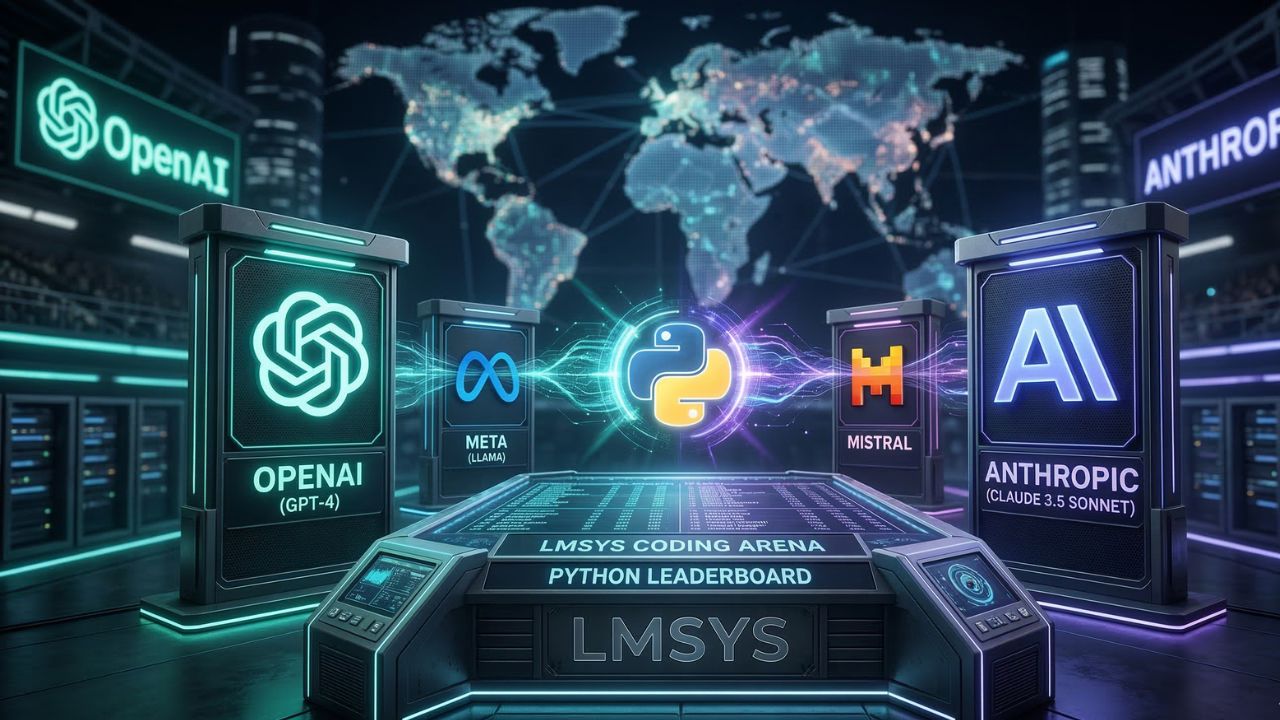
- Proprietary Dominance: Frontier models from OpenAI (GPT-4 class) and Anthropic (Claude 3.5 class) consistently fight for the absolute top spot in complex Python reasoning.
- Open Source Catch-Up: Models like Meta's Llama series and Mistral's Mixtral frequently offer incredible value, scoring high enough to handle 80% of standard Python boilerplate at a fraction of the inference cost.
- Specialized Coding Models: Niche models trained explicitly on code repositories often punch above their weight class, outperforming massive generalist models in strict syntax generation.
The Heavyweights: Claude vs. GPT
When filtering the arena strictly for Python, the battle is fiercely competitive. Anthropic's Claude 3.5 Sonnet has frequently demonstrated superior capability in zero-shot Python refactoring and understanding massive codebases.
Conversely, OpenAI's latest iterations often excel at generating complex data science visualizations and integrating seamlessly with external Python libraries.
Your choice depends on whether your team is focused on backend system architecture or data-heavy machine learning pipelines.
Integrating the Right Model into Your Agile Sprint
Moving from Data to Action
Once you have identified the top-ranking Python model on the LMSYS leaderboard, you must integrate it into your sprint planning. Do not give your team access to an outdated model simply because it is cheaper.
Steps for data-driven implementation:
- Audit Your Current Stack: Identify which LLM your current code editors (like Cursor or Blackbox) are defaulting to.
- Consult the Arena: Filter the LMSYS leaderboard for "Coding" and verify if your current model is still in the top tier.
- Mandate the Best: Configure your team's API routing to explicitly use the highest Elo-rated model for complex Python epics.
Continuous Monitoring
The AI landscape moves at breakneck speed. A model that ranks #1 in January might fall out of the top five by March.
Make checking the arena leaderboard a standard part of your quarterly architectural reviews.
Conclusion
The era of relying on static, easily gamed coding benchmarks is over. If your engineering team relies heavily on Python for data analysis, backend services, or automation, you cannot afford to base your infrastructure on outdated metrics.
The LMSYS Coding Arena provides the only mathematically sound, crowdsourced, and dynamic benchmark that reflects true developer reality.
Stop guessing, start consulting the Elo ratings, and ensure your team is always equipped with the most capable AI available.
Frequently Asked Questions (FAQ)
It is a crowdsourced, open-source research project by UC Berkeley that evaluates Large Language Models. It uses blind A/B testing where developers prompt two anonymous models with coding tasks, vote on the best response, and rank them using an Elo rating system.
Rankings fluctuate rapidly, but frontier models like Anthropic's Claude 3.5 Sonnet and OpenAI's latest GPT-4 iterations consistently trade the #1 spot for Python. Claude is frequently praised for architectural refactoring, while GPT excels in data science library integrations.
Scores are calculated using the Elo rating system, similar to competitive chess. When two models compete blindly, the winner gains points from the loser. Defeating a highly-ranked model yields more points, ensuring the leaderboard dynamically reflects comparative, real-world performance.
According to recent arena data, Claude 3.5 frequently edges out GPT-4 in complex, multi-file Python coding tasks and zero-shot bug fixing. However, GPT-4 remains highly competitive, particularly when writing isolated scripts or generating Python code for data visualizations.
Open-source models like Meta's Llama 3 and Mistral's coding variants rank incredibly well, often sitting just below the top proprietary models. They offer exceptional value, proving highly capable of handling standard Python boilerplate and routine syntax generation.
Sources
- LMSYS Org (Large Model Systems Organization), UC Berkeley. "Chatbot Arena: An Open Platform for Evaluating LLMs by Human Preference."
- Hugging Face Leaderboards. "Open LLM Leaderboard and Code Evaluation Metrics."
- Zheng, Lianmin, et al. "Judging LLM-as-a-Judge with MT-Bench and Chatbot Arena." (Research paper detailing the Elo rating methodology).