Upskilling Junior Developers: How to Build the "AI Wranglers" Your Team Needs
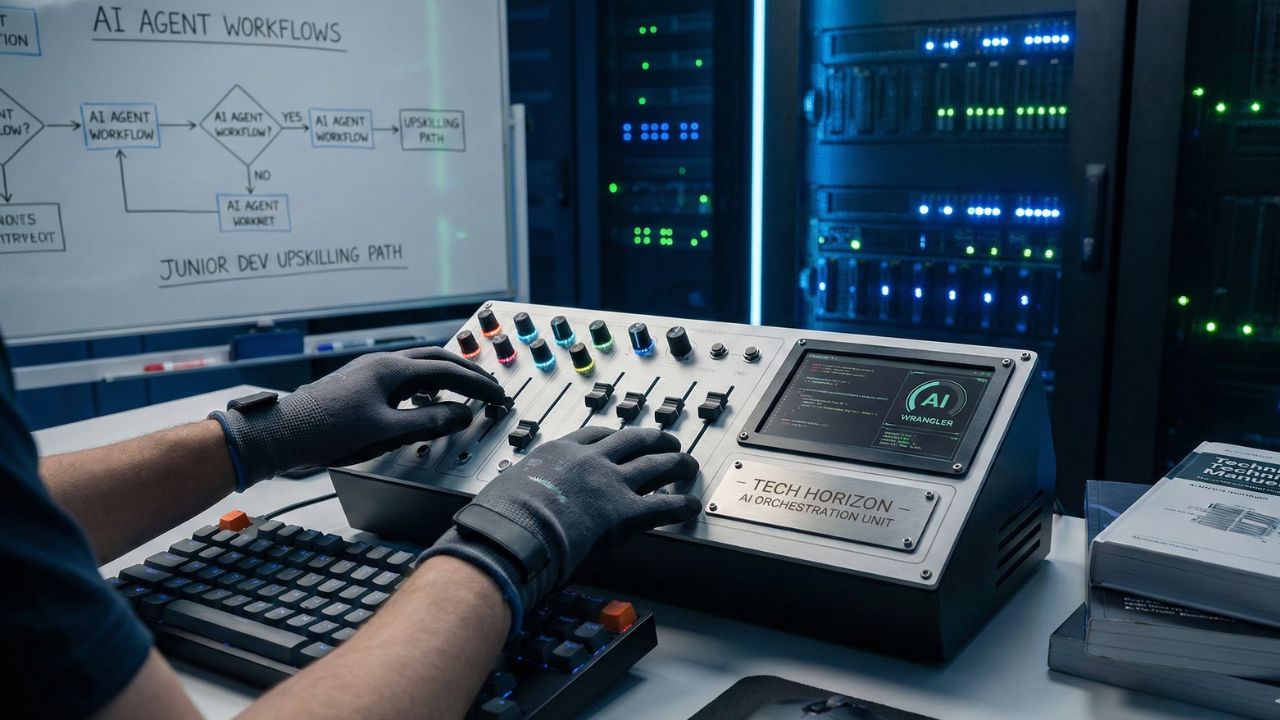
- The role of junior devs is shifting from writing code to validating AI-generated code.
- "AI Wrangling" requires a new skill set: prompt engineering, system design, and debugging logic.
- Training programs must focus on how to effectively orchestrate multiple AI agents.
- Upskilling prevents the collapse of your senior talent pipeline in the long term.
- Ignoring this shift risks creating a workforce that is obsolete in an AI-first world.
The traditional career path for a junior developer is broken. The tasks they used to learn on—writing boilerplate code, fixing minor bugs, and creating basic unit tests—are now done instantly by AI.
To survive and thrive, engineering leaders must embrace upskilling junior developers to be AI wranglers. You cannot simply fire your junior staff and replace them with bots; you need humans to manage the bots.
This deep dive is part of our extensive guide on the Agentic SDLC, which explores the complete transformation of the global capability center workforce.
Without a clear strategy to transform your entry-level talent into skilled AI orchestrators, your organization faces a future critical skills gap.
The Death of the "Coder" and the Rise of the "Wrangler"
Historically, a junior developer's value was measured by lines of code written.
Today, that metric is meaningless. An AI agent can generate thousands of lines of code in minutes. The new value proposition for a junior engineer is their ability to be an effective AI Wrangler.
This means they are no longer just builders; they are supervisors, validators, and integrators of AI-generated output.
Why the Shift is Non-Negotiable
If you stop hiring and training juniors because "AI can do it," you break the talent supply chain.
Where will your future senior architects come from in five years? You must continue to bring in early-career talent, but their training ground must fundamentally change from manual coding to AI orchestration.
The Core Curriculum for an "AI Wrangler"
The new training curriculum is less about syntax and more about semantics and systems thinking. Here are the three critical pillars for upskilling your junior team.
1. Advanced Prompt Engineering & Context Management
Writing a basic prompt is easy. Writing a prompt that gets complex, secure, and production-ready code from an LLM is a high-level skill.
Juniors need to learn how to provide the right context, set constraints, and iterate on prompts to guide the AI towards the desired outcome. This is the new "coding."
2. Code Validation and Debugging Logic
When an AI generates a block of code, the junior developer's job is to verify it. Does it meet the business requirements? Is it secure? Is it performant?
They need to spot subtle logic errors and hallucinations that an automated test might miss. This requires a deeper understanding of system design than ever before.
For context on the economics of this shift, read about the Cost of Coding AI Agents: Is It Time to Replace Your Junior Dev Pipeline?
3. Orchestrating Multi-Agent Systems
The future isn't just one developer with one AI assistant. It's a developer managing a fleet of specialized AI agents—one for coding, one for testing, one for documentation.
Juniors must learn how to build workflows where these agents interact effectively. This is a key component of modern workforce planning, which we cover in Predictive Analytics for GCC Workforce Planning.

Frequently Asked Questions (FAQ)
They need to master prompt engineering, learn to validate and debug AI-generated code, understand system architecture to guide AI agents, and develop strong problem-solving skills to handle edge cases where AI fails.
The path becomes faster but steeper. Developers move away from rote coding tasks earlier in their careers and must take on system-level design and architectural responsibilities sooner. The jump from "junior" to "senior" now requires mastering AI orchestration.
Absolutely. The alternative is a workforce that cannot leverage the most powerful productivity multipliers available. Training them to use AI tools effectively is the only way to realize the massive efficiency gains that AI promises while ensuring code quality and security.
Conclusion
Upskilling junior developers to be AI wranglers is not an optional "nice-to-have" training module. It is a strategic imperative for the survival of your engineering organization.
By redefining the junior role from code generation to AI orchestration, you not only solve an immediate productivity challenge but also secure your future pipeline of senior technical leaders.
The developers who can effectively wrangle AI agents will be the most valuable assets in the software engineering world of tomorrow.