Why Your Media GCC is Already Obsolete
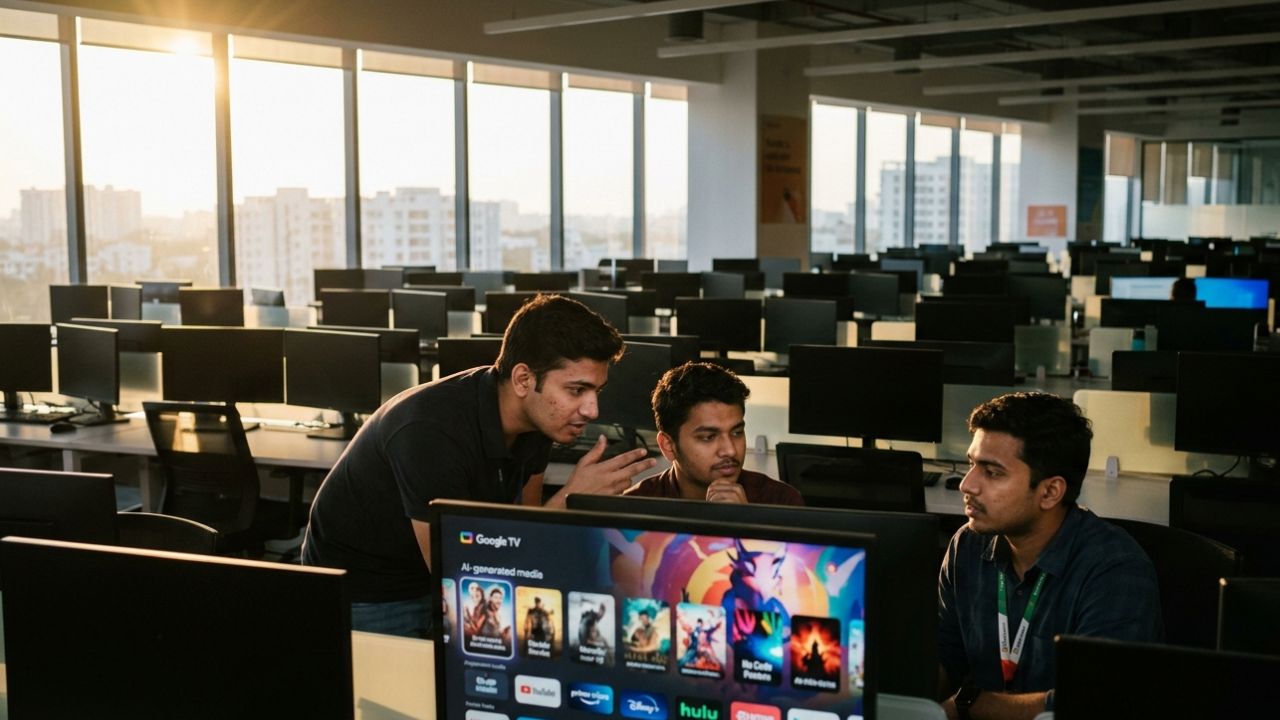
Your India-based media team is still manually tagging images like it's 2019, while Google just automated the entire living room experience. For Global Capability Centers (GCCs) heavily invested in digital media, entertainment pipelines, and streaming operations, the writing is clearly on the wall. The era of traditional, human-intensive "Digital Asset Management" (DAM) is officially dead.
Historically, media giants scaled their operations through labor arbitrage. If a streaming platform launched in twenty new regions, they hired a thousand offshore contractors in Bengaluru or Hyderabad to curate thumbnails, write localized descriptions, tag metadata, and organize millions of static images. However, the paradigm shifted overnight. Google’s aggressive rollout of generative AI experiences for Google TV proves that the future is no longer about retrieving static assets—it is about "Generative Asset Orchestration."
The Era of "Human-in-the-loop" Curation is Over
For over a decade, Indian IT and BPO sectors have treated content curation as a high-volume, low-margin factory process. Teams of digital librarians spent countless hours manually sorting media libraries, ensuring compliance, and tagging elements so search algorithms could find them. This legacy approach to digital asset management is bleeding your ROI in a macroeconomic environment that demands hyper-efficiency.
Today, manual metadata tagging is a technical liability. Large Language Models (LLMs) and Multimodal AI systems, such as Google's Gemini, can ingest thousands of hours of video and millions of images simultaneously. They do not just identify what is in the image; they understand context, emotion, lighting, and narrative continuity. An AI model can process an entire media repository and generate precise, multilingual metadata in a fraction of the time it takes a human-in-the-loop workflow, effectively rendering legacy DAM systems obsolete.
Enter Generative Asset Orchestration
So, what is generative asset orchestration in streaming? It is the transition from a "store and fetch" model to a "context and generate" model. Instead of maintaining a massive server filled with pre-rendered, static images for every possible user scenario, modern streaming platforms are moving toward real-time generative environments.
When a viewer turns on a smart television today, they are not greeted by a generic carousel of pre-selected artwork. Systems driven by advanced AI dynamically generate bespoke visual layouts, blending context-aware graphics with real-time analytics. This means the offshore teams that previously spent months curating localized promotional artwork are no longer needed for those tasks. The AI is the new curator.
This fundamental disruption directly echoes the broader Google Gemini impact on Indian GCCs. The transition from offshore IT disruption to sovereign, automated intelligence is happening at an unprecedented velocity.
The Brutal Economics: Cost-Benefit of AI vs. Offshore Tagging
From an enterprise FinOps perspective, the cost-benefit analysis is indisputable. Maintaining a sprawling Indian media GCC to manage repetitive DAM tasks involves overhead costs covering real estate, HR, management layers, and constant retraining due to high attrition rates. Conversely, deploying a multimodal generative AI model incurs a predictable API or infrastructure compute cost.
Once the AI pipeline is established, the marginal cost of tagging the next million images approaches zero. AI operates continuously, scaling instantly to handle peak traffic during major global media releases without requiring overtime pay or shift scheduling. For corporate executives, retaining legacy offshore tagging operations in 2026 is an indefensible strategy that actively sabotages profitability.
From Content Librarians to Generative Pipeline Architects
Does this mean the end of the Indian Media GCC? No, but it dictates a brutal and immediate transformation. Indian tech hubs must aggressively pivot from acting as basic content librarians to becoming highly specialized generative pipeline architects. This requires Indian GCCs to move up the value chain by transitioning from execution to orchestration.
GCC leaders must redefine their hiring strategies. The industry no longer needs data entry clerks; it needs prompt engineers, AI governance specialists, and RAG (Retrieval-Augmented Generation) architects. These teams will be responsible for building the localized infrastructure that allows AI models to safely and effectively interact with proprietary media assets.
Essential KPIs and Skills for the AI-Driven Media Hub
To survive this offshore IT disruption, what are the new KPIs for AI-driven media hubs? Vanity metrics like "number of images tagged per hour" must be abandoned. The new metrics of success include "AI hallucination rates," "orchestration latency," and "automated asset engagement lift."
What skills do GCC leaders need for generative media? Strategic foresight is paramount. Leaders must understand how to integrate Gemini into media workflows seamlessly without compromising data security or brand integrity. They need to transition their workforces into oversight roles, managing the AI systems that now perform the heavy lifting. Generative AI in streaming is not a future concept; it is the current operational baseline.
Frequently Asked Questions
Generative AI eliminates the need for large-scale, manual data tagging and curation teams. It forces Indian Media GCCs to pivot from labor-intensive execution to high-value AI orchestration, requiring a massive upskilling of the existing workforce.
It is the process of using multimodal AI to dynamically generate, tag, and deliver context-specific media assets to users in real-time, replacing the outdated method of fetching static, pre-curated images from legacy databases.
Yes. Traditional DAM roles focused on repetitive data entry and manual image organization are effectively dead. However, they are being replaced by roles focused on managing AI pipelines and prompt engineering.
By abandoning legacy "human-in-the-loop" operations and restructuring their teams to become architectural hubs. They must focus on designing, fine-tuning, and governing the AI models that automate enterprise media workflows.
Modern KPIs include orchestration latency, compute cost per generated asset, workflow automation percentages, and the engagement lift driven by AI-personalized media assets.
Google TV’s AI integration moves the interface from static browsing to an ambient, generative experience. It utilizes AI to automatically curate and generate visual environments based on the viewer’s context and behavior without human intervention.
Leaders need deep competencies in AI governance, cloud infrastructure optimization, LLM prompt engineering, and agile transformation to pivot their organizations away from legacy BPO models.
Absolutely. Multimodal AI models can ingest and understand vast libraries of unstructured media significantly faster, cheaper, and more accurately than human operators.
Integration involves shifting to an API-first architecture where Gemini is deployed to autonomously analyze video frames, extract contextual metadata, generate localized copy, and produce dynamic thumbnails.
AI provides an overwhelmingly positive ROI by eliminating the variable headcount costs associated with offshore tagging. It replaces high overhead, training, and attrition costs with a predictable, instantly scalable compute expense.
Sources and References
- Google Blog: Introducing AI-driven experiences on Google TV
- Google Cloud: Enterprise AI and Multimodal Capabilities
- NASSCOM: The Future of Indian GCCs and AI Transformation

About the Author: Sanjay Saini
Sanjay Saini is an Enterprise AI Strategy Director specializing in digital transformation and AI ROI models. He covers high-stakes news at the intersection of leadership and sovereign AI infrastructure.
Connect on LinkedIn