Google AI Catches 25% of Missed Cancers, But Radiologists Keep Overruling It
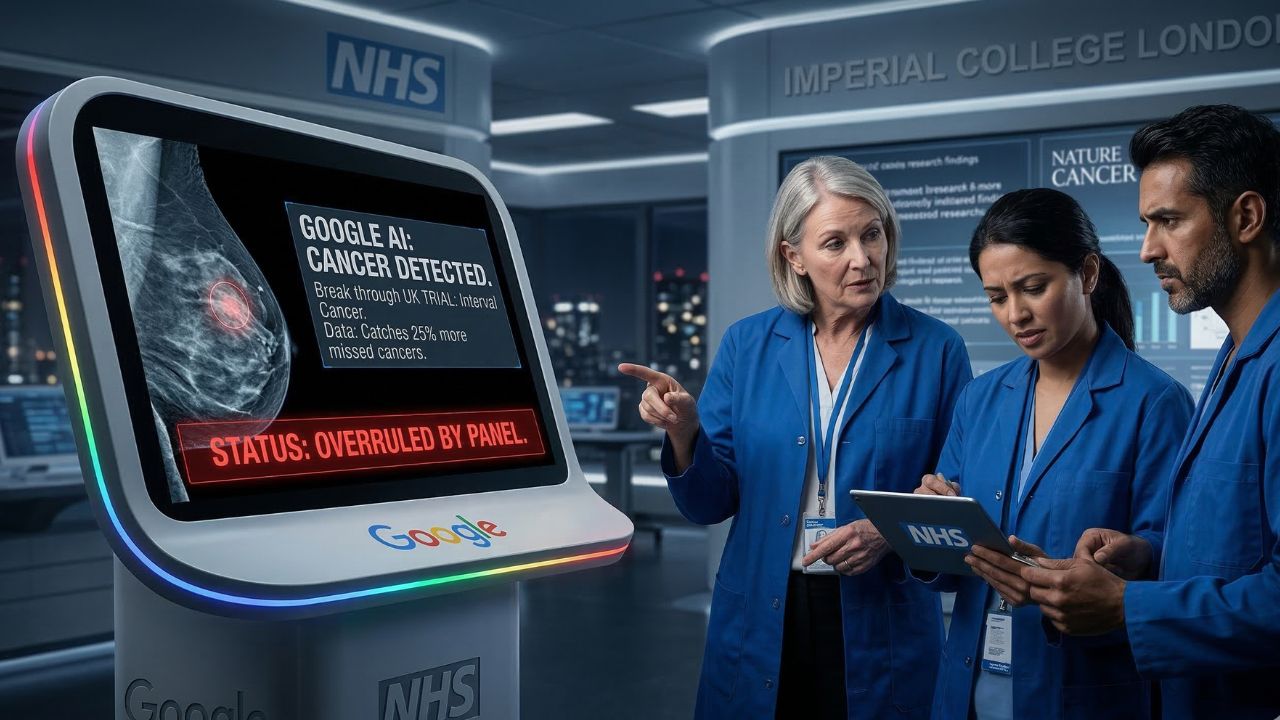
Google just published landmark clinical data proving its experimental AI system can spot aggressive breast cancers that human doctors completely missed. But the massive real-world trial with the UK's National Health Service exposed a fascinating psychological hurdle: human specialists still do not trust the machine.
Quick Facts
- The breakthrough metric: Google's AI identified 25% of "interval cancers" that had previously slipped past traditional screening methods.
- The workload collapse: When deployed as an automated "second reader," the technology slashed radiologist screening workloads by a staggering 40%.
- The human override: Arbitration panels occasionally rejected the AI's correct diagnoses, proving that establishing physician trust is now the biggest bottleneck.
- The massive scale: The peer-reviewed findings, published as a pair of studies in Nature Cancer, analyzed mammograms from over 125,000 women.
The "Second Reader" Solution
For years, artificial intelligence companies promised to revolutionize medical imaging. Google just backed up that claim with hard clinical data, publishing a pair of explosive studies alongside Imperial College London and the NHS.
The research targets a brutal vulnerability in modern oncology: interval cancers. These are the aggressive tumors that emerge between routine mammograms, often surfacing only after physical symptoms appear. By analyzing historical scans of 125,000 women, Google's AI caught a quarter of these elusive cancers that highly trained human eyes had previously missed.
The UK's frontline defense against breast cancer relies on a rigorous double-reading standard where two specialists review every single mammogram. This creates a massive safety net but strains an already overwhelmed medical system. Radiologists are currently forced to review roughly 5,000 scans annually with incredibly limited dedicated hours.
Google's researchers tested their algorithm as an independent "second reader" in this workflow. The results were immediate and structural. The AI accurately maintained the required clinical benchmarks while eliminating nearly half of the human workload.
This shift gives healthcare professionals the breathing room to focus entirely on complex, high-risk cases rather than drowning in a nationwide screening backlog.
The Psychology of the Override
Building a highly accurate diagnostic machine is only half the battle. The true test is whether human doctors will actually listen to it in a high-stakes clinical setting.
During simulated reviews, researchers observed a dangerous tension between flesh and silicon. When the AI flagged a subtle, early-stage cancer that humans missed, arbitration panels of expert specialists occasionally overruled the machine's correct diagnosis.
"While arbitration successfully filters out false positives, we observed a critical tension during our simulated review: Arbitration panel specialists occasionally overruled AI-detected cancers that would have otherwise gone undetected. These findings highlight the need for continued research on human-AI interaction to build specialist trust in AI's ability to catch subtle, early-stage cancers."
— Google Health Research Team
This dynamic reveals that raw accuracy is useless without physician confidence. The medical industry must now figure out how to build profound trust in an algorithm's ability to see patterns that are invisible to the naked eye.
Why It Matters
Google's clinical triumph permanently alters the trajectory of medical diagnostics. By successfully automating the "second reader" role, this technology presents a viable solution to the crushing global shortage of radiologists.
Medical software companies and legacy healthcare providers will now be forced to integrate deep learning into their diagnostic pipelines or risk facing severe liability for missing preventable tumors.
However, the ultimate success of AI in healthcare no longer depends on coding a smarter algorithm—it entirely depends on convincing veteran doctors to trust the machine over their own intuition.
Sources and References
About the Author: Sanjay Saini
Sanjay Saini is an Enterprise AI Strategy Director specializing in digital transformation and AI ROI models. He covers high-stakes news at the intersection of leadership and sovereign AI infrastructure.
Connect on LinkedIn