Why Character.AI’s New Feature Just Killed Indian Graphic Design BPOs
Key Takeaways
- The End of Manual Arbitrage: Character.ai's new "Imagine Gallery" proves that persistent, highly specific multimodal content can be generated instantly without human intervention.
- An Existential Threat: BPOs running on linear graphic design, storyboarding, and basic multimedia production must pivot immediately or face obsolescence.
- The GCC Imperative: The future belongs exclusively to AI orchestrators, not manual content factories. Indian IT hubs must undergo a rapid skills transition.
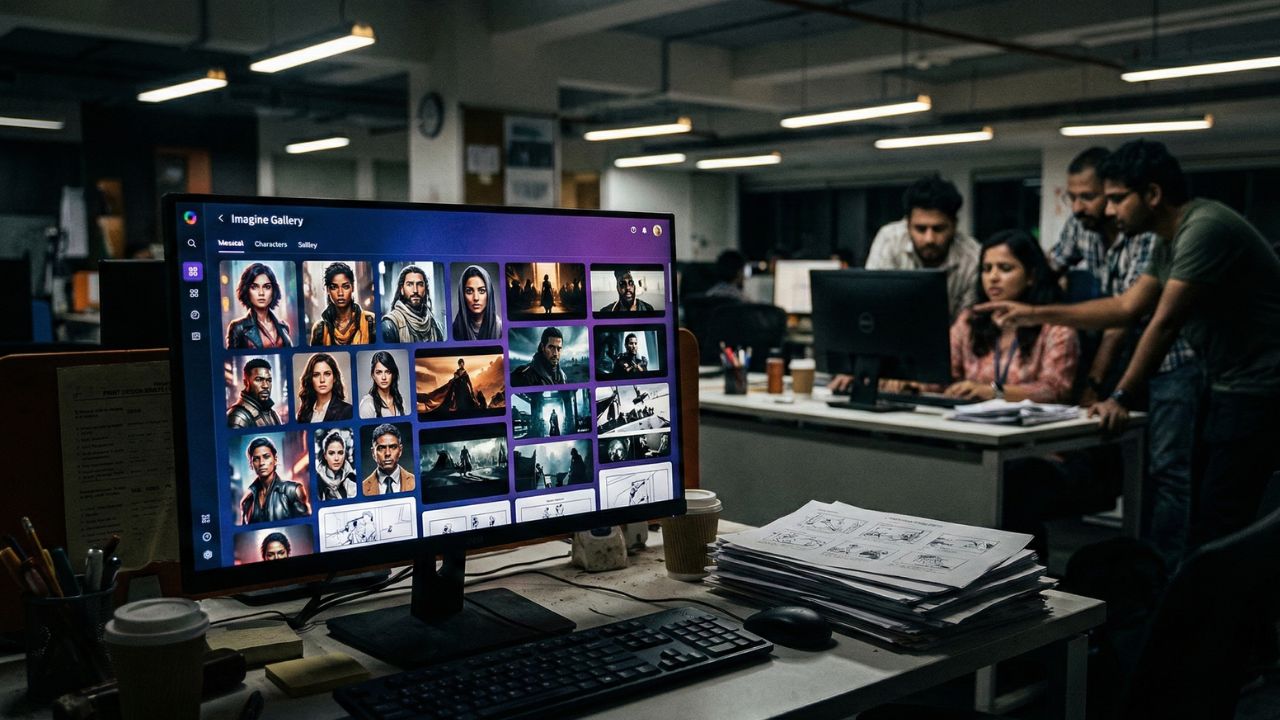
Character.ai's "Imagine Gallery" isn't just a consumer feature update; it's a preview of fully autonomous, zero-cost multimodal content generation at scale. While casual users see a fun new space where all their generated moments come together in one organized visual grid, enterprise strategists and Global Capability Center (GCC) leaders must view this through an entirely different lens. For Indian BPOs reliant on manual graphic design, storyboarding, or basic multimedia production, this signals an existential threat to offshore media arbitrage.
The global outsourcing industry has thrived for decades on a relatively simple equation: labor arbitrage. Western enterprises shipped high-volume, repetitive tasks—like background removal, ad banner formatting, social media graphics, and basic storyboarding—to IT hubs in India. However, when an AI can synthesize dramatic scenes, surreal worlds, and unexpected moments natively within a conversational interface, the foundation of this business model crumbles.
The Legacy of Indian Design BPOs
For the last twenty years, the Indian tech ecosystem has aggressively expanded its capabilities beyond call centers and basic software testing. A massive sub-industry of creative Business Process Outsourcing (BPO) emerged. Thousands of agencies have been built around providing bulk creative services. They handle the "grunt work" of the creative industry: formatting thousands of product images for e-commerce catalogs, drafting corporate presentation decks, and generating endless variations of digital marketing assets.
This model relied on a slow, linear workflow. A brand manager in New York would write a brief, send it to a team in Bengaluru or Pune, wait 24 to 48 hours for a draft, submit revisions, and eventually receive the final asset. It was affordable compared to onshore rates, but it was still fraught with friction. The primary value proposition was strictly cost savings.
How Multimodal AI Shatters Cost Arbitrage
Enter features like Character.ai's Imagine Gallery. It is critical to understand that this is not merely a standalone image generator like mid-2023 versions of Midjourney. The Imagine Gallery introduces persistent memory and stateful persona generation. Every moment generated, past and present, is included automatically. Users can filter by Persona, keeping standout moments within easy reach. The AI understands the context of the conversation and visually extrapolates it without needing a meticulously crafted, five-page creative brief.
This is where the disruption accelerates. If a conversational agent can act as an art director, illustrator, and archivist simultaneously, the friction of outsourcing is eliminated entirely. Why would an enterprise pay for an offshore "seat" or hourly rate when a multimodal AI can generate, catalog, and apply media assets directly into the workflow instantly, for a fraction of a cent per API call?
GCCs Must Pivot: From Manual Factories to AI Orchestration
The writing is on the wall for Indian GCCs and outsourced media hubs. Stop defending manual content creation. The transition required is immense but absolutely necessary: the shift from being an operational cost-center to an AI Orchestration hub. Generative AI is obliterating offshore media arbitrage, meaning that simply offering "cheaper hands" is no longer a viable corporate strategy.
To survive, these organizations must evolve their service catalogs. Instead of selling a team of ten junior graphic designers to format images, a modern GCC must sell an integrated AI pipeline. They must configure the multimodal enterprise architectures, establish the fine-tuned brand personas (similar to Character.ai's models), manage the vector databases that store these generated assets, and implement stringent AI quality assurance checks.
As we've extensively covered in our analysis of the future of GCCs in India with AI, the strategic advantage will shift to teams that can securely deploy these AI models within corporate guardrails, ensuring that generated media adheres to copyright laws and strict brand compliance.
Redefining the Skills Matrix for Indian IT Hubs
Character.ai's move into continuous multimodal generation just made thousands of offshore design seats obsolete overnight. So, what happens to the workforce? A massive reskilling initiative is the only solution. The designer of tomorrow in the Indian IT hub is not manipulating layers in Photoshop; they are managing the outputs of highly sophisticated neural networks.
New roles will emerge. We will see the rise of Multimodal QA Specialists, who audit AI-generated galleries for hallucinations or off-brand anomalies. We will need AI Workflow Architects who plug API endpoints into existing enterprise CMS platforms. The ultimate value delivery shifts from the creation of the pixel to the governance of the prompt.
Features like Imagine Gallery represent the normalization of AI media. When images, videos, comics, and books are effortlessly synthesized via chat, the barrier to creation approaches zero. Indian IT and BPO leaders must heed this warning: the future belongs exclusively to AI orchestrators. Adaptation is not optional; it is the fundamental requirement for survival in the multimodal era.
Explore Related Multimodal AI Insights
- The Multimodal Memory Architecture Tech Giants Are Hiding
- How to Cut Multimodal AI Infrastructure Costs by 60%
Frequently Asked Questions
Generative AI models are automating routine graphic design tasks, such as background removal, basic storyboarding, and layout adjustments. This dramatically reduces the demand for lower-tier offshore design seats historically handled by Indian BPOs.
Imagine Gallery transitions Character.ai from text-only interactions to persistent multimodal asset creation. For creators, it means an infinite, zero-cost pipeline for generating visual context seamlessly without hiring external illustrators or designers.
AI will not replace BPOs that pivot to high-end strategic orchestration, but it absolutely will replace manual content factories that rely strictly on labor arbitrage for repetitive multimedia production.
Global Capability Centers must invest in AI training, transitioning their staff from pixel-pushers to prompt engineers, AI workflow managers, and quality assurance specialists who manage autonomous media generation pipelines.
The primary second-order effect is the collapse of the hourly billing model for media generation. Vendors will be forced to move toward outcome-based pricing or subscription-based AI management services.
They slash external agency and outsourcing costs by up to 80%. Enterprises can now internalize vast amounts of media production using bundled AI interfaces, turning Capex and Opex spending into mere API subscription costs.
Yes. Offshore teams that proactively integrate generative AI can significantly increase their delivery speed and margins, provided they shift their business model from headcount-based billing to value-based or asset-based billing.
The future is highly technical. Indian IT hubs will shift from housing thousands of entry-level graphic designers to employing specialized AI architects who design the underlying systems and manage the multimodal vector architectures.
Cost arbitrage relies on the premise that offshore human labor is cheaper than onshore human labor. AI generation operates at near-zero marginal cost, making even the cheapest offshore human labor economically uncompetitive for basic tasks.
Designers must master advanced prompt engineering, cross-platform AI asset integration, maintaining brand consistency through AI guardrails, and shifting from operational creation to strategic art direction.
Sources and References
About the Author: Sanjay Saini
Sanjay Saini is an Enterprise AI Strategy Director specializing in digital transformation and AI ROI models. He covers high-stakes news at the intersection of leadership and sovereign AI infrastructure.
Connect on LinkedIn