The WWDC 2026 Secret: Why Apple's AI Push Kills Indian API Outsourcing
Key Takeaways
- The API-Wrapper Death: Apple’s aggressive push for zero-latency, on-device AI signals the absolute end of the cloud-reliant "API-wrapper" outsourcing model.
- The GCC Pivot Mandate: Indian GCCs and BPOs must urgently transition their massive developer pools from basic Swift UI to complex CoreML optimization.
- Intelligence Arbitrage Requirement: Failing to adopt an intelligence arbitrage strategy risks losing massive enterprise contracts to highly specialized, localized engineering teams.
Apple’s aggressive push for zero-latency, on-device AI at WWDC 2026 signals the death of the "API-wrapper" outsourcing model. For Indian GCCs and BPOs that built their revenue on coding cloud-heavy iOS apps, this is a crisis of unprecedented proportions. The API-wrapper outsourcing model that built India's iOS hubs is officially dead following Apple's edge-AI mandate. Discover the intelligence arbitrage pivot your GCC must execute today to prevent massive contract losses.
The Apple WWDC 2026 Mandate: Zero-Latency Edge AI
At the heart of Apple’s Worldwide Developers Conference (WWDC) 2026 is an uncompromising pivot toward edge computing. Over the past few years, the standard operating procedure for mobile app development relied heavily on cloud infrastructure. Developers would construct clean user interfaces in Swift, but the core processing—specifically generative AI or advanced logic—was inevitably offloaded to cloud APIs. Apple's newest architecture fundamentally disrupts this approach. By prioritizing local execution to guarantee user privacy and eliminate latency, Apple has established a new technical paradigm that penalizes cloud dependency. This is not just a standard software update; it is an architectural revolution that threatens the baseline operations of offshore IT hubs globally.
The Crisis for Cloud-Heavy iOS Workflows
For Indian Global Capability Centers (GCCs) and large-scale Business Process Outsourcing (BPO) firms, this technological shift is an existential threat. Historically, a massive percentage of offshore revenue was generated by maintaining cloud-heavy applications. The "API-wrapper" model allowed offshore development teams equipped with basic Swift UI knowledge to stitch together various cloud services, delivering functional applications without understanding the underlying AI models. Thousands of developers across major tech hubs like Bangalore, Hyderabad, and Pune have built their careers maintaining these lightweight frontends. Under Apple's new edge AI mandate, apps that continuously ping external servers for intelligence tasks will face severe battery optimization penalties, reduced algorithmic priority, and strict privacy warnings within the new OS, rendering them unviable for modern enterprise clients.
The Survival Pivot: Transitioning 10,000+ Developers to CoreML
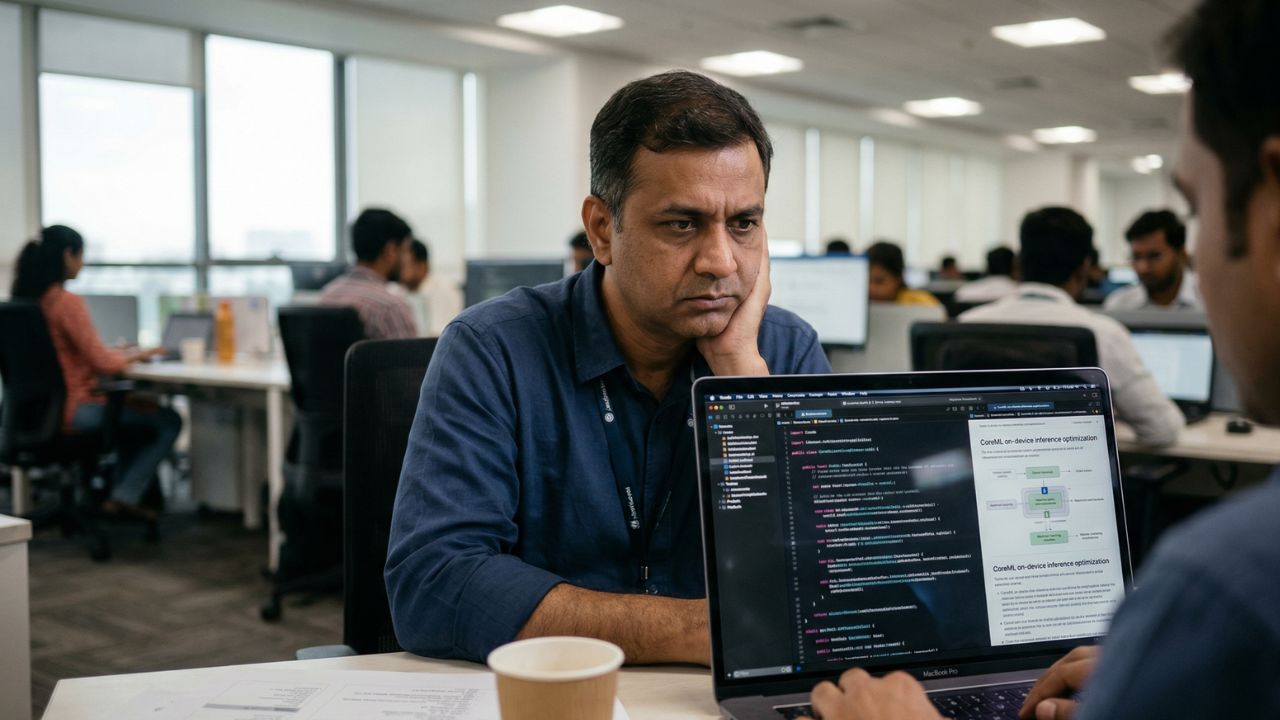
The deep-dive reality is that GCC leadership must urgently overhaul their vast engineering resources. The 10,000+ iOS developers currently stationed in Indian tech hubs can no longer coast on basic frontend competencies. The new development standard demands deep, granular expertise in complex edge-compute methodologies, neural engine optimization, and local LLM deployment through CoreML. Directly managing model weights, optimizing memory allocation, and orchestrating localized intelligence within the Swift environment are now mandatory prerequisites. If Indian offshore firms cannot rapidly transition their talent to master these on-device orchestration techniques, they risk catastrophic financial damage. Highly specialized, local US-based engineering squads that understand how to compress and execute AI natively on Apple Silicon will swiftly consume the market share once dominated by legacy offshore providers.
Restructuring for Intelligence Arbitrage
The financial shockwaves of this transition are completely rewriting the rules of offshore IT billing. The traditional headcount-based billing model, where enterprise clients pay for sheer volume of human hours spent writing boilerplate code, is obsolete. Because on-device AI executes tasks instantly and bypasses expensive cloud latency, clients are rightfully demanding outcome-based pricing frameworks. This disruption leaves Indian IT leaders with no choice but to deploy a sophisticated intelligence arbitrage strategy. Rather than selling bulk coding hours, GCCs must sell highly specialized engineering pipelines that extract maximum value from Apple's localized hardware. To successfully navigate this transition, organizations must deeply analyze the future of GCCs in India with AI and completely redefine their value proposition in a market where edge compute dictates the future of enterprise mobility.
Frequently Asked Questions
The Apple WWDC 2026 announcement fundamentally shifts development from cloud-reliant APIs to on-device edge computing. For outsourced developers, this means the traditional practice of building lightweight frontends that call remote servers for AI tasks is obsolete. Developers must now engineer complex, local solutions that leverage the device's neural engine directly to eliminate latency and meet strict new privacy standards.
On-device AI will severely disrupt entry-level offshore iOS development jobs that focus solely on basic UI coding and third-party cloud integrations. As Apple prioritizes local CoreML execution, demand will shift radically toward highly skilled architects capable of managing model weights, memory optimization, and localized intelligence orchestration within the Swift environment.
The future of Indian GCCs in this ecosystem depends entirely on their ability to transition from labor arbitrage to intelligence arbitrage. They must evolve from being code factories into specialized centers of excellence focused on hardware-accelerated machine learning. Organizations that fail to upscale their workforce to master Apple Silicon architecture risk losing major enterprise contracts to localized teams.
Offshore teams must embark on aggressive, mandatory reskilling programs to transition from cloud APIs to CoreML. This involves moving away from web-based latency models and learning to compress, deploy, and execute large language models directly on mobile hardware. Engineering workflows must be restructured to prioritize memory management, battery efficiency, and local data privacy protocols over standard REST architecture.
Yes, Apple Intelligence is poised to replace a significant portion of traditional, manual software testing. With the introduction of deeply integrated, autonomous AI agents at the OS level, repetitive quality assurance tasks, basic bug hunting, and UI validation will be handled instantaneously by localized models, drastically reducing the need for large, manual offshore testing teams.
To survive the 2026 technology landscape, GCC iOS developers must acquire deep expertise in CoreML, Metal, neural engine optimization, and local LLM deployment. They need to understand how to orchestrate autonomous workflows natively within the Apple ecosystem, bypassing cloud dependencies while strictly adhering to on-device privacy frameworks.
Edge computing destroys the traditional time-and-materials billing model. Because on-device AI executes complex tasks with zero latency and bypasses expensive cloud token costs, clients are no longer willing to pay for the hourly labor of large developer teams. The industry is rapidly shifting toward outcome-based pricing, where value is measured by the efficiency and algorithmic success of the deployed edge solution.
Indian BPOs face a massive existential threat from Apple's local AI strategy. As mobile devices become capable of autonomously resolving user queries, processing localized data, and handling complex interactions without server round-trips, the need for human-operated customer support and data processing layers is dramatically minimized.
Restructuring an offshore iOS team requires abandoning massive pools of junior developers in favor of lean, highly specialized units of AI architects. The new team structure must integrate machine learning engineers natively with Swift developers, creating cohesive units dedicated solely to optimizing algorithmic performance directly on Apple Silicon.
The intelligence arbitrage strategy for the Apple ecosystem involves leveraging the extreme computational power of local devices to perform tasks that previously required expensive cloud computing or human intervention. By mastering the orchestration of free, localized inference through CoreML, enterprise organizations can completely bypass cloud LLM token taxes and human labor costs.
Sources and References
- Apple Developer: Core ML Integration and Neural Engine Optimization
- Apple Newsroom: Apple’s Worldwide Developers Conference Returns
- Apple Developer: Apple Intelligence and On-Device Processing Architecture

About the Author: Sanjay Saini
Sanjay Saini is an Enterprise AI Strategy Director specializing in digital transformation and AI ROI models. He covers high-stakes news at the intersection of leadership and sovereign AI infrastructure.
Connect on LinkedIn