The Musk Monopoly: Why the SpaceX-Cursor Deal Will Trigger an Antitrust Storm
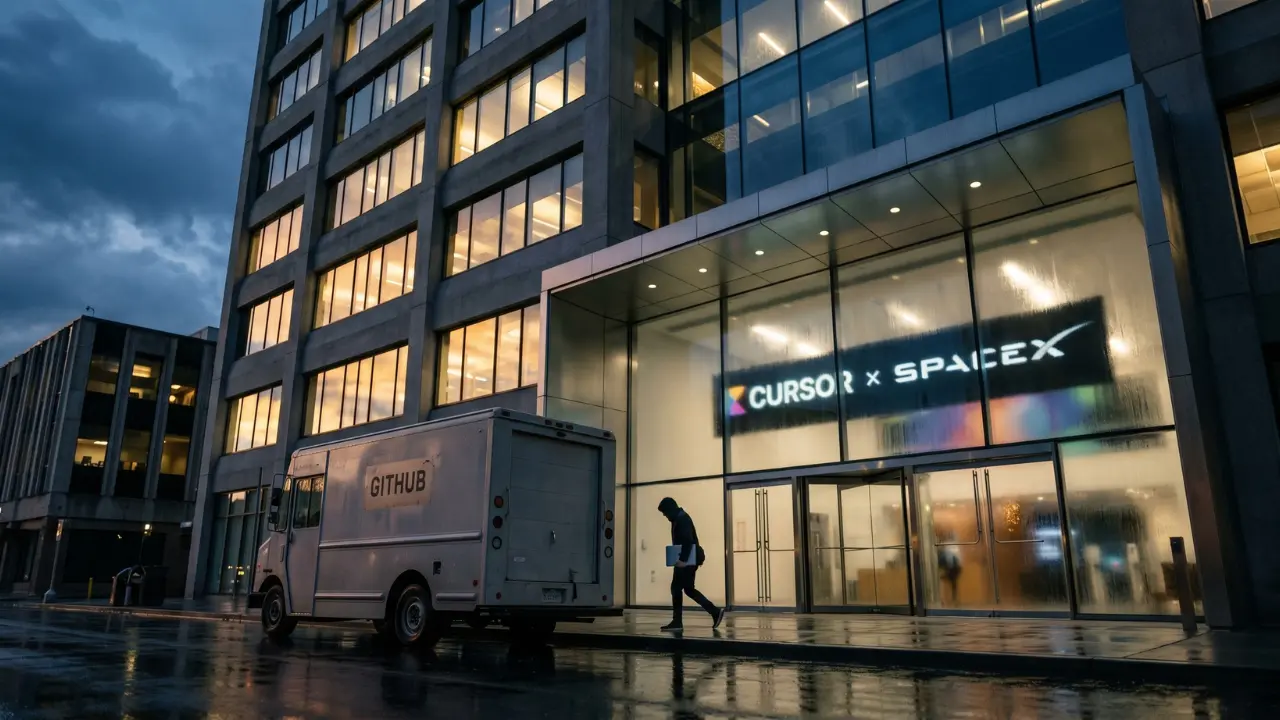
The celebration around SpaceX’s $60 billion deal to acquire Cursor lasted less than twenty-four hours before the harder questions began.
Regulators in Washington and Brussels are already studying the announcement.
Competing vendors from Redmond to San Francisco are holding emergency strategy sessions.
And enterprise CIOs, particularly those with multi-year commitments to a single AI coding provider, are quietly auditing their exposure.
This is no longer a simple startup acquisition story. It is the first vertically integrated mega-deal of the AI era, and it will define how governments regulate compute and developer tooling for the rest of the decade.
Why the FTC and EU Cannot Ignore This Deal
The antitrust concern is structural, not ideological.
Musk already controls the Colossus supercomputer in Memphis, the xAI foundation model lab, and the largest distribution channel for technical audiences through X.
Acquiring Cursor adds the dominant AI coding interface to that stack. Regulators will ask a straightforward question: can rival AI coding tools realistically compete when the vertically integrated incumbent controls the underlying compute?
The FTC under the 2023 merger guidelines is explicitly empowered to scrutinize vertical integrations that may foreclose competition at an adjacent layer.
The European Commission has even sharper tools through the Digital Markets Act and the recently enforced AI Act, which classifies large general-purpose AI systems as subject to heightened obligations.
Expect formal Phase 1 review in both jurisdictions within ninety days. Expect the deal timeline to stretch well into 2027 if remedies are demanded.
The Competitive Earthquake at Microsoft, Anthropic, and Google
For Microsoft, the deal is an existential threat to GitHub Copilot’s market leadership.
Copilot was built on the assumption that the combination of GitHub distribution plus OpenAI models was unassailable. A SpaceX-Cursor product backed by one million GPUs of Colossus compute breaks that assumption.
Microsoft’s counter-move will likely involve deeper OpenAI integration, aggressive enterprise discounting, and potentially a defensive acquisition of a remaining independent coding startup.
For Anthropic, the threat is different but equally serious. Claude Code has built credibility among senior engineers precisely because Anthropic is positioned as the neutral, safety-focused alternative.
That narrative now has to compete against raw compute supremacy, and Anthropic must decide whether to deepen its AWS and Google Cloud partnerships or accelerate its own agentic coding roadmap.
For Google, the deal exposes the long-standing gap between owning world-class models and owning developer workflows. Gemini Code Assist has technology, but it has never captured the loyalty that Cursor commands on engineering teams.
For smaller players, from Replit to Codeium to the long tail of specialized agentic tools, the question is survival through differentiation or acquisition.
The CIO Playbook for Vendor Concentration Risk
Enterprise technology leaders have been here before. The 2010s taught every CIO that single-cloud dependency eventually becomes a boardroom liability.
The same lesson now applies to AI developer tooling, and the window to act is short.
First, audit existing Cursor and rival AI coding commitments. Identify contracts with lock-in clauses or data residency terms that would complicate a switch under changed ownership.
Second, mandate multi-vendor pilots. At least one alternative AI coding assistant should be running in parallel across critical engineering teams by the end of Q3.
Third, push portability into procurement. Prompts, agent configurations, and codebase context should be exportable in open formats, not trapped inside proprietary Cursor profiles.
Fourth, prepare for pricing realignment. History suggests that vertically integrated market leaders raise prices on enterprise SKUs within eighteen months of closing. Budget accordingly.
For Agile leaders and CTOs tracking the shift toward AI orchestration models, vendor neutrality is no longer an architectural preference. It is a risk management imperative.
The Geopolitical Subtext
There is a dimension of this deal that rarely surfaces in technology coverage.
If SpaceX-Cursor becomes the default toolchain for enterprise software development, a significant share of global source code will flow through infrastructure owned by a single American founder with complex international relationships.
Sovereign technology advocates in India, the European Union, and Southeast Asia are already treating this as a call to accelerate indigenous AI coding tools.
Expect government procurement policies in these regions to carry explicit preferences for domestically hosted or open-source alternatives within the next fiscal cycle.
For senior management at Indian GCCs and enterprise IT functions, the strategic question is no longer which AI coding tool is best. It is which tools will still be procurable by their government clients two years from now.
Frequently Asked Questions
Yes. A $60 billion acquisition combining the leading AI coding tool with the Colossus supercomputer is almost certain to attract scrutiny from the FTC in the United States and the European Commission under the Digital Markets Act. Regulators are expected to examine both vertical integration concerns and potential foreclosure of rival AI developer tools.
The deal directly challenges Microsoft's GitHub Copilot and Anthropic's Claude Code for developer mindshare. Microsoft may respond with deeper OpenAI integration or a counter-acquisition, while Anthropic and Google will need to accelerate their own agentic coding roadmaps to avoid being squeezed out of the enterprise developer market.
CIOs should immediately audit current AI tooling commitments, negotiate multi-vendor clauses into enterprise contracts, and pilot at least one alternative AI coding assistant alongside any SpaceX-Cursor deployment. Portability of prompts, context, and agent configurations must become a standard procurement requirement.