SpaceX’s $60B Cursor Deal: The AI Coding Arms Race Escalates
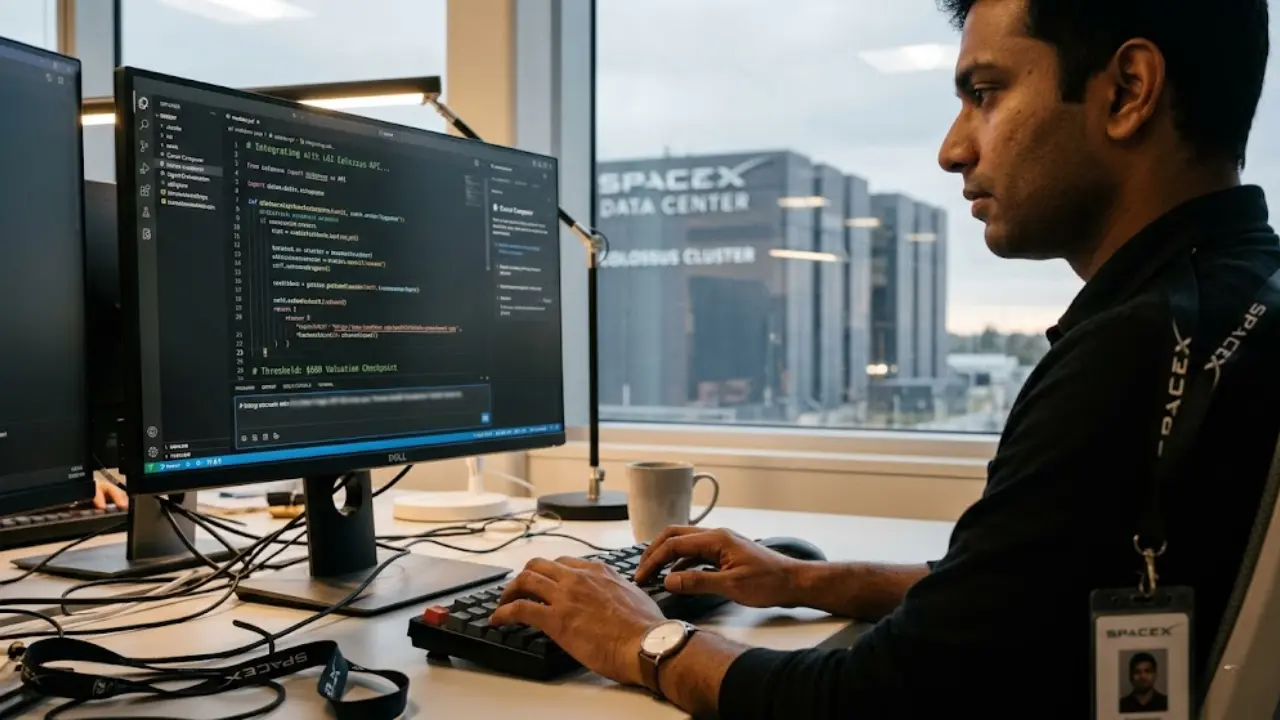
In a maneuver that fundamentally blurs the line between aerospace infrastructure and software engineering, SpaceX has officially secured the rights to acquire the leading AI coding startup, Cursor, for a staggering $60 billion.
Alternatively, the Elon Musk-led conglomerate holds the option to pay $10 billion for ongoing joint development.
The April 21, 2026, announcement solidifies Musk's aggressive pivot toward dominating the developer tooling ecosystem.
This megadeal arrives precisely as SpaceX prepares for a highly anticipated IPO targeting a massive $1.75 trillion valuation.
Following SpaceX’s absorption of xAI earlier this year, the company is rapidly restructuring into an AI-first juggernaut.
At the heart of this partnership is raw, unprecedented compute access.
Cursor’s proprietary AI models will now be hyper-scaled using SpaceX’s "Colossus" supercomputer in Memphis, which boasts a capacity equivalent to one million H100 GPUs.
Colossus Meets Composer: The Death of Manual Syntax
For software architects, senior engineers, and Agile practitioners, this integration changes the fundamental physics of code generation.
The bottleneck in modern software development is no longer drafting syntax.
Instead, the bottleneck is architectural orchestration and managing the agentic harness.
Cursor’s ability to execute complex, multi-file reasoning will be supercharged by xAI’s Colossus infrastructure.
This compute injection will dramatically compress Agile sprint timelines. Development teams are rapidly transitioning into the "vibe coding" era, shifting away from writing discrete functions line-by-line.
Developers will increasingly transition into becoming AI orchestrators, guiding intelligent agents to construct entire microservices through high-level natural language prompts.
Models backed by a million GPUs can ingest and comprehend entire enterprise codebases in seconds.
However, this hyper-velocity introduces critical architectural risks. When an AI can scaffold robust backend services in minutes, the rate of accumulating undocumented technical debt scales proportionately.
To survive this shift, Agile teams must overhaul their CI/CD pipelines.
They must integrate aggressive, AI-aware automated testing to validate machine-generated logic against enterprise security standards.
Pre-IPO Megadeal: Rewriting Enterprise Lock-In and GCC Outsourcing
From the C-Suite perspective, this $60 billion valuation is a calculated pre-IPO power play.
It is designed to position SpaceX as the foundational compute layer of global knowledge work.
CEOs and Tech Founders must recognize that the fragmented AI tooling market is aggressively consolidating.
As developers become deeply entrenched in the SpaceX/xAI ecosystem, the enterprise cost of switching infrastructure will become astronomical.
For CTOs and Global Capability Center (GCC) leaders, particularly in India, this consolidation signals a brutal paradigm shift.
The offshore outsourcing model relies heavily on linear headcount scaling—a strategy that is now obsolete.
When elite Indian engineers armed with Colossus-backed Cursor licenses achieve 10x productivity, enterprises will stop paying for raw headcount.
Instead, they will demand smaller, highly specialized pods of AI orchestrators.
Senior management must rigorously audit their tech stacks today. The race to adopt AI must be balanced against the realities of API costs, data privacy, and vendor lock-in.
Frequently Asked Questions
SpaceX has secured a dual-path agreement granting them the option to acquire Cursor outright for $60 billion later in 2026. If the full acquisition is not finalized, SpaceX will pay $10 billion for their ongoing collaborative development.
Colossus is a massive AI training cluster operated by SpaceX's xAI division, boasting computing power equivalent to one million GPUs. This infrastructure will be used to hyper-scale Cursor's coding models, allowing them to process massive enterprise codebases instantly.
The role of the software engineer is shifting from manually typing syntax to orchestrating AI agents. Developers will use Cursor's supercharged models to generate complex microservices, requiring stronger skills in architectural review and automated QA testing.