John Ternus Named Apple CEO: The Engineer's Era Begins
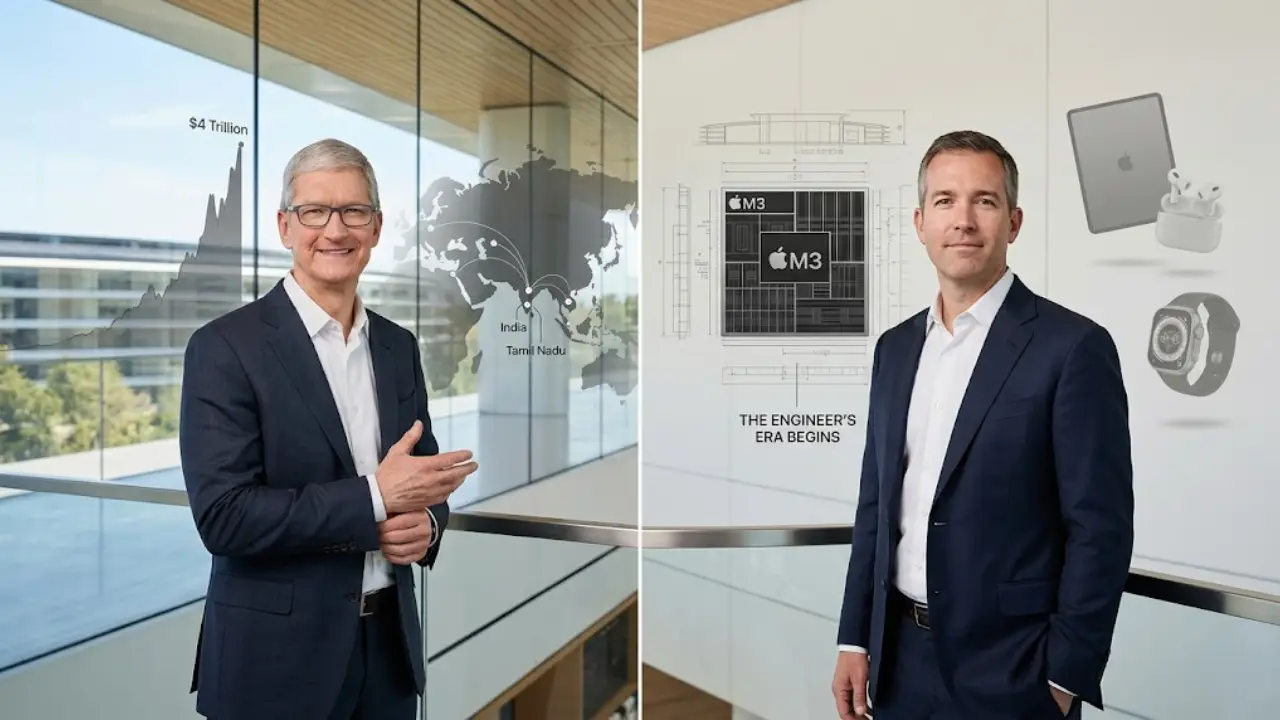
Apple has officially closed the book on the fifteen-year Tim Cook era.
In a press release dated April 20, 2026, the company announced that John Ternus, senior vice president of Hardware Engineering, will assume the role of chief executive officer effective September 1, 2026. Cook transitions to the position of executive chairman of Apple's board, where he will continue engaging with policymakers globally.
The succession, unanimously approved by the Board of Directors, follows what Apple described as "a thoughtful, long-term succession planning process."
The scale of Cook's outgoing ledger is staggering and sets a near-impossible benchmark.
Under his leadership since 2011, Apple grew from a market capitalization of roughly $350 billion to $4 trillion — a more than 1,000% increase.
Annual revenue nearly quadrupled, from $108 billion in fiscal 2011 to over $416 billion in fiscal 2025. The Services business alone is now a $100 billion Fortune-40-scale entity, and Apple's active installed base now exceeds 2.5 billion devices across more than 200 countries.
Cook also oversaw the successful transition to Apple-designed silicon — a strategic lever Ternus inherits as his single most valuable weapon.
Ternus, a 25-year Apple veteran who joined the product design team in 2001, is not a financial or operational CEO in the Cook mold — he is a mechanical engineer from the University of Pennsylvania who worked under Steve Jobs and rose through hardware ranks to lead the teams behind iPad, AirPods, Apple Watch Ultra 3, the MacBook Neo, and the recent iPhone 17 Pro, iPhone 17, and iPhone Air lineup.
In Cook's own words, Ternus has "the mind of an engineer, the soul of an innovator, and the heart to lead with integrity."
Arthur Levinson, Apple's non-executive chairman for the past 15 years, will become lead independent director on the same September 1 date, with Ternus joining the board.
Why a Hardware Engineer at the Helm Rewires Apple's Stack Priorities
For developers who build on Apple's platforms, the elevation of a hardware engineer — not a services chief, not a software lead, not an AI executive — is the single most important signal in this announcement.
It confirms that the vertical integration thesis that began with the M1 transition is now permanent company doctrine, and that the silicon-software-device tight coupling will deepen rather than loosen under the new regime.
Ternus's direct fingerprints are on Apple's most consequential recent hardware bets: the M-series Mac renaissance, the 3-D printed titanium chassis of Apple Watch Ultra 3, the recycled aluminum compound now standardized across multiple product lines, and the AirPods evolution into an FDA-recognized over-the-counter hearing aid platform.
For iOS, macOS, and visionOS developers, this translates into a predictable roadmap: expect tighter Metal API optimizations tied to specific silicon generations, more aggressive on-device ML acceleration baked into successive chip families, and harder sensor-driven platform capabilities that reward native development over cross-platform abstractions like React Native or Flutter.
The second-order effect hits daily workflow inside engineering teams. Architects building for Apple's ecosystem now have a far clearer bet to make when justifying native-first roadmaps to product owners: a hardware CEO will not soften the platform's integration requirements to accommodate the lowest common denominator.
Scrum teams working on sprint commitments against iOS 20, macOS 27, and visionOS 4 should expect continued deprecation cycles, stricter App Store hardware-capability gates, and a sharper reward curve for features that exploit specific Neural Engine, Secure Enclave, or ANE capabilities.
The "write once, run anywhere" dream remains dead on Apple surfaces.
There is also a quieter architectural consequence for backend and cloud teams.
Ternus's tenure has been defined by reliability, durability, and repairability innovations — not by services or cloud expansion.
CTOs managing hybrid Apple-device fleets should anticipate that Private Cloud Compute, on-device Apple Intelligence, and the broader privacy-first inference architecture will continue pulling compute toward the edge and away from centralized API calls.
This has direct cost, latency, and compliance implications for any team currently leaning on cloud LLM endpoints for features that Apple is quietly re-architecting to run locally on a neural accelerator.
The $4 Trillion Handover: Strategic Calculus for CTOs, CIOs, and GCC Leaders
For C-suite leaders, the Cook-to-Ternus transition is not a personnel update — it is a multi-year strategic tell about where Apple's capital, partnerships, and procurement leverage will flow.
Cook's remaining mandate as executive chairman — engaging with policymakers globally — is itself a significant disclosure.
It confirms that geopolitical negotiation, tariff navigation, and China-India supply-chain rebalancing remain board-level priorities, now handled by a dedicated chair rather than a distracted CEO.
The operational engine, meanwhile, shifts fully to product.
This has direct consequences for India's tech ecosystem. Apple's manufacturing footprint expansion in India — a Cook-era initiative tied to his policymaker relationships — now has a board-level sponsor in Cook even as day-to-day execution passes to Ternus.
For Indian GCC leaders whose roadmaps depend on Apple-device enterprise fleets, MDM strategies, and B2B deployment programs, the stability signal is strong.
For component suppliers and EMS partners in Tamil Nadu and Karnataka, Cook's continued policymaker engagement suggests the diversification away from China-centric assembly will accelerate rather than slow.
The risk vector is narrower but real: a hardware-first CEO will demand tighter supplier KPIs on yield, defect rate, and reliability — the exact areas where Ternus built his reputation internally.
The harsher reality sits in the AI infrastructure question no one at Apple is addressing directly in the succession announcement.
Cook's tenure delivered the silicon transition; Ternus inherits the AI era.
Apple Intelligence rollout, Private Cloud Compute economics, and the unresolved question of whether Apple builds, buys, or partners for frontier model capability all land on the new CEO's desk.
For enterprise CTOs evaluating Apple as a platform for AI-enabled workflows, this is the single variable to watch.
The cost-per-token wars playing out across Nvidia, OpenAI, and Anthropic do not touch Apple directly — yet.
But a hardware CEO running a company with 2.5 billion edge devices has a structurally different answer to AI infrastructure ROI than a services-led competitor, and enterprise architects should begin modeling that divergence now.
Investor and CFO-facing considerations also sharpen. The $100 billion Services business — effectively a Fortune 40 company embedded inside Apple — is not Ternus's native operating territory.
Expect analyst scrutiny in the first two earnings cycles post-transition on whether Services growth holds its double-digit trajectory under an engineer CEO, or whether the hardware gravity reasserts itself in product prioritization.
For Indian and GCC leaders benchmarking their own succession plans, the Ternus appointment is a case study worth internalizing: Apple has just validated that deep-functional domain expertise, 25-year institutional tenure, and demonstrated product-shipping cadence can outweigh the conventional CFO-to-CEO or COO-to-CEO pathway that has dominated Fortune 500 succession for a decade.
For parallel context on how another mega-cap tech company is navigating a near-identical generational handover amid the AI pivot, readers should review our deep analysis of the Adobe CEO succession and its AI-era implications, which traces a remarkably similar playbook with very different strategic outcomes.
Frequently Asked Questions
John Ternus becomes Apple's CEO effective September 1, 2026. Tim Cook will continue as CEO through the summer of 2026 to work closely with Ternus on the transition, after which Cook assumes the role of executive chairman of Apple's board.
Ternus joined Apple's product design team in 2001, became vice president of Hardware Engineering in 2013, and joined the executive team in 2021 as senior vice president of Hardware Engineering. He holds a mechanical engineering degree from the University of Pennsylvania and previously worked at Virtual Research Systems. He has led hardware work on iPad, AirPods, iPhone, Mac, and Apple Watch.
As executive chairman, Tim Cook will assist with certain aspects of the company, including engaging with policymakers around the world. Arthur Levinson, who has been non-executive chairman for the past 15 years, will transition to lead independent director on September 1, 2026, while Ternus joins the board of directors on the same date.