Prototype to Production: The 9-Gate AI Checklist
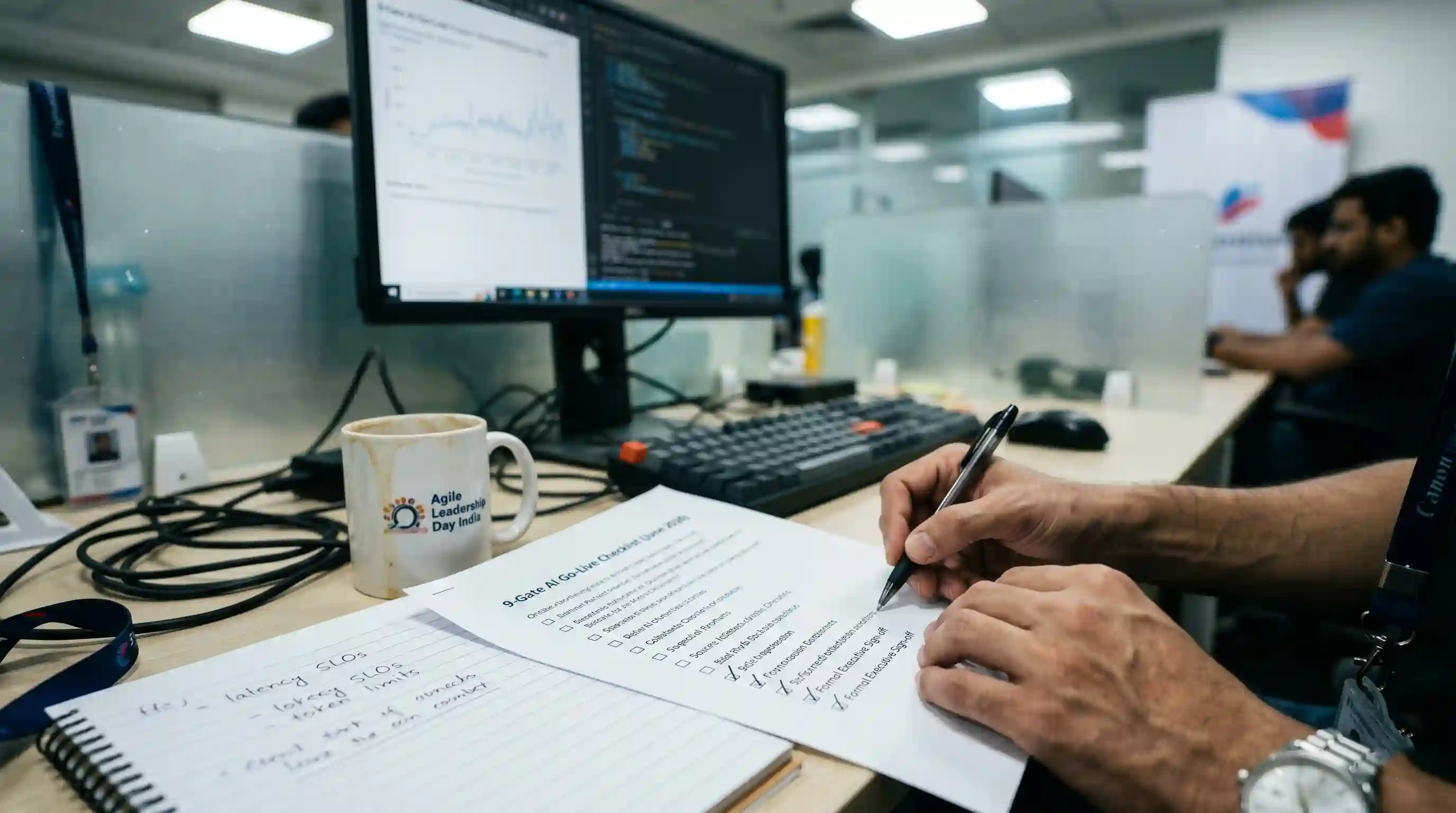
- Prototypes test feasibility; production demands reliability: Sandbox demos prove an agent can work, but go-live gates prove it will work under chaotic enterprise load.
- Cost ceilings are mandatory: Without strict token and loop limits, an autonomous agent can silently burn through massive budgets in hours.
- Rollbacks require programmatic kill-switches: You cannot gracefully degrade an autonomous system without explicit, pre-defined termination criteria.
- Sign-off establishes liability: Moving to production requires explicit executive and security approval mapping directly to defined MLOps gates.
A working prototype is not a product. The gap between them is a set of gates—evaluations, observability, rollback criteria, cost ceilings, and formal sign-off—that most teams skip until an incident forces them to retrofit each one painfully.
When executives ask why AI agents fail in production, the answer often points back to a nonexistent deployment methodology. Engineering teams build impressive proofs-of-concept on golden inputs, then blindly push them live without establishing strict go-live criteria.
To escape pilot purgatory, you must stop treating AI deployments as casual software updates. Transitioning a generative workflow requires an explicit prototype to production AI checklist to validate reliability, security, and scalability before user impact occurs.
Why a Working Prototype is Not a Product
In a prototype stage, an agent operates within a curated, highly controlled environment. The inputs are sanitized, concurrency is limited to a single user, and the data is perfectly clean.
Production destroys these conditions. Real users will submit ambiguous prompts, legacy systems will throttle your API calls, and the agent will be forced to navigate incomplete data payloads.
A prototype only measures whether the model's logic holds. A production agent must survive the brownfield integration layer, handle authentication failures, and recover from compounding errors automatically.
The 9-Gate Prototype to Production AI Checklist
This lifecycle and maturity migration checklist moves your agent from a fragile sandbox state into a resilient enterprise asset.
Gates 1-3: Evals and Reliability Metrics
1. Task Success Rate Validation: You cannot ship based on uptime. The agent must consistently clear a predefined task success threshold (e.g., 95%) across a diverse, adversarial evaluation dataset.
2. Trajectory Accuracy Scoring: The agent must demonstrate efficient tool-calling. If the model takes twenty unnecessary steps to fetch a single record, it fails the efficiency gate and is not ready for live token costs.
3. Integration Contract Formalization: The prototype must abandon mocked APIs. The agent must successfully authenticate against production-equivalent databases while obeying strict service-account permissions.
Gates 4-6: Observability, Load, and Cost
4. End-to-End Observability Deployment: You must implement a full tracing layer. If the agent hallucinates, engineers must be able to view the exact prompt, retrieved context, and tool output that triggered the error.
5. Concurrent Load Testing: Demos run sequentially. Production runs concurrently. The agent must maintain its latency Service Level Objectives (SLOs) when bombarded with hundreds of simultaneous sessions.
6. Hard Cost Ceilings and Token Limits: Agents can enter infinite loops. You must establish programmatic cost ceilings that automatically kill a session if token consumption exceeds a predefined budget limit.
Gates 7-9: Rollback, Guardrails, and Sign-off
7. Automated Rollback and Kill-Switches: If the system begins executing destructive actions, you need an immediate kill-switch. Implement kill-switch and observability protocols to trigger these programmatic safety mechanisms.
8. Compliance and NIST Alignment: Before launch, the agent must clear regulatory compliance. This is separate from operational readiness; map your system using an autonomous-agent compliance/NIST checklist.
9. Formal Executive Sign-off: The final gate is human. The business owner, security lead, and engineering manager must explicitly sign off on the agent's failure rates, recognizing the residual liability of the deployment.
Conclusion & CTA
Pushing a working prototype directly into live operations is the fastest way to trigger a highly visible, costly AI failure. The gap between a demo and a deployment is bridged entirely by engineering discipline and rigorous testing methodologies.
Stop launching fragile sandboxes. Institute the 9-gate prototype-to-production checklist today. Force every autonomous workflow to prove its reliability, establish hard cost ceilings, and implement your kill-switches before a single live user interacts with your agent.

Frequently Asked Questions (FAQ)
The checklist requires clearing nine strict operational gates: task success validation, trajectory scoring, integration contract formalization, end-to-end observability, load testing, strict cost ceilings, automated rollbacks, compliance alignment, and explicit executive sign-off before launch.
Production-ready means the agent has been tested against long-tail, adversarial inputs and messy enterprise systems. It guarantees that the agent operates within defined cost ceilings, logs every trajectory for observability, and can safely self-terminate or recover during API failures.
An agent must pass pre-deployment evaluations for task success and hallucination rates. It must also clear infrastructure gates, including concurrency load testing, API rate-limit handling, and the implementation of deterministic kill-switches and monitoring layers.
A prototype operates in a sanitized environment with perfectly mocked APIs, golden inputs, and single-user concurrency. A production agent navigates brownfield architecture, handles adversarial prompts, manages rate limits, and operates securely under massive concurrent load.
Before shipping, engineering teams must run end-to-end task success evaluations, trajectory accuracy scoring, and groundedness checks. These evals ensure the agent calls the correct tools efficiently and restricts its answers exclusively to verified enterprise data.
Complete step-level observability is mandatory. You must capture the agent's exact prompt, the retrieved context payload, the raw JSON of every tool call, and the final output. This allows engineers to debug probabilistic failures and silent hallucinations immediately.
Kill-switch criteria are defined by token consumption limits, consecutive API failure thresholds, and latency caps. If an agent loops unproductively or attempts to access unauthorized data repeatedly, the orchestration layer must automatically terminate the session and alert a human.
Go-live decisions require tripartite sign-off: the Engineering Lead validates technical stability, the Security/Compliance Lead validates data privacy and zero-trust access, and the Business Owner accepts the operational liability and defined margin of error for the agent.
Teams must simulate peak concurrent user sessions to measure multi-turn latency and API throttling impacts. Cost testing involves tracking token consumption per task to establish hard budget ceilings, preventing runaway inference loops from draining cloud budgets overnight.
If organizations establish clear "production-ready" definitions and go-live gates upfront, the transition can take just a few weeks. However, teams that skip architectural planning and attempt to retrofit observability and security after a failed demo often stall for multiple quarters.