Your AI Generated Code Review Checklist Fails Audit
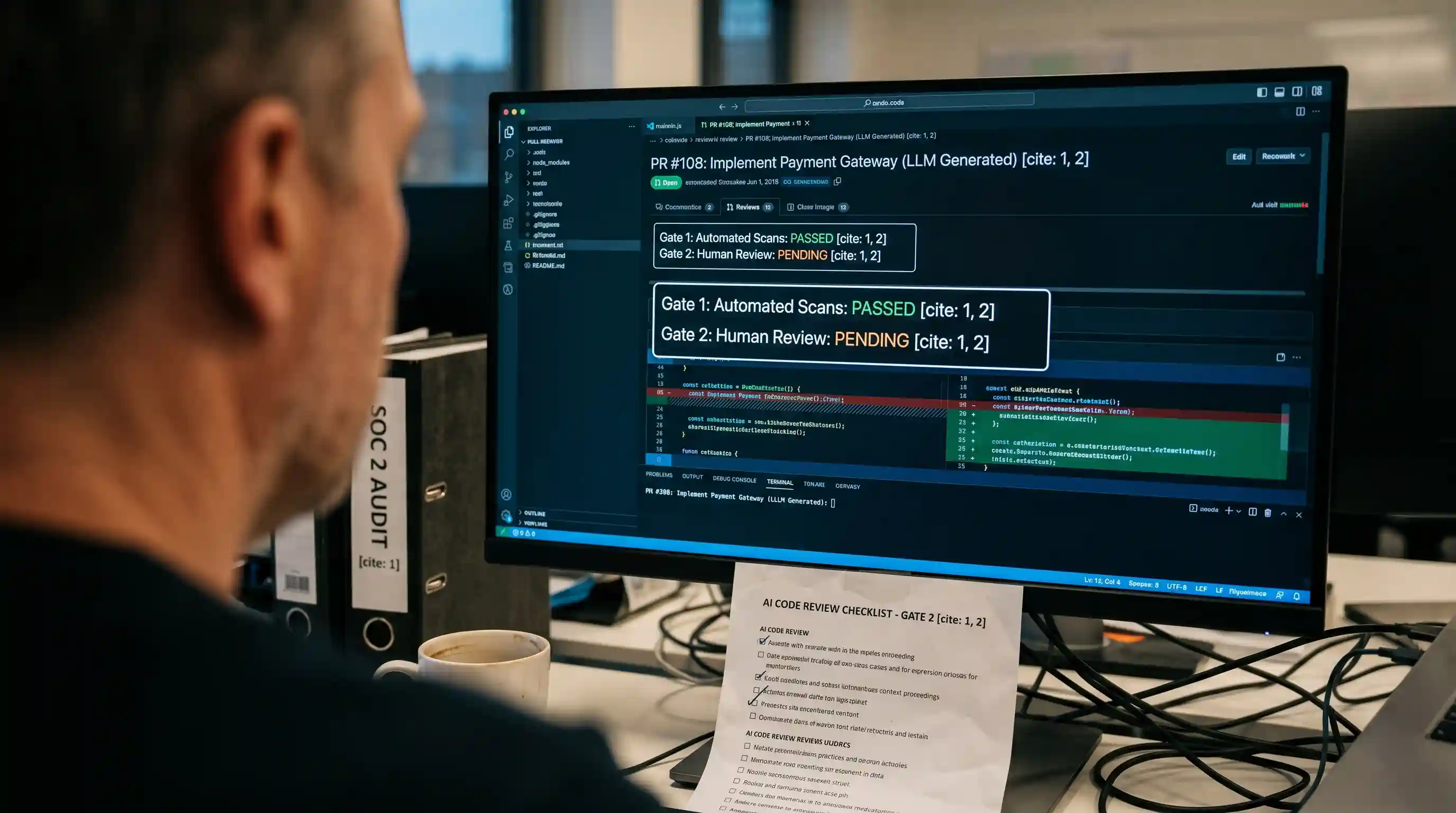
- Compliance Blindspots: Traditional peer reviews fail to satisfy EU AI Act Article 15 requirements because they ignore AI-specific attack vectors.
- The 12-Step Standard: A compliant AI generated code review checklist requires four phases: Provenance, Vulnerability Scanning, Logic Validation, and Evidence Archival.
- Automated Enforcement: Manual reviews are too slow for vibe coding; you must implement automated pull request AI gates inside GitHub or GitLab.
- Regulatory Proof: Implementing this checklist provides the exact evidence chain required for AI code review SOC 2 Type II audits.
Most AI generated code review checklists miss Article 15 cybersecurity gates and prompt injection vectors entirely.
Engineering teams mistakenly believe that treating Copilot or Cursor outputs like standard human commits is sufficient for compliance. It is not.
When Big 4 auditors examine your workflows, they aren't just looking for functional bugs; they are looking for joint-authorship provenance and evidence of AI-specific risk mitigation. We covered the macro-level failures in our master guide on vibe coding governance and enterprise risk management.
Now, it is time to operationalize those defenses at the pull request level. If your current copilot review checklist doesn't account for hallucinated dependencies or model data exfiltration, your next compliance audit is already compromised. Get the 12-step checklist auditors actually accept.
Why Reviewing AI-Generated Code is Fundamentally Different
Reviewing AI-generated code is not the same as reviewing human code. Traditional secure SDLC assumes a human authored every line, which means intent and logic can be traced back to a specific developer's thought process.
Vibe coding changes this paradigm. Authorship is now a joint effort between a human prompt and an LLM's statistical output. Because models generate code at unprecedented speeds, a standard human reviewer simply cannot keep up with the volume or spot subtle, AI-specific flaws without augmented tooling.
This requires a dedicated Cursor code review policy that actively hunts for prompt injections, hallucinated APIs, and insecure output handling.
To effectively manage this shift, leaders must adapt their team structures, a concept we explore deeply in our framework for managing vibe coding teams.
The 12-Step AI Generated Code Review Checklist
To pass audit, your organization must enforce this 12-step checklist on every AI-assisted pull request.
Phase 1: Provenance and Authorship Validation
1. Verify AI Provenance Tags: Ensure every block of AI-generated code is explicitly tagged with the model version and the original developer prompt.
2. Check Data Exfiltration Boundaries: Confirm the developer did not include PII, PHI, or proprietary algorithms in the prompt context window.
3. Validate Approved Tooling: Ensure the code was generated by an enterprise-approved, zero-retention LLM tenant, not a shadow IT subscription.
Phase 2: Vulnerability and Hallucination Scanning
4. Execute Prompt Injection SAST: Run specialized linters designed to catch indirect prompt injections hidden within third-party comments or strings. For a deeper look at these specific threats, review our breakdown of vibe coding security risks.
5. Verify Dependency Existence: Check every imported package against a live registry to ensure the LLM hasn't hallucinated a dependency that a typosquatter could hijack.
6. Scan for Hallucinated APIs: Validate that all internal and external API calls generated by the model actually exist in the current documentation.
7. Assess Insecure Output Handling: Treat all AI code as untrusted user input. Verify that proper sanitization and validation wrappers are in place.
Phase 3: Architectural and Logic Validation
8. Test for Overreliance & Logic Blindspots: The human reviewer must confirm they fully understand the generated algorithm and aren't blindly trusting the LLM's logic.
9. Enforce Minimum Test Coverage: AI-generated functions must be accompanied by human-reviewed unit and integration tests.
10. Check for Technical Debt Accrual: Assess if the AI's solution is overly complex or introduces unnecessary boilerplate that will bloat the codebase.
Phase 4: Compliance and Evidence Archival
11. Log the Review Decision: The named human reviewer must explicitly record their approval, noting that AI-specific checks were completed.
12. Archive the Evidence Chain: Automatically export the provenance data, SAST results, and approval logs to an immutable compliance vault for future Article 15 or SOC 2 audits.
Automating the Process: Pull Request AI Gates
Manual enforcement of a 12-step checklist will destroy your sprint velocity. You must rely heavily on AI code review automation.
Integrate these steps directly into your CI/CD pipelines as hard pull request AI gates. GitHub Actions or GitLab CI can automatically run the dependency verification, SAST prompt injection scans, and provenance tagging before a human ever looks at the diff.
The human reviewer should only step in for Phase 3 (Logic Validation) and Phase 4 (Decision Logging). This hybrid approach maintains developer speed while ensuring a mathematically provable compliance posture.

Frequently Asked Questions (FAQ)
It must include provenance tracking, hallucinated dependency verification, prompt injection scanning, API hallucination checks, and explicit human sign-off logging to satisfy modern compliance audits.
Reviewing AI code requires validating joint-authorship provenance and actively hunting for LLM-specific vulnerabilities—like hallucinated APIs and indirect prompt injections—that traditional human-authored code reviews do not anticipate.
Steps that enforce prompt injection scanning, prevent supply-chain attacks via hallucinated dependencies, and log the immutable evidence chain of human oversight directly satisfy Article 15's robustness and cybersecurity mandates.
You must automate an AI-aware Software Bill of Materials (SBOM) diff on every pull request to verify that suggested packages exist on official registries, preventing typosquatting attacks.
Standard SAST tools often fail here. You must deploy specialized, LLM-aware linters that analyze data flow from external inputs (like third-party comments) into the model's context window during the generation phase.
While it doesn't need a separate queue, it does require a distinct set of automated CI/CD gates that fire specifically when AI provenance tags are detected in the commit history.
By heavily automating the vulnerability and provenance scanning phases within the CI/CD pipeline, the human portion of an AI code review should take no longer than a standard peer review, focusing purely on architectural logic.
A named, human peer reviewer with explicit training in AI code security must provide the final sign-off. This individual assumes accountability for the AI's output entering the production environment.
You must retain a provenance log (who prompted what), the model version used, the SAST vulnerability scan results, and the timestamped human approval decision to satisfy SOC 2 and EU AI Act audits.
Implement custom GitHub Actions or GitLab CI runners that enforce pull request AI gates. These runners automatically execute dependency checks, prompt injection linters, and provenance tagging before enabling the merge button.