Why Paying Per AI Token is a Guaranteed Loss: The Guide to Localizing Enterprise AI Token Costs
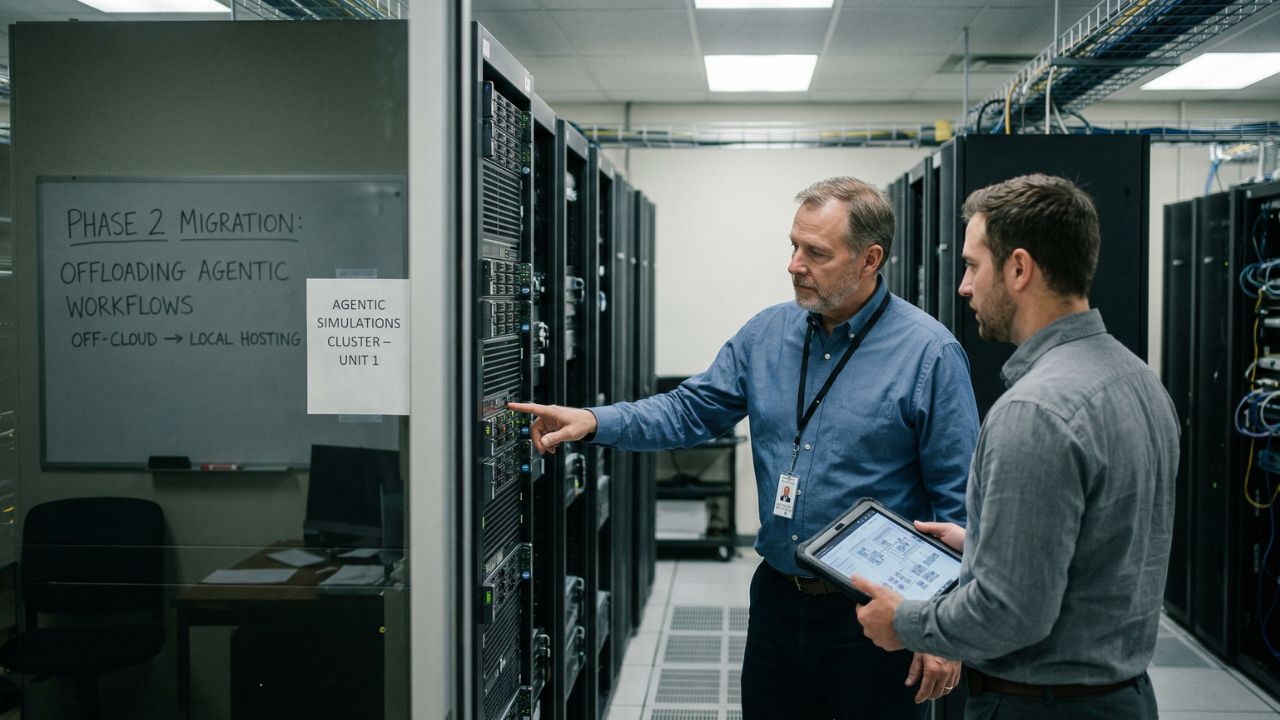
- The "API Token Tax" Destroys Budgets: Renting intelligence by the token is a fundamentally flawed model that aggressively punishes successful scaling.
- Agentic Workflows Exponentially Increase Costs: Autonomous AI agents require continuous loops of reasoning, making variable cloud billing unpredictable for Scrum teams.
- FinOps Predictability is Mandatory: Localizing enterprise ai token costs shifts unpredictable OpEx into predictable CapEx.
- Open Source is the Future: Running open-source LLMs on local hardware completely bypasses hyperscaler markups.
Every time your AI agent executes a workflow, Amazon or Microsoft takes a cut of your margin. When enterprise teams first pilot artificial intelligence, renting public cloud APIs seems logical. However, as organizations move from simple chatbots to autonomous agentic workflows, the math completely breaks down. Transitioning to a sovereign ai infrastructure for enterprise is the only sustainable way to build AI bots without destroying your IT budget.
Scaling an AI workforce on variable cloud pricing guarantees massive budget overruns. If your Scrum teams are trying to integrate localizing enterprise ai token costs into their sprint planning, they are likely realizing the impossibility of forecasting API burn rates. To protect your margins and guarantee sprint continuity, you must stop renting external APIs.
The Hidden Trap of Cloud Budgeting in Agile
The API token tax is the premium hyperscalers charge for passing your data through their proprietary Large Language Models (LLMs). You are billed for every input token (your prompt) and every output token (the AI's response). While this costs pennies at the pilot stage, the costs compound aggressively.
If an Agile development team uses an AI coding assistant, every line of code generated, reviewed, and refactored incurs a micro-charge. Over a two-week sprint, a team of fifty developers can easily rack up tens of thousands of dollars in hidden API fees. Autonomous AI inherently resists strict monitoring because its token consumption is dynamically generated.
Why Agentic Workflows Break the Bank
Unlike traditional software, autonomous AI agents operate in continuous loops. They plan, execute, evaluate, and retry. If an agent encounters a complex problem during a sprint, it might trigger hundreds of API calls in a matter of minutes to find a solution. This means that an agentic workforce inflates cloud budgets exponentially compared to traditional static applications.
Product Owners attempting to write accurate user stories cannot predict how many reasoning steps an agent will take. Therefore, forecasting the exact API budget required to move a user story to "Done" is impossible under a pay-per-token model. This unpredictability creates a significant barrier to effective Agile delivery.
The FinOps Math: Localizing Enterprise AI Token Costs
To regain control over Agile delivery pipelines, technology leaders are drastically changing their infrastructure strategy. The solution is localizing enterprise ai token costs by moving workloads off the public cloud. When you purchase bare-metal servers, you incur a fixed Capital Expenditure (CapEx).
Once the hardware is racked and powered, the marginal cost of generating an AI token drops to near zero. This financial shift completely changes how Scrum teams plan their sprints. Instead of worrying about API limits, developers have access to massive, predictable compute power that does not fluctuate in price based on utilization.
Realigning Sprint Planning for Hardware Economics
When you control your own hardware, compute capacity becomes a fixed resource rather than a financial liability. During Sprint Planning, the Scrum Master and Product Owner must treat this compute capacity as a critical dependency. Instead of estimating financial costs, teams estimate hardware utilization.
In a cloud-dependent environment, Scrum Masters are often forced to act as financial gatekeepers. By localizing enterprise AI token costs, they are freed from this restrictive policing and can return to their primary objective: facilitating flow and increasing delivery velocity. When developers aren't afraid of triggering massive bills, they iterate faster.
Transitioning to Bare-Metal Architectures
Enterprise leaders are ripping out their cloud LLMs and replacing them with high-performance bare-metal servers. This transition requires mapping out the heaviest API consumers. Understanding the performance benchmarks of smci ai servers vs cloud llm apis is critical during this phase.
By deploying open-source models like Llama 3 or Mistral on localized hardware, enterprises completely eliminate the "API token tax". They secure proprietary data, bypass hyperscaler markups, and empower their Agile teams with infinite, flat-rate inference capabilities that support a truly scalable agentic workforce.

Frequently Asked Questions (FAQ)
What is the definition of an AI API token tax?
The API token tax refers to the aggressive, variable costs charged by public cloud hyperscalers for accessing proprietary LLMs. You are billed fractionally for every input and output, which destroys budgets at scale.
How does localizing enterprise ai token costs improve margins?
By hosting bare-metal servers, enterprises shift from unpredictable OpEx to fixed CapEx. Once operational, the cost per token drops to near zero, heavily protecting corporate profit margins.
Why does scaling an agentic workforce inflate cloud budgets?
Autonomous agents operate in continuous reasoning loops. They iteratively plan, execute, and verify, consuming massive amounts of tokens in the background compared to simple chatbots.
What is the break-even point for buying AI servers vs. renting?
For organizations running heavy workloads, the break-even point typically occurs between 6 to 8 months of active deployment compared to paying perpetual cloud fees.