Agent Amnesia: Why "Memory" is the Key to Enterprise Reliability
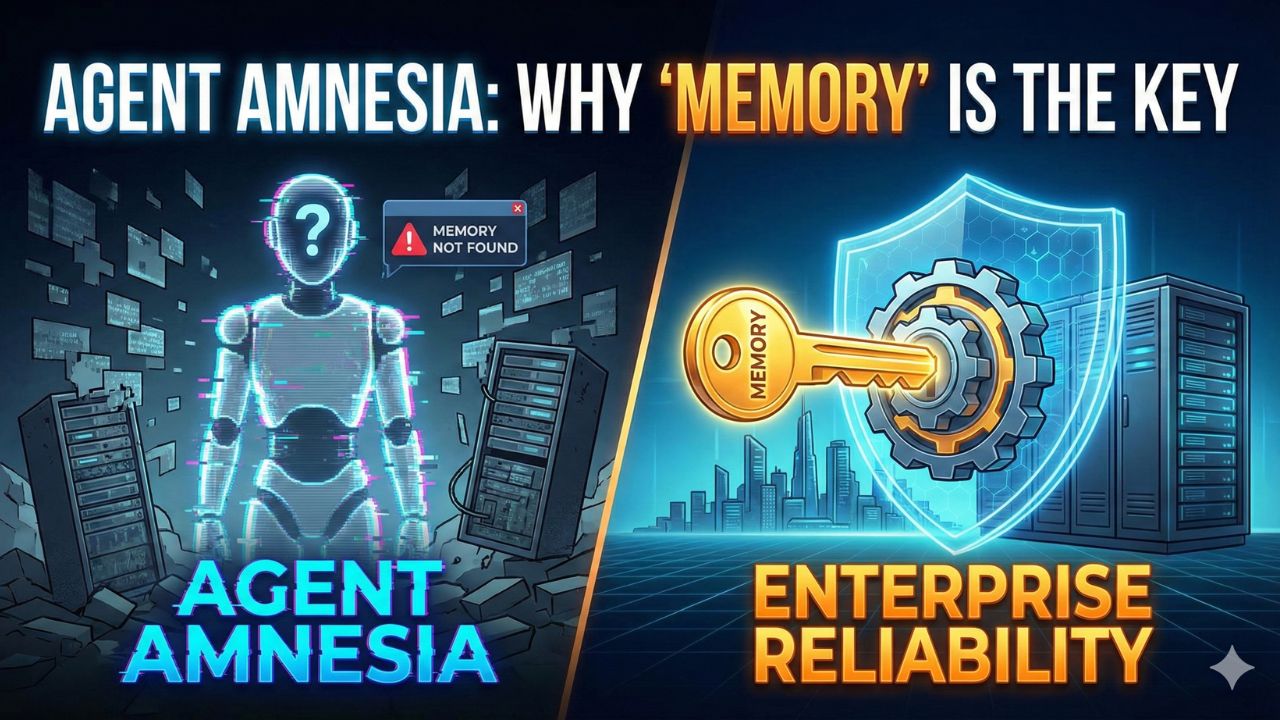
Imagine hiring a brilliant employee who forgets everything the moment they walk out of the room. Every morning, you have to re-introduce yourself, explain the project from scratch, and re-send every email. They are smart, but they have Amnesia.
This is the state of most AI deployments today. Standard LLMs are "Stateless"—they process a query and reset. While this works for a chatbot, it is catastrophic for Business Process Automation.
To move from "Toys" to "Enterprise Tools," we must solve the problem of Persistence. This deep dive explores how frameworks like LangGraph are solving this with Checkpointers and State Graphs.
Context: The Leader’s Guide to Multi-Agent Systems See how Memory fits into the broader "Agent Swarm" architecture.1. The "Stateless" Trap in Business Logic
Why does ChatGPT fail at real work? Because real work involves Wait Times.
Consider a "Procurement Agent" designed to handle invoice approvals:
- Step 1: Read PDF Invoice.
- Step 2: Verify amount is under $5,000.
- Step 3: Email the Manager for approval.
- Step 4: (Wait 2 Days for Manager to click "Approve").
- Step 5: Send payment to SAP.
2. The Solution: Persistence Layers (Checkpointers)
To solve this, we don't just need a database; we need a State Machine. In frameworks like LangGraph, this is handled by "Checkpointers."
A Checkpointer acts like a "Save Game" feature. After every single step the agent takes, it saves the entire state of the world to a database (like Postgres or Redis).
# Concept: LangGraph Checkpointer
workflow = StateGraph(AgentState)

# Add logic nodes
workflow.add_node("read_invoice", read_invoice_tool)
workflow.add_node("human_approval", wait_for_human)

# Compile with Persistence
app = workflow.compile(checkpointer=PostgresCheckpointer())

# When the human approves 3 days later:
app.invoke({"action": "approve"}, thread_id="invoice_123")
# The agent "wakes up", loads the state from DB, and continues.
This enables "Time Travel." You can not only resume workflows, but you can also "Rewind" an agent to a previous state if it makes a mistake, edit its memory, and let it try again.
3. Memory Architecture: Redis vs. Vector DBs
Not all memory is the same. In 2026, we distinguish between two types of agent memory:
1. Procedural Memory (Hot State)
Tool: Redis / Postgres.
Use Case: "Where am I in this workflow?" Used for the Checkpointers described above. It stores the immediate context, variables, and next steps.
2. Semantic Memory (Cold Storage)
Tool: Vector Databases (Pinecone, Milvus).
Use Case: "What did we learn last month?" This is used for RAG (Retrieval Augmented Generation). The agent queries this to find similar invoices from the past or company policies.
Comparison: Which Framework handles Memory best? See why LangGraph is the winner for stateful persistence.4. Frequently Asked Questions (FAQ)
A: Short-Term Memory is the "Context Window" (the active chat history) which is limited and expensive. Long-Term Memory is external storage (Vector DBs or SQL) where an agent stores facts to retrieve weeks later, much like a human writing in a notebook.
A: Business processes are rarely instant. If an invoice needs approval from a human, the agent must "pause" and wait 3 days. Without State Management (persistence), the agent dies when the script ends, forgetting the invoice ever existed.
A: A Checkpointer is a mechanism that saves the entire state of the agent (variables, history, next steps) to a database after every step. This allows you to "replay" an agent's actions or resume a crashed workflow exactly where it left off.
