How to Become a Forward Deployed AI Engineer in 90 Days
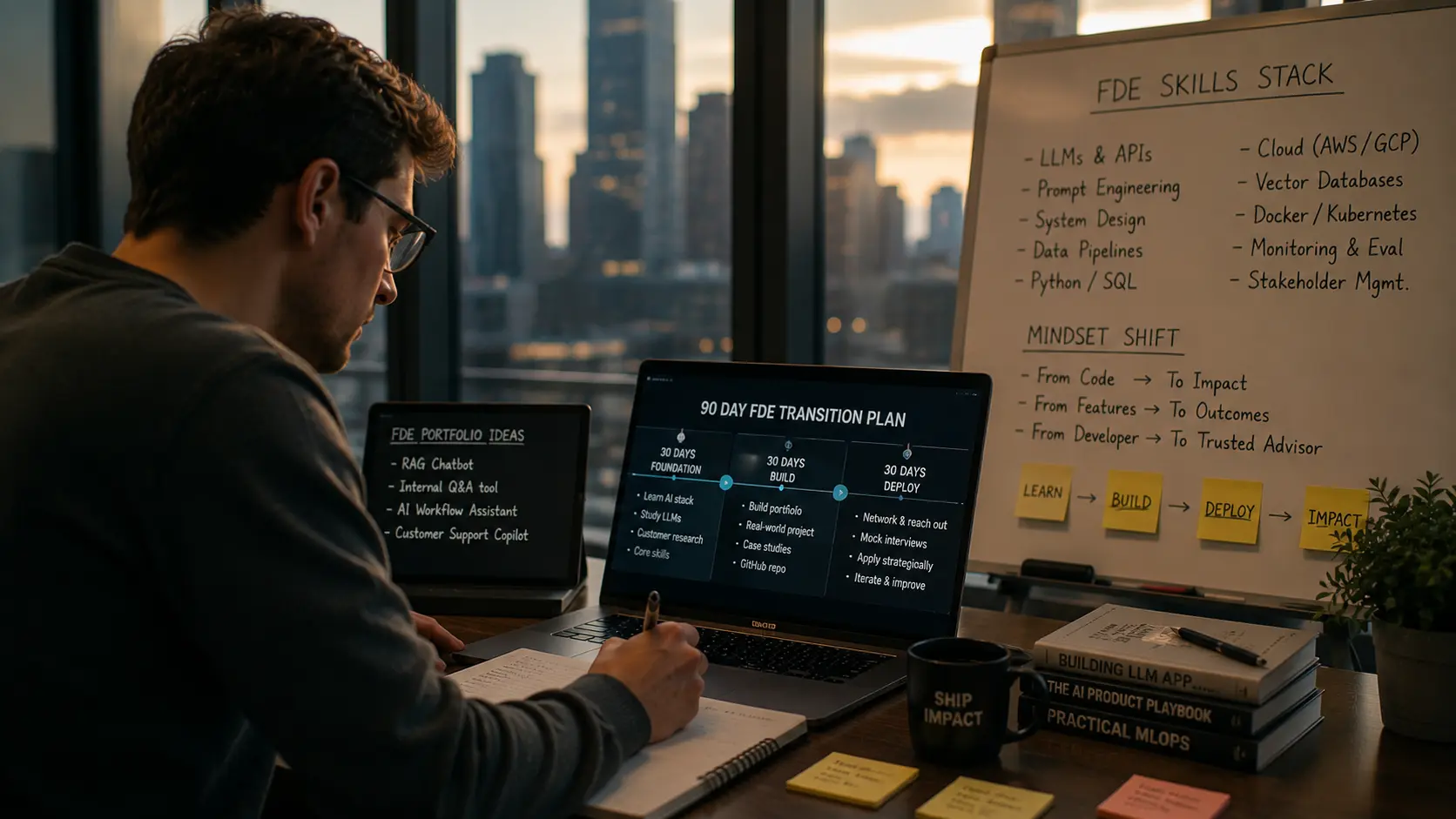
- The Realistic Timeline: For senior engineers with five-plus years of production experience, the transition takes 60 to 120 days, with 90 days being the exact modal timeline.
- The Positioning Filter: Your initial priority is not coding; it is rewriting your LinkedIn to bypass exact-match recruiter keyword filters.
- The Artifact Bar: You must build one comprehensive public portfolio project that explicitly demonstrates your grasp of the FDE skill stack.
- The True Interview Threat: Candidates rarely fail on raw coding; they fail on customer-empathy simulations and LLM-specific system design.
How to become a forward deployed ai engineer from software engineer—the 4-week LinkedIn rewrite that doubles recruiter inbound.
The playbook is inside. For senior software engineers, the transition to enterprise AI deployment is the highest-leverage career move of 2026.
However, most candidates waste months learning the wrong theoretical skills. To understand why the deployment market is exploding, first review our master architecture in the Forward Deployed Engineer 2026 Playbook.
If you already understand the market, the following 90-day curriculum is exactly how you execute the transition.
The 90-Day FDE Transition Timeline
Transitioning from a traditional backend or full-stack role into an FDE position requires a strictly phased approach.
The work breaks down into three distinct, four-week blocks. Do not attempt to build a portfolio before optimizing your inbound recruiter pipeline.
Weeks 1–4: Positioning and the LinkedIn Rewrite
The single highest-ROI action in your entire transition is rewriting your professional positioning.
Recruiters are desperately searching for FDEs, but they use exact-match, case-sensitive filtering.
You must overhaul your LinkedIn headline, your "About" section, and your most recent role bullets.
Incorporate specific title-modifiers. The explicit mention of phrases like "production AI systems," "evals," and "RAG" inside current-role descriptions puts you directly into the recruiter pipeline.
Engineers executing this correctly typically double their recruiter inbound within fourteen days.
Weeks 5–8: Skill Demonstration and FDE Portfolio Projects
Once your positioning attracts recruiters, you need a technical artifact to prove your capabilities.
You must build one public portfolio project on GitHub that exhibits the full FDE skill stack.
Do not build a massive, complex application. The depth of the project matters far less than its structural completeness.
The minimum viable artifact is a small agent application featuring a RAG pipeline, a Model Context Protocol (MCP) server integration, and an LLM-as-Judge eval suite with at least one regression test.
You must also include a written architecture decision record (ADR) explaining your trade-offs.
Weeks 9–12: Interview Loop Optimization
The final four weeks are dedicated strictly to interview preparation. Traditional algorithmic preparation is insufficient.
You must run mock interview loops focused specifically on the two most common FDE failure modes: the customer-empathy simulation and system design with eval gates.
Most senior engineers do not fail FDE loops on coding; they fail on these exact two stages.
Core Skills to Build Your FDE Portfolio
Building your portfolio requires demonstrating five distinct skills that separate regular software engineers from hireable FDEs.
These skills are heavily vetted during technical loops.
Evals Engineering and RAG Pipelines
Evals engineering is now the single most common reason candidates fail FDE final rounds.
Your portfolio must show you understand how to catch model regressions. You must prove you know why naive LLM-as-Judge fails on multi-turn agent traces and how to mitigate it.
If you cannot whiteboard a regression eval suite with a golden dataset and drift detection, you will not pass.
To urgently close this specific knowledge gap, review our deep dive on the evals engineering skills for forward deployed engineers.
The Senior Engineer Advantage
Mid-career software engineers possess a massive, hidden advantage over junior candidates.
The customer-empathy and system-design interview stages reward the exact judgment that comes from successfully shipping production systems through rigid corporate compliance gates.
If you have a decade of experience in regulated sectors like fintech or healthcare, your domain credibility is a competitive moat no recent graduate can match.
To maximize this advantage, many candidates pair their technical upskilling with the best AI leadership courses in India to sharpen their executive communication skills.

Frequently Asked Questions (FAQ)
For a senior software engineer possessing five or more years of production experience, the transition realistically takes 60 to 120 days. The most common modal timeline is exactly 90 days, split evenly into positioning, portfolio building, and targeted interview preparation.
Recruiters look for public repositories demonstrating structural completeness. The ideal artifact is a compact agent application featuring a RAG pipeline, an MCP server integration, a robust LLM-as-Judge eval suite with regression tests, and a clearly written architecture decision record.
While knowing major frameworks like LangChain or LlamaIndex demonstrates speed, building custom integrations often better signals your fundamental understanding of the underlying architectures. Top labs value your ability to manage token costs, latency, and system constraints over pure framework reliance.
You must inject exact-match title modifiers into your headline, summary, and recent job descriptions. Explicitly using phrases like "AI Engineer," "production AI systems," "evals," and "RAG pipelines" is the single highest-ROI action to immediately trigger recruiter Boolean searches.
Absolutely not. AI labs are aggressively prioritizing deployment capabilities over ML research credentials. A senior backend engineer possessing strong system design instincts, modern eval fluency, and customer empathy is a significantly more competitive candidate than a pure academic researcher.
The five critical skills are: evals engineering (including LLM-as-Judge), customer empathy under extreme technical constraint, production LLM system design, regulatory/compliance fluency, and the discipline to thoroughly document architectural decisions as you ship.
You must learn evals first. Evals engineering is the most heavily weighted skill in 2026 interview loops and the most under-supplied skill in the candidate pool. It is the stage that actively filters 70% of candidates who otherwise have strong technical CVs.
Open-source Model Context Protocol (MCP) contributions are highly valuable. Integrating an MCP server into your public portfolio project actively signals to recruiters that you understand the exact shape and standard of modern FDE deliverables and integration architecture.
Yes, but you must aggressively simulate it. FDE interviews feature intense "explain this to a CISO" simulations. You must prove you can hold technical boundaries under pressure and demonstrate strong customer empathy, relying on your past experience negotiating with internal corporate stakeholders.
Generic certifications hold little weight. The fastest, most effective way to signal FDE readiness is building a public, four-week portfolio project that explicitly features RAG, comprehensive eval suites, and a written architecture decision record, proving you can ship production-grade AI systems.