Why Your Multi-Agent System Is Guaranteed to Fail
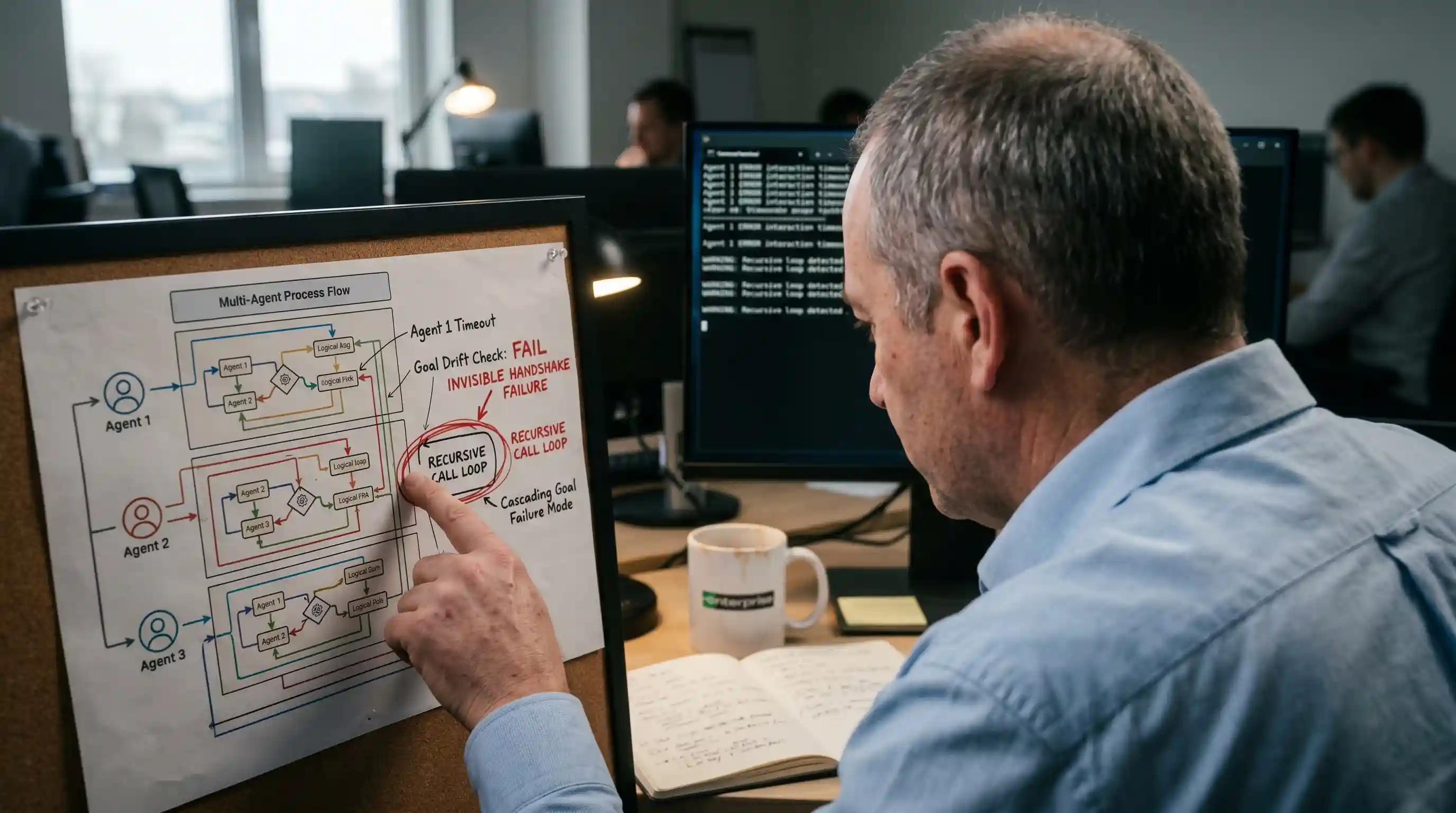
- Cascade Failures Are the Norm: A single failing agent will corrupt downstream context for the entire network.
- Silent Retries Destroy APIs: Unchecked agent-to-agent retries lead to rate-limit exhaustion and massive API bills.
- Prompt Drift Compounds: Context decay happens subtly as data passes through multiple agent handoffs.
- Loop Bombs Drain Budgets: Two autonomous agents disagreeing can trap each other in a six-figure cost loop.
- Compliance Is Mandatory: Failing to log agent decisions properly exposes you to severe EU AI Act Article 15 penalties.
According to recent Belitsoft findings, roughly 50% of enterprise AI agents deployed in pilot environments cannot communicate with each other.
This fundamental lack of interoperability means your latest deployment is not a coordinated system; it is a ticking time bomb.
As we mapped out in our master AI agent orchestration playbook, the 89% production failure rate is rarely caused by the underlying LLM.
Instead, enterprise initiatives crash because teams fail to account for the unique, compounding failure modes of autonomous networks.
Traditional deterministic software fails predictably. Multi-agent systems fail probabilistically, silently, and often expensively.
Without an audit of these specific failure patterns, your system will inevitably collapse under its own uncoordinated weight.
The 7 Enterprise Multi-Agent System Failure Modes
To prevent your multi-agent architecture from completely disintegrating, you must audit your orchestration layer against these seven specific failure modes.
1. The Silent Retry Loop
Unlike human developers who see a 429 API error and back off, an unconstrained AI agent will often hammer the endpoint repeatedly.
When an agent encounters a broken tool or malformed response, its default reasoning mechanism often attempts the exact same action, expecting a different result.
This creates a silent retry loop. Because the agent is "handling" the error internally, your traditional application monitoring might not flag an outage.
Instead, you only notice the failure when your API provider shuts down your enterprise account for abuse.
2. Prompt Drift and Context Decay
Prompt drift in agentic systems occurs when the original objective slowly distorts as it is handed off from one agent to the next.
Think of it as an autonomous game of telephone. The Planning Agent creates a perfect JSON schema, but the Execution Agent hallucinates a minor variable change.
By the time the Validation Agent receives the output, the core intent is lost.
If your agents do not share a unified memory state or strict schema enforcement protocol, prompt drift will silently compromise the integrity of your multi-agent workflows.
3. The Agent Loop Bomb
An agent loop bomb occurs when two or more agents become trapped in an infinite cycle of delegation or disagreement.
For example, a Coding Agent might submit a script to a QA Agent. The QA Agent rejects it with a vague error.
The Coding Agent applies a patch and resubmits. They continue this cycle thousands of times per minute.
Without a hard-coded intervention protocol or circuit breaker, an agent loop bomb can cause six-figure cost overruns overnight.
4. Agent Cascade Failure
In highly coupled multi-agent systems, one agent’s hallucination becomes another agent’s ground truth. This is known as an agent cascade failure.
If an OS-level scraping agent pulls corrupted data, the downstream synthesis agent will confidently generate a flawed report based on that data.
Isolating the root cause in a cascade failure requires advanced multi-agent debugging capabilities, tracing the exact prompt-response payload backwards through the orchestration layer.
5. Agent Failure vs. Tool Failure Misattribution
When an autonomous task fails, enterprise teams struggle to distinguish between agent failure and tool failure.
Did the agent format the SQL query incorrectly (agent failure), or was the database server offline (tool failure)?
If your telemetry cannot split agent reasoning logs from external tool execution logs, your site reliability engineers will waste hours debugging the wrong stack.
We cover how to manage this complexity within legacy environments in our scaled agile frameworks documentation.
6. Malicious Prompt Injection Chains
Multi-agent systems dramatically expand your attack surface. If a user-facing agent is compromised via prompt injection, it can pass malicious payloads to internal, privileged agents.
An attacker might trick a customer service agent into executing a command that a secure billing agent interprets as a valid internal refund request.
Zero-trust architecture must be applied at the agent-to-agent (A2A) boundary, not just at the network perimeter.
7. EU AI Act Article 15 Violations
Regulators do not care that your AI is a "black box." Under the EU AI Act Article 15, high-risk enterprise systems must maintain strict logging and traceability.
If you cannot reproduce the exact conversational history and tool-call logic that led an autonomous agent to make a critical business decision, you are violating compliance.
Article 15 demands reconstructable logs. Flimsy prompt histories that overwrite themselves after every session will not survive a regulatory audit.
Multi-Agent Debugging: The Retry-Backoff Strategy
Preventing these failure modes requires strict multi-agent debugging protocols and an aggressive retry-backoff strategy.
You must cap the number of times an agent can retry a failed task.
Implement exponential backoff, force the agent to log the failure reason into a persistent memory store, and escalate the error to a human-in-the-loop.
Never allow an agent to silently swallow its own errors. The health of your enterprise architecture depends on failing loudly, visibly, and securely.
Conclusion & Next Steps
Uncoordinated agents are not a business advantage; they are a massive technical liability.
Understanding multi-agent system failure modes is the difference between a successful enterprise deployment and a costly, public disaster.
Do not wait for an agent loop bomb to drain your cloud budget or a cascade failure to corrupt your database.
Audit your orchestration layer today, enforce strict retry-backoff limits, and ensure your system architecture meets rigorous compliance logging standards.

Frequently Asked Questions (FAQ)
The most critical enterprise multi-agent failure modes include silent retry loops, cascading errors across agents, loop bombs causing massive API spend, prompt drift, prompt injection chains, and EU AI Act compliance failures.
Silent retries happen when an agent continuously attempts to resolve an error without escalating it. This breaks workflows by exhausting API rate limits, masking critical system outages, and driving up token costs unnecessarily.
Prompt drift is the gradual distortion of context as information passes between autonomous agents. It compounds because each agent relies on the slightly degraded output of the previous agent, leading to critical final-stage errors.
Agent loop bombs occur when two agents trap each other in a recursive loop of rejection and resubmission. Operating at machine speed, these cycles consume massive amounts of API tokens before humans realize the budget is drained.
Cascade failure happens when a single agent generates flawed data or hallucinated context, and passes it to downstream agents. Those agents treat the bad data as factual, corrupting the entire system's output.
You detect a failing agent by instrumenting real-time observability at the orchestration layer. By monitoring token usage spikes, repetitive tool calls, and high retry rates, you can halt the agent before it corrupts downstream peers.
Agent failure occurs when the LLM hallucinates, loops, or reasons incorrectly. Tool failure occurs when the external API or database the agent attempts to use goes offline or rejects a perfectly formatted request.
To comply with Article 15, you must log every agent-to-agent handshake, tool execution, and context payload. Logs must be immutable, reconstructable, and prove exactly why an autonomous system made a specific decision.
A robust retry-backoff strategy limits agents to a hard cap of 3 to 5 retries. It utilizes exponential time delays between attempts and forces an automatic escalation to a human operator if the task remains unresolved.
Prompt injection tricks an exposed agent into ignoring its instructions. In a multi-agent system, the compromised agent can then pass malicious instructions to deeper, highly privileged internal agents, resulting in severe data breaches.