Agent Orchestration Layer: The Camunda Blueprint Leak
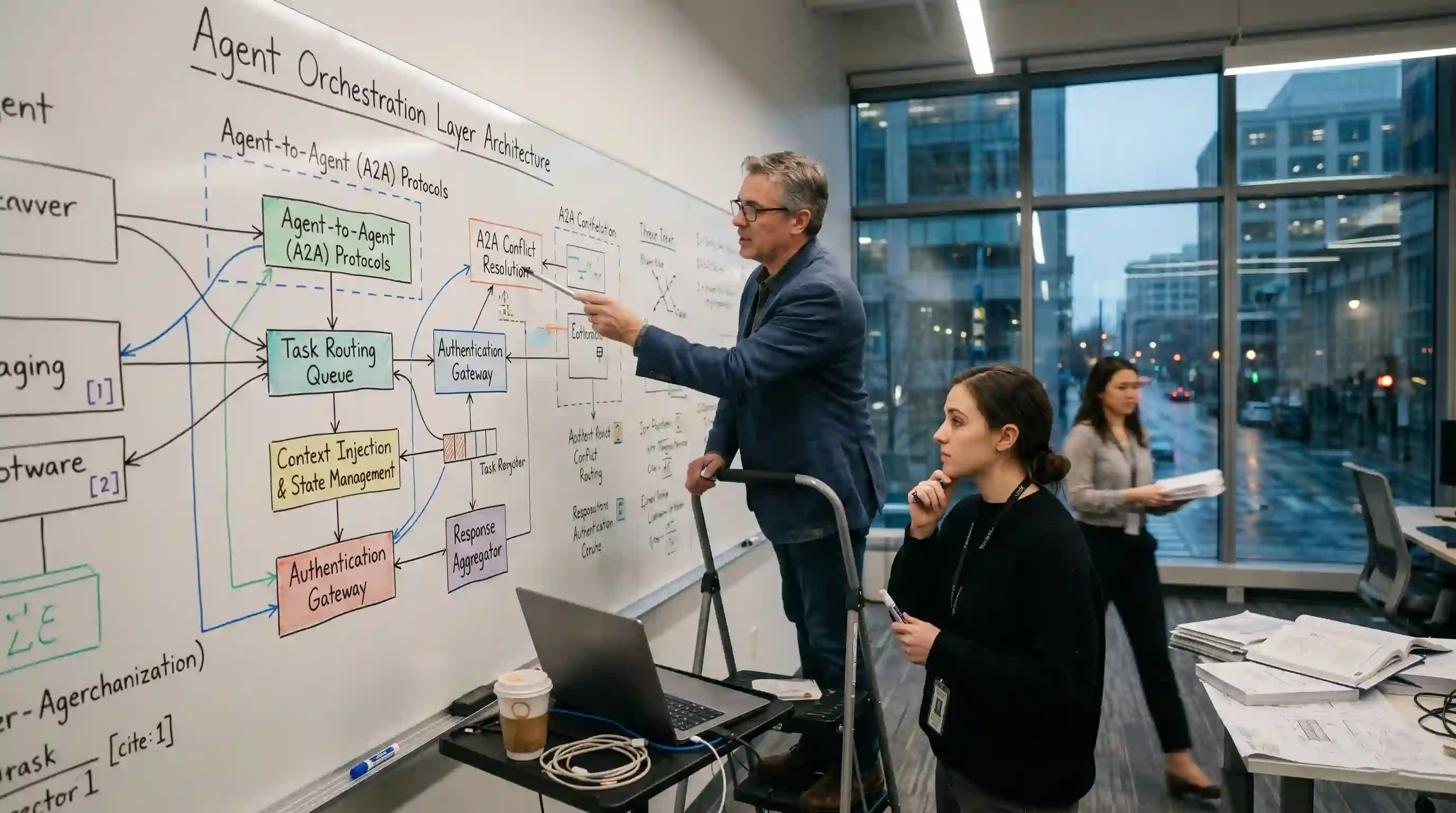
- Deterministic Guardrails: BPMN enforces strict workflow boundaries that autonomous AI agents cannot bypass or hallucinate around.
- State Management: The orchestration engine acts as a persistent memory bank, holding the exact state of long-running agentic tasks.
- Native Escalation Paths: The blueprint highlights how failing agents are automatically paused for human-in-the-loop review.
- Compliance Ready: Every agent decision is logged as a finite process step, instantly solving EU AI Act logging requirements.
BPMN wasn't built for autonomous AI, but a leaked Camunda blueprint just proved it's the only way to keep multi-agent systems from imploding in production.
As we detailed in our master AI agent orchestration playbook, enterprise multi-agent deployments fail 89% of the time because they lack a deterministic backbone.
The recent circulation of an internal Camunda architecture document reveals exactly how top-tier engineering teams are solving this orchestrational nightmare.
They aren't writing custom Python loops to manage agent handoffs. Instead, they are using Business Process Model and Notation (BPMN) to put a strict, auditable leash on autonomous agents, preventing them from running rogue.
The Missing Deterministic Backbone
Most engineering teams attempt to manage AI agents by letting the LLM dictate the workflow. This is a critical architectural error.
Language models are probabilistic. If you rely on an LLM to decide what happens next in a critical enterprise workflow, you are inviting chaos.
A true agent orchestration layer must be deterministic. The system must know exactly what step comes next, regardless of what the AI model thinks.
This is where workflow engines like Camunda come in. By treating an AI agent as just another worker executing a specific task, you regain total control over the overarching business process.
Dissecting the Camunda Blueprint Leak
The recently circulated architecture blueprints demonstrate a radical shift in how we view AI integration within legacy systems.
Instead of building complex, fragile API wrappers, the blueprint maps out a strategy where agents interact with the Camunda engine via standard external task patterns.
External Task Workers as Agents
In the leaked model, an AI agent operates purely as an External Task Worker.
Camunda holds the master state of the process. When a task requires reasoning or generative output, Camunda locks the task and pings the specific agent via a secure endpoint.
The agent completes the task, returns the structured JSON payload to Camunda, and shuts down.
The agent does not decide what happens next; Camunda routes the output to the next logical BPMN node.
BPMN Compensation Events for Hallucinations
What happens when an agent hallucinates or returns malformed data? The blueprint utilizes BPMN Compensation Events.
If an agent's output fails a downstream validation check, Camunda triggers a boundary event.
This rolls back the process state safely. It prevents corrupted data from cascading through your enterprise architecture.
Understanding these multi-agent system failure modes is vital for implementing effective compensation strategies.
Bridging Legacy Systems and Autonomous AI
Enterprise companies cannot rip and replace their entire backend just to accommodate AI agents.
The genius of the Camunda blueprint is that it bridges the gap. A single BPMN workflow can orchestrate a Java microservice, a legacy on-prem database call, and a cutting-edge autonomous agent sequentially.
This hybrid approach allows product leaders to safely inject AI into existing workflows without destroying system stability.
We cover the organizational alignment required for these transformations deeply in our agile product management strategy framework.
Overcoming the "Infinite Loop" Trap
One of the most dangerous multi-agent failure modes is the infinite loop, where two autonomous agents repeatedly reject each other's outputs.
The Camunda orchestration layer solves this natively using timer boundaries and retry limits.
If an agent-to-agent task exceeds a hardcoded 60-second limit, or fails three retry attempts, Camunda kills the process instance immediately.
It then routes the task to a human-in-the-loop queue, saving thousands of dollars in wasted API token costs.
Conclusion & Next Steps
Relying on probabilistic models to manage deterministic enterprise workflows is a guaranteed path to production failure.
The Camunda blueprint leak proves that the future of multi-agent orchestration lies in strict, battle-tested workflow engines.
If you are struggling to get your AI agents out of the pilot phase, stop rewriting your Python loops.
Audit your orchestration architecture today. Map your workflows in BPMN, integrate your agents as secure external workers, and establish the hard deterministic boundaries required to safely scale autonomous systems.

Frequently Asked Questions (FAQ)
An agent orchestration layer is a centralized control system that manages the execution, state, and routing of multiple AI agents. It ensures that autonomous agents collaborate efficiently, follow predefined business logic, and do not execute runaway tasks.
Camunda manages agents by treating them as external task workers within a deterministic BPMN workflow. The engine dictates the process flow, assigns specific tasks to specialized agents, waits for the structured output, and then seamlessly routes it to the next step.
The "leak" refers to a widely circulated internal architecture document demonstrating how enterprise engineering teams are bypassing fragile, custom-coded multi-agent loops by using Camunda's robust BPMN engine to securely manage, audit, and constrain autonomous AI agents.
BPMN provides a visual, auditable, and deterministic framework. Unlike custom Python scripts which can fail silently, BPMN allows teams to easily map complex human-in-the-loop escalations, set hard timeouts, and quickly rollback states when an AI agent hallucinates.
Camunda prevents runaway costs by using strict timer boundary events and retry limits. If an agent loops or hangs for too long, the workflow engine automatically kills the task and escalates it to a human, halting further API usage instantly.