OpenAI ACP + Stripe: 40% More Agent Traffic
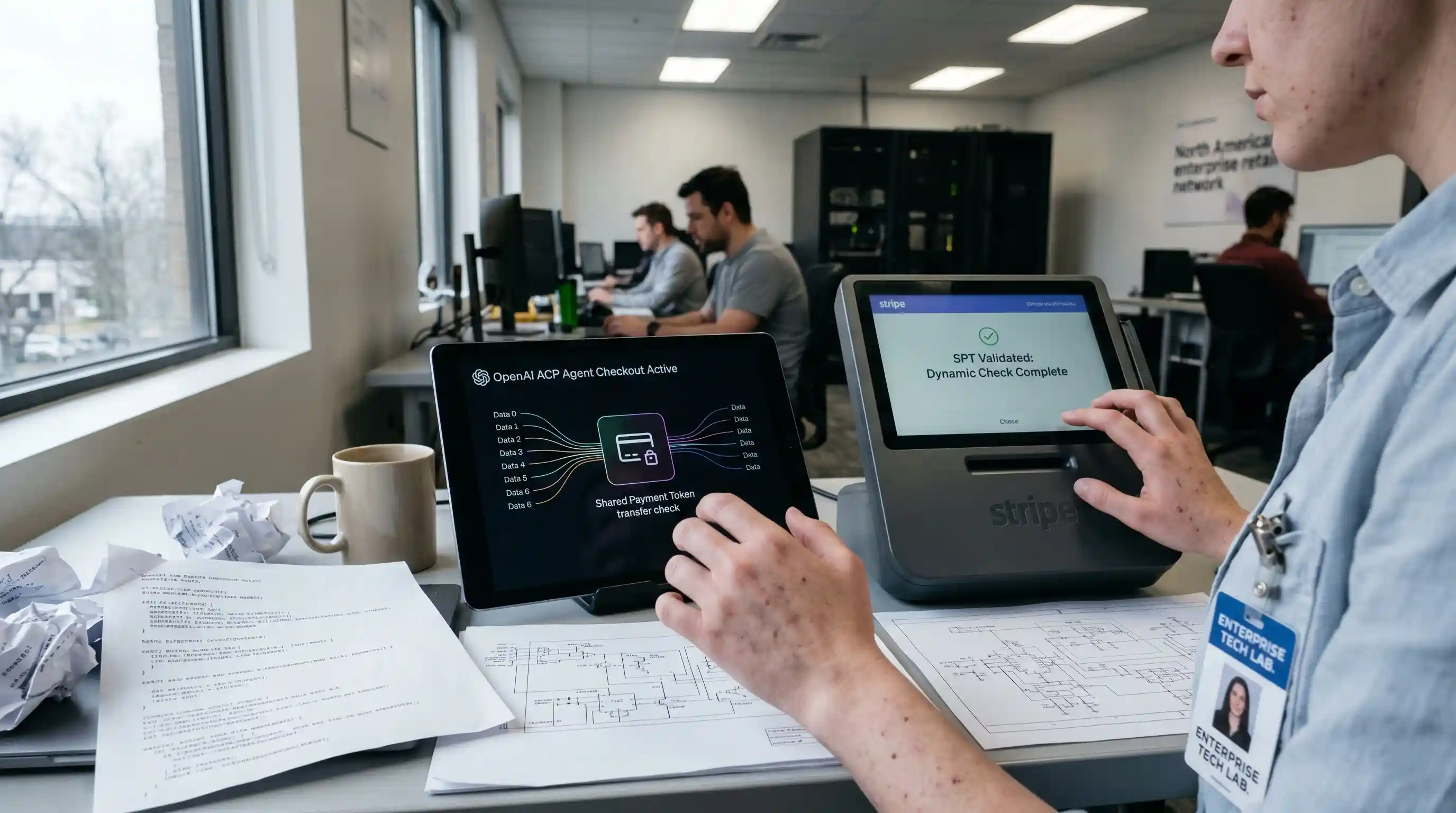
- The Checkout Standard: ACP is the dominant protocol governing how consumer-facing AI agents assemble and submit shopping carts.
- Massive Traffic Gains: Supporting both OpenAI's ACP and Google's UCP yields approximately 40% more agent traffic than single-protocol stores.
- Instant Conversions: ACP powers the "Buy-it-in-ChatGPT" Instant Checkout experience.
- Shared Payment Tokens (SPT): ACP utilizes specialized tokens to securely hand off payment intent from the AI model to the merchant's Stripe environment.
OpenAI's Agentic Commerce Protocol with Stripe powers Buy-it-in-ChatGPT. The data from 2026 early adoption is absolute: merchants backing both ACP and UCP see ~40% more agent traffic.
Leaving this protocol out of your e-commerce stack means instantly forfeiting almost half of the emerging autonomous buyer market.
To fully capitalize on this multi-trillion-dollar shift, engineering and product leaders must master the complete stack of agentic commerce AI agent payment protocols.
This specific sub-page zooms directly into the checkout layer, dissecting how the OpenAI Agentic Commerce Protocol (ACP) functions alongside Stripe to capture massive AI-driven volume.
What is OpenAI's Agentic Commerce Protocol (ACP)?
The Agentic Commerce Protocol (ACP) was co-developed by OpenAI and Stripe to bridge the gap between generative AI interfaces and traditional merchant checkouts.
ACP operates specifically at the "Checkout" layer of the agentic transaction stack.
It provides a standardized mechanism for an autonomous agent to select items, configure variants, and lock in pricing before requesting human authorization.
Powering "Buy-it-in-ChatGPT"
The most visible application of ACP is the "Buy-it-in-ChatGPT" Instant Checkout.
This feature allows a consumer to ask an agent to find and purchase an item, and the agent executes the cart assembly entirely within the chat interface.
Major retailers, including Walmart, Target, and Best Buy, are already utilizing ACP to capture these high-intent, low-friction transactions.
The Shared Payment Token (SPT) Architecture
At the core of the ACP specification is the Shared Payment Token (SPT).
The SPT allows the AI agent to hold a secure, temporary representation of the cart's value and the user's payment intent without ever touching raw credit card data.
This token is then passed securely to the merchant's Stripe endpoint for final clearing.
The 40% Agent Traffic Boost: ACP + UCP
The most critical commercial data point of 2026 is that merchants cannot afford to be protocol maximalists.
While ACP dominates the OpenAI ecosystem, Google's Universal Commerce Protocol (UCP) commands the Gemini and Google Search surfaces.
Enterprise merchants who integrate both ACP and UCP see roughly 40% more agentic traffic than those who limit themselves to a single standard.
Composing ACP with Foundational Protocols
Before an agent can build a cart with ACP, it must first be able to read your product catalog.
This discovery layer is typically handled by the Model Context Protocol (MCP).
Understanding how discovery hands off to checkout is vital. Product managers should review our deep dive into MCP vs A2A vs ACP to see how these foundational layers stack.
Combining ACP with Google's AP2
Once ACP has successfully assembled the cart and generated an SPT, the transaction still needs human authorization to prevent liability disputes.
This is where protocols compose across layers: ACP handles the checkout, while a protocol like AP2 handles the cryptographically signed authorization.
For a practical look at this architecture, review our guide on how to integrate AP2 for merchants.
Stripe Integration and April 2026 Spec Changes
Because Stripe co-authored the ACP standard, integrating the protocol into an existing Stripe merchant environment is highly streamlined.
How Merchants Integrate ACP with Stripe
Merchants already using Stripe's modern Payment Intents API can enable ACP endpoints with minimal backend restructuring.
Stripe's infrastructure natively decodes the Shared Payment Token (SPT) generated by the OpenAI agent, converting it into a standard transaction payload.
What Changed in the April 2026 Spec Release?
The April 2026 specification release for ACP introduced critical updates for handling dynamic pricing and real-time inventory checks.
It ensures that if an item sells out in the milliseconds between the AI agent assembling the cart and the human authorizing the payment, the SPT automatically invalidates, protecting the merchant from fulfillment errors.
Conclusion
Ignoring the OpenAI Agentic Commerce Protocol (ACP) means actively rejecting one of the highest-converting traffic sources of 2026.
By seamlessly composing ACP with Stripe, merchants can instantly modernize their checkout infrastructure to accommodate the multi-trillion-dollar AI spending wave.
Don't wait until your competitors capture your audience's AI agents—audit your checkout endpoint integrations and begin testing ACP payloads today.

Frequently Asked Questions (FAQ)
ACP is a standardized checkout protocol co-developed by OpenAI and Stripe that allows AI agents to autonomously assemble carts and submit orders on behalf of human users directly from conversational interfaces.
The ACP specification is jointly maintained and updated by OpenAI and Stripe, ensuring tight alignment between generative AI model capabilities and global payment processing infrastructure requirements.
A Shared Payment Token (SPT) is a secure, temporary cryptographic token generated by ACP that represents a user's assembled cart and payment intent, which is then securely passed to the merchant's payment processor.
ACP standardizes the API calls between ChatGPT and the merchant's storefront, allowing the AI to lock in item selection, pricing, and shipping data so the user can instantly approve the final purchase without leaving the chat.
Major enterprise retailers, including Walmart, Target, and Best Buy, are already utilizing the Agentic Commerce Protocol to capture consumer AI shopping traffic through platforms like ChatGPT.
They operate at different layers. ACP operates at the checkout layer to assemble the cart, while AP2 operates at the authorization layer, using signed mandates to prove the human explicitly approved the purchase.
While initial rollouts were heavily focused on North American retail enterprise networks, ACP's underlying architecture via Stripe allows for scalable global deployment depending on regional regulatory frameworks.
MCP (Model Context Protocol) operates at Layer 1 (Discovery), allowing the AI agent to find and parse product data. ACP operates at Layer 2 (Checkout), standardizing how the agent actually submits the assembled cart.
The April 2026 spec release introduced enhanced support for real-time inventory validation and dynamic pricing updates, ensuring Shared Payment Tokens invalidate instantly if stock depletes before final authorization.
Merchants integrate ACP by updating their Stripe API endpoints to accept Shared Payment Tokens (SPTs). Because Stripe co-developed the protocol, it natively maps ACP payloads directly into standard Stripe Payment Intents.