Deepfakes in the Boardroom: Defeating "CEO Doppelgänger" Attacks
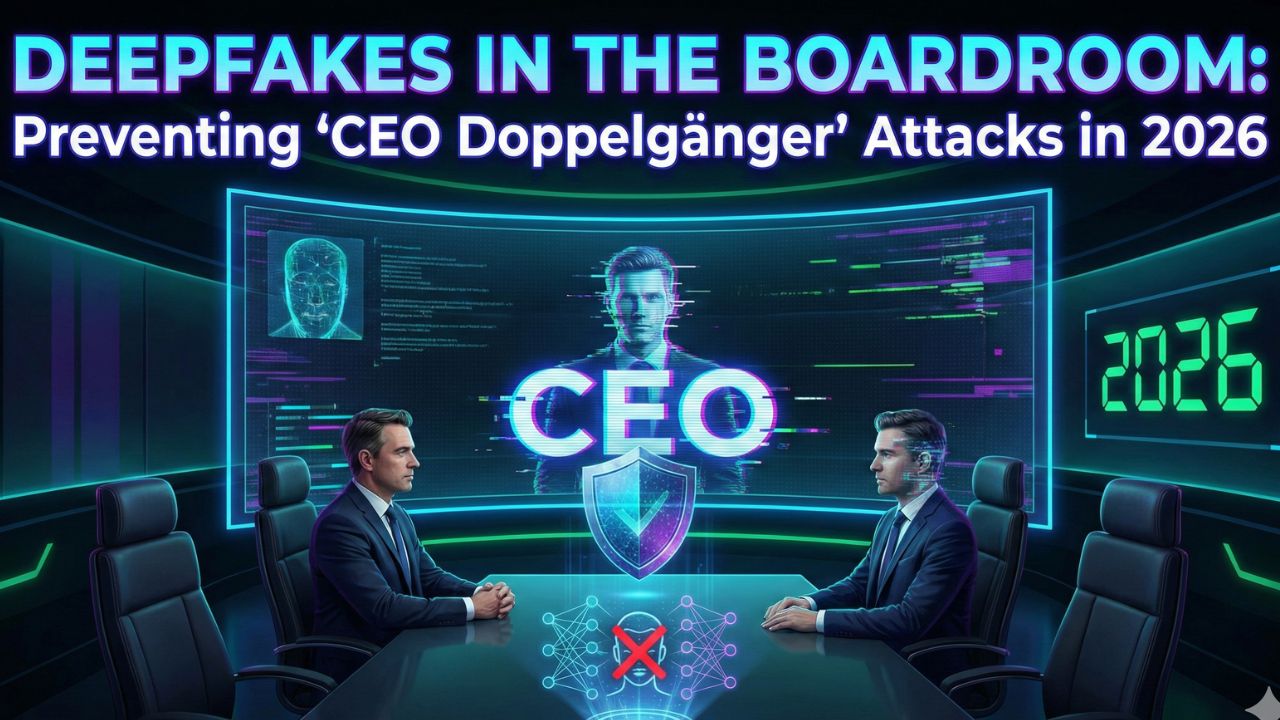
- The $25M Precedent: The "CEO Doppelgänger" attack is no longer theoretical. Sophisticated threat actors are cloning executive voices and faces in real-time to bypass massive financial controls.
- Vigilance is a Failed Strategy: Human detection accuracy for high-end enterprise deepfakes is hovering around 50%. You cannot train your employees out of this vulnerability.
- Cryptographic Provenance (C2PA): The future of digital trust requires cryptographically signing video streams at the hardware source to prove undeniable origin.
- Passive Liveness is Mandatory: Traditional "active" checks (e.g., asking users to blink) are obsolete. You must deploy passive rPPG technology to detect active blood flow in video feeds.
- The Out-of-Band Mandate: No high-value transaction requested over a video call should ever be authorized without secondary verification on an entirely different, encrypted channel.
The era of "seeing is believing" is officially over in the corporate enterprise.
Consider the devastating incident from early 2024: A diligent finance worker at a multinational firm was systematically tricked into wiring $25 million to fraudsters. The employee was initially suspicious of the email request, but his fears vanished completely when he joined a video conference call and directly saw his Chief Financial Officer (CFO) and several other known colleagues. They looked incredibly real. They sounded perfectly real. But chillingly, none of them were human.
This is the definitive "CEO Doppelgänger" attack. It stands as the single greatest, most immediate threat to corporate governance boards in 2026. Deepfake-driven social engineering fraud has violently surged by over 1,700% in North America, driven by open-source models now capable of flawlessly cloning a human voice using just 3 seconds of scraped public audio.
This technical guide aggressively moves beyond the functionally useless advice of "more employee awareness training." Instead, we provide a rigorous, 3-layer technical protocol specifically engineered to secure your boardroom communications and financial workflows against synthetic media infiltration.
Layer 1: Cryptographic Provenance (The "Digital Nutrition Label")
You can no longer reliably detect state-sponsored or high-end deepfakes simply by analyzing pixels for blurring or unnatural lighting. You must transition to verifying the cryptographic chain of custody. The undisputed global standard for achieving this is C2PA (Coalition for Content Provenance and Authenticity).
How C2PA Secures the Enterprise
Think of the C2PA standard as an unbreakable, tamper-evident digital seal for enterprise media. It empowers organizations to embed cryptographically verifiable metadata—often called Content Credentials—directly into videos, images, and live streams at the absolute point of creation.
- Immutable Origin Assertion: The embedded metadata explicitly proves who generated the content (e.g., mathematically verified as "Signed by Acme Corp CEO's Authenticated Hardware Device").
- Strict Edit History Tracking: C2PA tracks every single manipulation made to the file. If a malicious AI tool alters a single frame mid-stream, the underlying cryptographic hash instantly breaks, throwing a fatal warning to the viewer.
- The 2026 Mandate: We project that leading enterprise communication platforms (like Zoom and Microsoft Teams) will natively require and display a green "Verified" badge exclusively for C2PA-signed internal streams.
Layer 2: Liveness V3 (Passive vs. Active Detection)
For several years, digital banks heavily utilized "Active Liveness" checks: "Please blink three times," or "Turn your head slowly to the left." In the agentic era, these checks are completely obsolete. Generative AI models can now synthesize blinking, authentic smiling, and complex head-turning in real-time, easily bypassing legacy security gates.
The Required Upgrade: Passive Liveness
To defend the boardroom, you must deploy "Passive" liveness detection. This operates silently in the background, analyzing biological factors that AI simply cannot synthesize on a flat screen.
- rPPG (Remote Photoplethysmography): This advanced technology meticulously analyzes microscopic, invisible color changes in skin pixels caused by actual human blood flow. A synthetic deepfake has no heartbeat; a real, living executive does.
- Texture & Depth Analysis: Genuine human skin interacts with ambient light dynamically, differently than a generated 2D mesh. Passive algorithms instantly detect these micro-textures and precise depth maps in under 300 milliseconds to flag synthetic overlays.
The Strategic Shift: Stop asking your executives to frustratingly "perform" for their webcams. Deploy robust passive liveness tools that ruthlessly analyze the biological signal, not just the rendered image.
Layer 3: The Protocol (The Human Challenge-Response)
Even elite cryptographic technology can occasionally fail or be misconfigured. Therefore, you must engineer a "fail-safe" human protocol specifically for high-value transactions (e.g., any wire transfer exceeding $50,000).
The "Challenge-Response" Protocol
This functions as a strict cryptographic handshake, but performed cognitively by humans.
- The Visual OTP (One-Time Password): The requestor (e.g., the Finance Director) physically displays a randomly generated, high-contrast 6-digit code on their screen. The approver (e.g., the CEO) must dynamically read it back. Because current deepfake avatars struggle to process and react to novel, live visual data in real-time without glitching, this exposes the latency of the fraud.
- Out-of-Band Verification (OOB): Never authorize a critical request on the exact same channel it was initiated. If the CEO asks for emergency funds on a Zoom call, you must verify it via a secondary channel, like Signal or a cryptographically secured internal app. You must break the attacker's single vector of compromise.
- The Executive "Duress Word": Pre-establish a highly specific, unnatural secret word or phrase that explicitly indicates, "I am currently being forced to make this call." If the executive casually drops the word into conversation, the finance team is trained to verbally play along to protect the executive, but instantly freeze all related funds on the backend.
Implementation: The 2026 Boardroom Defense Checklist
| Defense Layer | Immediate Action Item | Primary Tooling Category |
|---|---|---|
| 1. Provenance | Enforce mandatory C2PA cryptographic signing on all executive broadcasts, earnings calls, and internal town halls. | Content Credential Systems (Adobe CAI, Microsoft) |
| 2. Detection | Deploy Passive Liveness (rPPG) detection APIs continuously on all internal zero-trust video conferencing gateways. | Biometric IDV / rPPG Analyzers |
| 3. Governance | Legally mandate "Out-of-Band" (OOB) secondary verification for any financial transfer exceeding $50,000. | Internal Policy / Signal / Encrypted Comms |
Frequently Asked Questions (FAQ)
Can we just train employees to visually spot deepfakes?
No. Human detection accuracy for high-end enterprise deepfakes is hovering around 50-60%, which is statistically barely better than a coin flip. Relying on sheer "vigilance" or "gut feeling" is a mathematically failed strategy that attackers will quickly exploit.
What is C2PA and is it currently mandatory?
C2PA (Coalition for Content Provenance and Authenticity) is an open technical standard that allows publishers to embed tamper-evident metadata into files. While not yet legally mandatory globally, it acts like a digital "nutrition label" proving the origin of the content, and is rapidly becoming the de facto compliance standard for enterprise communications.
Why is "Active" liveness detection (blinking) no longer secure?
Generative AI can now effortlessly simulate blinking, smiling, and head-turning in real-time. "Passive" liveness detection, which instead analyzes imperceptible blood flow patterns (rPPG) and skin texture mapping, is currently significantly harder for synthetic overlays to spoof.
What exactly is a Challenge-Response protocol?
It is a core security method where one party presents a random, unpredictable question (the Challenge) and the other must seamlessly provide the valid answer (the Response). In high-stakes video calls, this means asking the CEO to read a random OTP code displayed on the screen to prove they are reacting dynamically in real-time, not running off a pre-rendered script.