Back to Hub: Agentic AI for Business Leaders
Return to the 2026 Strategic Roadmap
10 Agentic AI Use Cases That Drive Real ROI (Finance, Healthcare & Retail)
For the past 18 months, business leaders have been asking: "Generative AI is impressive, but where is the ROI?"
The answer lies in the transition from Chatbots (which talk) to Agents (which do). While GenAI creates content, Agentic AI executes workflows. This capability to autonomously perform multi-step tasks is what unlocks operational cost savings.
Below, we analyze 10 operational use cases across Finance, Healthcare, and Retail where Agentic AI is delivering measurable financial impact in 2026. These are not theoretical concepts; they are deployed realities.
Sector 1: Finance & Fintech
The financial sector is the earliest adopter of Agentic AI, primarily for its ability to handle high-volume, rules-heavy compliance and transaction tasks.
Use Case #1: Claims Processing
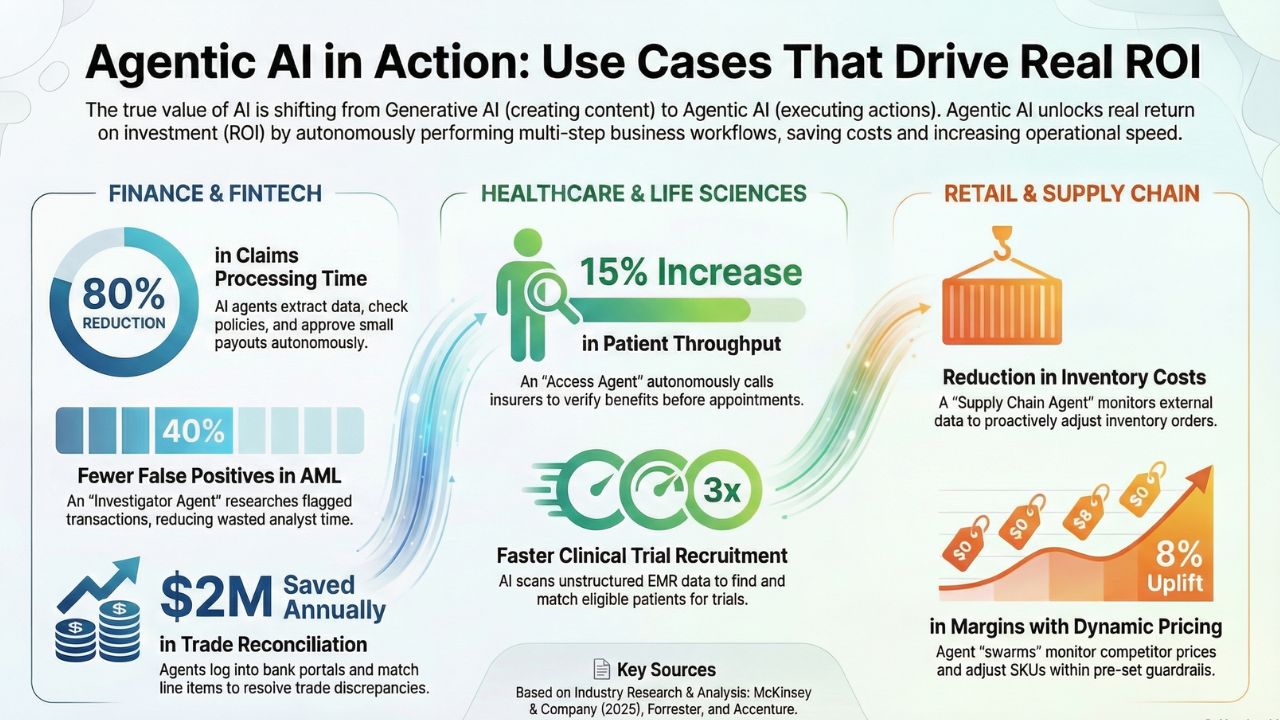
80% Reduction in Processing Time
The Challenge: Manual review of insurance claims requires cross-referencing PDFs, policy documents, and databases. It is slow and prone to human error.
Agentic Solution: A "Claims Swarm" composed of three agents. Agent A (Vision) extracts data from damaged car photos. Agent B (Policy) checks coverage limits. Agent C (Finance) approves payouts under $5,000 autonomously.
Financial Result: Cost per claim reduced from $15 to $3. Customer settlement time reduced from 5 days to 10 minutes.
Use Case #2: Anti-Money Laundering (AML)
40% Fewer False Positives
The Challenge: Traditional rule-based AML systems flag too many legitimate transactions, wasting analyst time.
Agentic Solution: An "Investigator Agent" that doesn't just flag a transaction but autonomously researches the entity on the open web, checks news sentiment, and drafts a Suspicious Activity Report (SAR) for human sign-off.
Use Case #3: Institutional Trading Reconciliation
$2M Saved in Annual Labor
The Challenge: reconciling trade breaks between internal ledgers and external clearing houses is a manual spreadsheet nightmare.
Agentic Solution: Agents log into bank portals, download statements, match line items using fuzzy logic, and auto-email counterparties to resolve discrepancies.
Sector 2: Healthcare & Life Sciences
In healthcare, the ROI of Agentic AI is measured in both dollars and "Clinician Joy"—removing the administrative burden that causes burnout.
Use Case #4: Patient Onboarding & Insurance
15% Increase in Patient Throughput
The Challenge: Front-desk staff spend hours verifying insurance eligibility and chasing prior authorizations.
Agentic Solution: An "Access Agent" calls payer IVR systems and portals autonomously to verify benefits before the patient arrives, updating the EHR in real-time.
Use Case #5: Clinical Trial Patient Matching
3x Faster Recruitment
The Challenge: Finding patients for rare disease trials involves manually reading thousands of unstructured doctor notes.
Agentic Solution: A secure agent scans unstructured EMR data, matches patient phenotypes against trial inclusion criteria, and drafts outreach emails for the PI (Principal Investigator) to send.
Sector 3: Retail & Supply Chain
Retail agents are moving from the call center to the warehouse, managing physical logistics through digital twins.
Use Case #6: Autonomous Procurement
12% Reduction in Inventory Costs
The Challenge: Demand forecasting is often reactive, leading to stockouts or overstock.
Agentic Solution: A "Supply Chain Agent" monitors weather, local events, and social trends. If a snowstorm is predicted, it autonomously increases orders for shovels and salt at regional distribution centers 5 days in advance.
Use Case #7: Dynamic Pricing Swarm
8% Uplift in Margins
The Challenge: Static pricing fails to capture peak demand or clear excess inventory quickly.
Agentic Solution: Agents monitor competitor pricing every minute and adjust SKU prices within pre-set "safe guardrails" to maximize margin without triggering a price war.
Measuring the ROI: The New Metrics
When presenting these use cases to the board, you cannot use "Accuracy" or "F1 Score." You must use business metrics. Here is the framework for 2026:
- Cost Per Resolution (CPR): Total cost of support agents / Number of tickets resolved.
- Revenue Per Employee (RPE): Does the AI allow your existing team to manage 2x the volume?
- Velocity: Reduction in cycle time (e.g., from "Application" to "Approved Loan").
Frequently Asked Questions (FAQ)
Q: What is the ROI of Agentic AI in Healthcare?
A: In healthcare, Agentic AI delivers ROI by automating administrative burdens like patient onboarding and insurance verification. Early adopters report saving 2-3 hours per clinician daily, reducing burnout and increasing patient throughput by 15%.
Q: How does Agentic AI differ from RPA in Finance?
A: RPA (Robotic Process Automation) follows strict rules for repetitive tasks. Agentic AI uses reasoning to handle exceptions. For example, an RPA bot fails if an invoice format changes; an AI Agent reads the new format, understands it, and proceeds without human intervention.
Q: Can AI agents really manage supply chains autonomously?
A: Yes, to a high degree. Level 3 Agentic Swarms can predict weather disruptions, re-route shipments, and negotiate spot rates with logistics providers autonomously, only alerting humans for critical strategic decisions.